You may have 15 years of experience. AI may give you 15 seconds.
Paddy Iyer18 September 202614 min read9 scenesInteractive
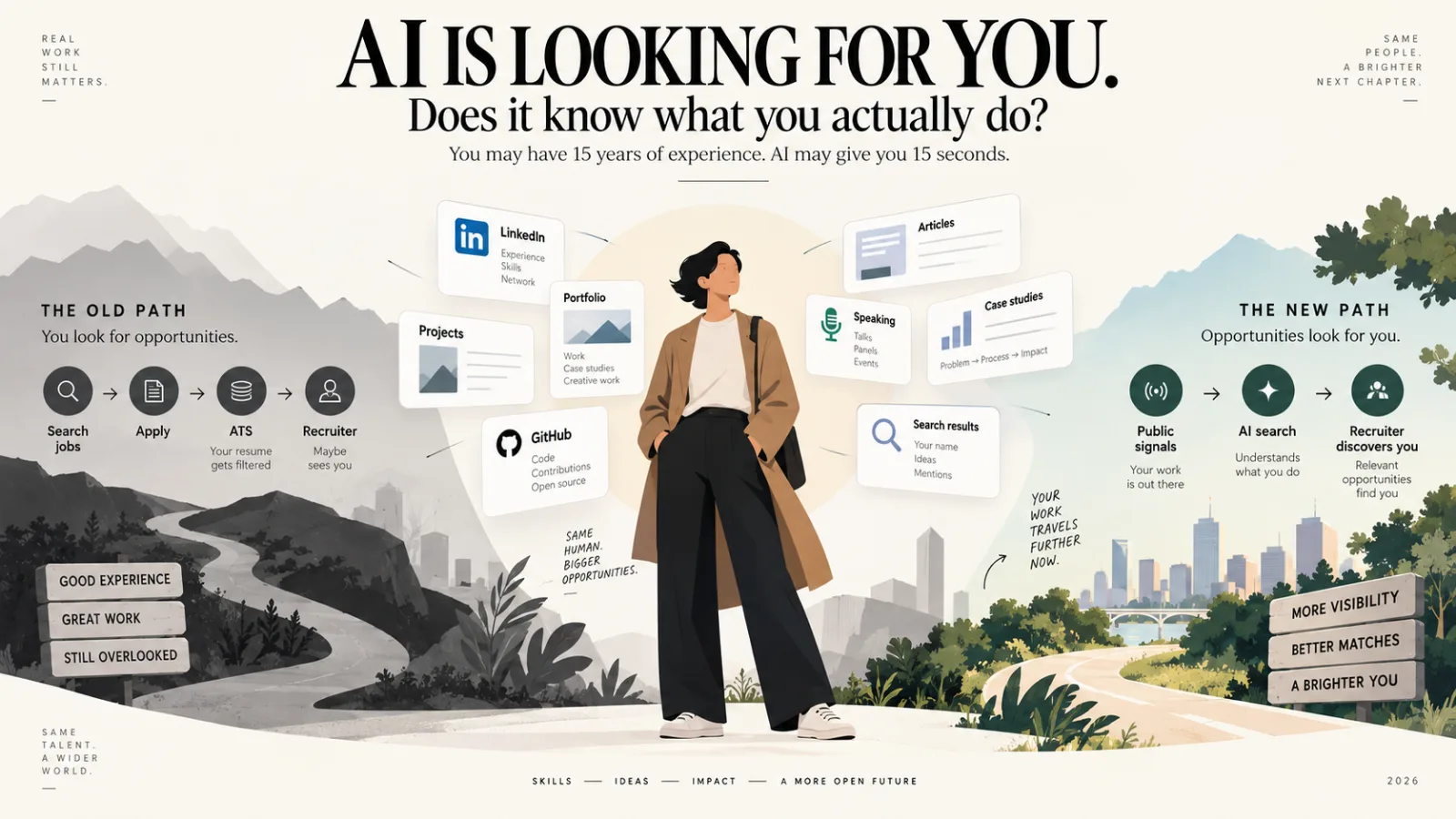
The old path looks for opportunities. The new one is looked for. Same person, same work — different readership.
Nothing here was written for a machine. All of it is now read by one.
The cast · Three people, one index
Three professionals. Three very different things a machine can see.
They are fictional, and they are everywhere. All three are good at their jobs. Only one of them is legible — and legibility, not talent, is what an agent can actually act on.
B2B SaaSOnboardingCheckoutMobile product designDesign systems
🤖
Beautiful. But what exactly did you design?
Leo
UI Specialist · 8 years
What his public work shows
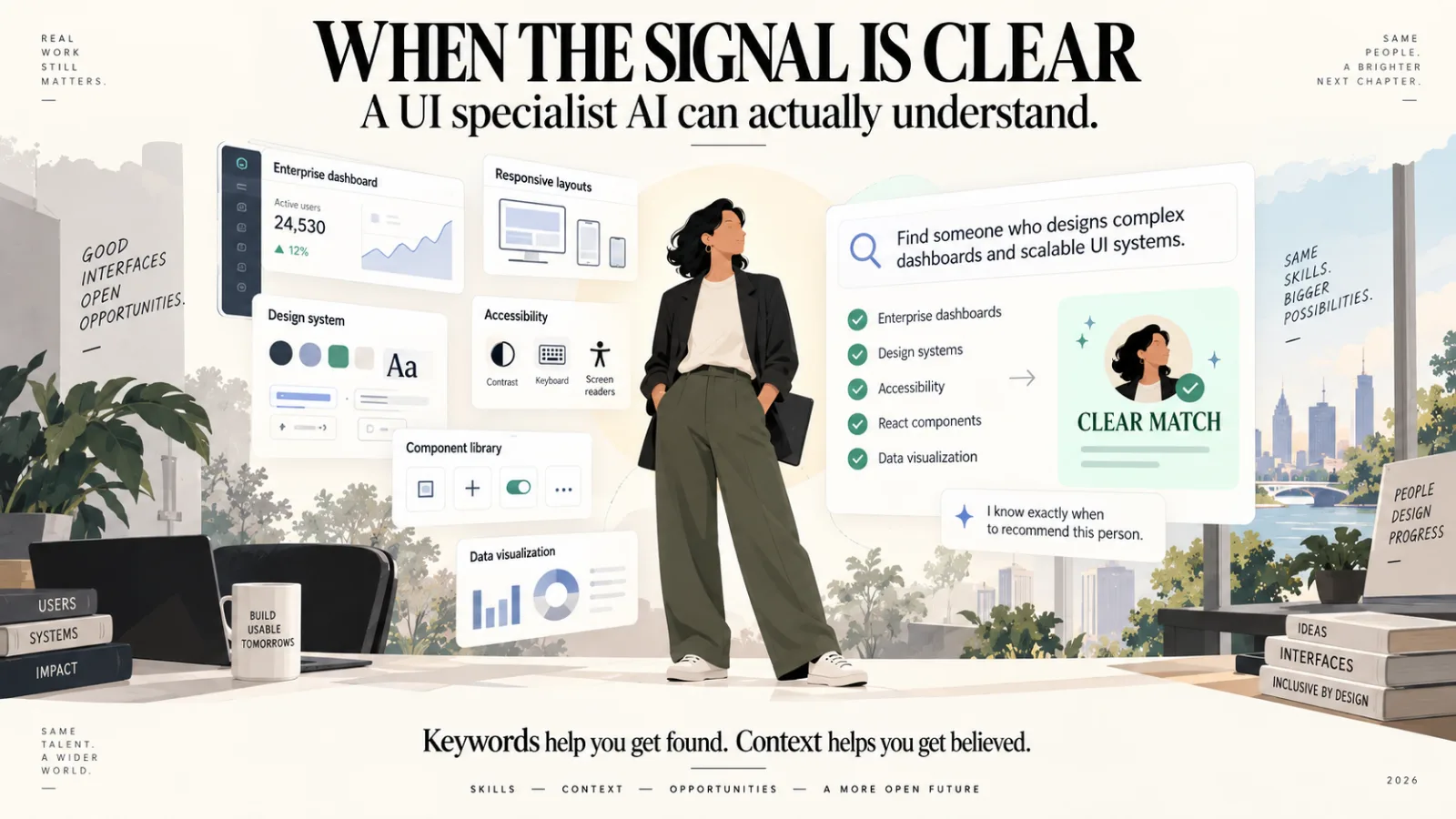
Enterprise dashboardsComplex data visualizationDesign systemsAccessibilityReact component librariesResponsive interfaces
And every project explains
The problem. His contribution. The technologies. What changed afterwards. In that order, in plain sentences, on a page anything can read.
🤖
I know exactly when to recommend this person.
Leo’s version of the same scan. Every requirement in the brief is attached to something a machine can point at.
Leo is not more talented than Arun. He is more retrievable. In 2026 those have quietly become the same career.
Section 01 · Two internets
The old internet was a library. The new one is an investigator.
On the left, a human with a search box and an afternoon. On the right, an agent with a problem statement and no afternoon at all. The difference is not speed. It is what the two of them are looking for.
The old internet
A human searches.
“Data Engineer”
01Types a job title into a search boxTwo words. Maybe three, on an ambitious day.
03Reads résumésSix seconds each, and a lot of forgiveness for vague wording.
↓
04Makes a judgmentFills the gaps with instinct, charity and bias — all three.
A human reading “technology professional” thinks: probably fine, let's talk. The gap in the page gets filled by a person who wants to like you.
The AI internet
A recruiter briefs an agent.
“Find someone who has built enterprise data pipelines on Databricks, understands streaming, and has worked with messy legacy systems.”
It reads across
Professional profilesPortfolio pagesArticlesGitHubProject descriptionsConference talksTechnical postsPublic résumésSearch indexes
Then it constructs an answer to one question
Who appears to fit this problem?
Note the words. Not who has this title. Not who applied. Who appears, from public evidence, to have solved this shape of problem before.
Left: retrieval. Right: reconstruction. The second one can find people the first one never could — and can miss people the first one would have called.
People used to search for jobs.
Now machines may search for people.
Which means the decisive moment has moved. It is no longer the interview, or the application, or the referral. It is the instant something reads your public record and decides whether you are relevant to a problem you never heard about.
Section 02 · The fifteen-second test
Pick someone. Watch a machine meet them.
A recruiter hands an agent a problem. The agent has your entire public record and roughly the attention a human gives a résumé. Here is what it comes back with. It is not unfair. It is just literal.
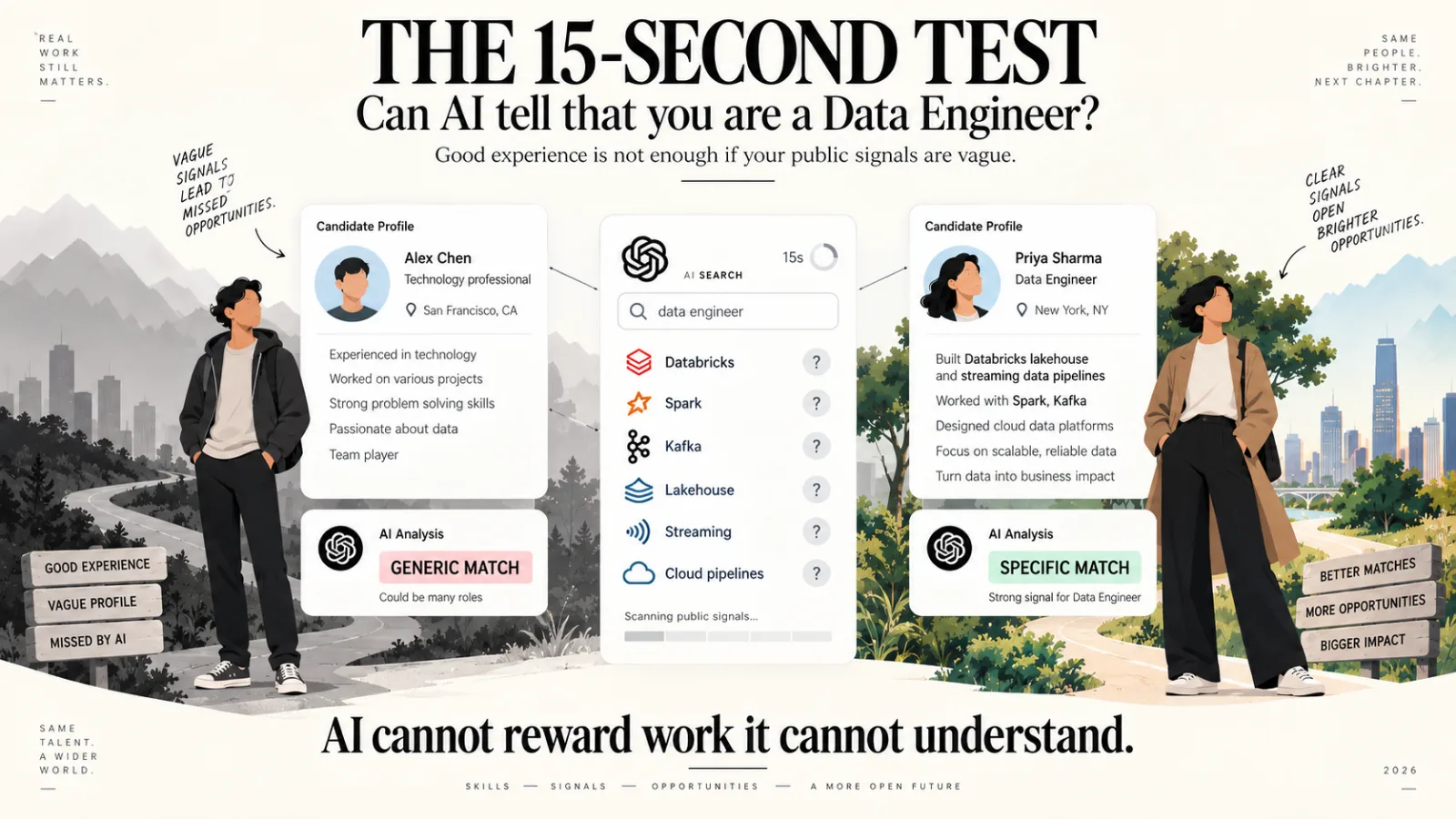
The same fifteen seconds, spent on two people with comparable experience and very different public sentences.
AI search · the brief
“Need someone who can modernize a legacy data platform into a cloud lakehouse.”
READY
LinkedInread
Portfolioread
GitHubread
Technical writingread
Public projectsread
Nothing is sent anywhere. The whole thing runs in your browser, on three people who do not exist.
Insufficient evidence for senior architecture responsibility.”
Arun has led two lakehouse migrations. Both of them are in his head, in a company wiki behind a login, and in the memory of four colleagues who have since scattered. None of that is in the index.
The uncomfortable part is that the machine is not wrong. It reported exactly what it could find. Every question mark is a thing that happened and was never written down anywhere public.
Section 03 · Same person, different signal
One career. Two sentences. Two completely different people.
Nothing below changes about the work, the years, the difficulty or the outcome. The only variable is the sentence left in public. Watch what that single sentence does to what a machine is able to conclude.
Profile A
“Experienced data professional skilled in cloud technologies, analytics and data engineering.”
What the machine can extract
·domain: data — probably
·cloud: unnamed
·tools: none stated
·problem solved: none stated
·system built: none stated
·who used it: none stated
Generic match
Retrievable for almost any data query, and compelling for none of them. Indistinguishable from eleven thousand other profiles with the same four adjectives.
Profile B · the same person, same job, same decade
“Designed Databricks lakehouse architecture replacing batch-heavy legacy pipelines; introduced streaming ingestion and governed datasets used across finance and operations.”
What the machine can extract
✓platform: Databricks
✓architecture: lakehouse, designed not used
✓legacy migration: batch → streaming
✓capability: streaming ingestion
✓governance: governed datasets
✓blast radius: finance + operations
Specific match
Retrievable for six different briefs, including three nobody would have thought to look for him under. The word designed alone answers the seniority question that Profile A left open.
🤖
Profile A tells me a field. Profile B tells me a decision. Only one of those can be checked against a problem.
AI cannot give you credit
for work it cannot understand.
This is the whole argument, and it is not a motivational one. It is mechanical. An agent has no access to your judgement, your late nights or the migration you saved. It has access to sentences. If the sentence does not contain the work, the work does not exist at retrieval time.
Section 04 · The beautiful portfolio problem
The most gorgeous portfolio on the internet, describing nothing.
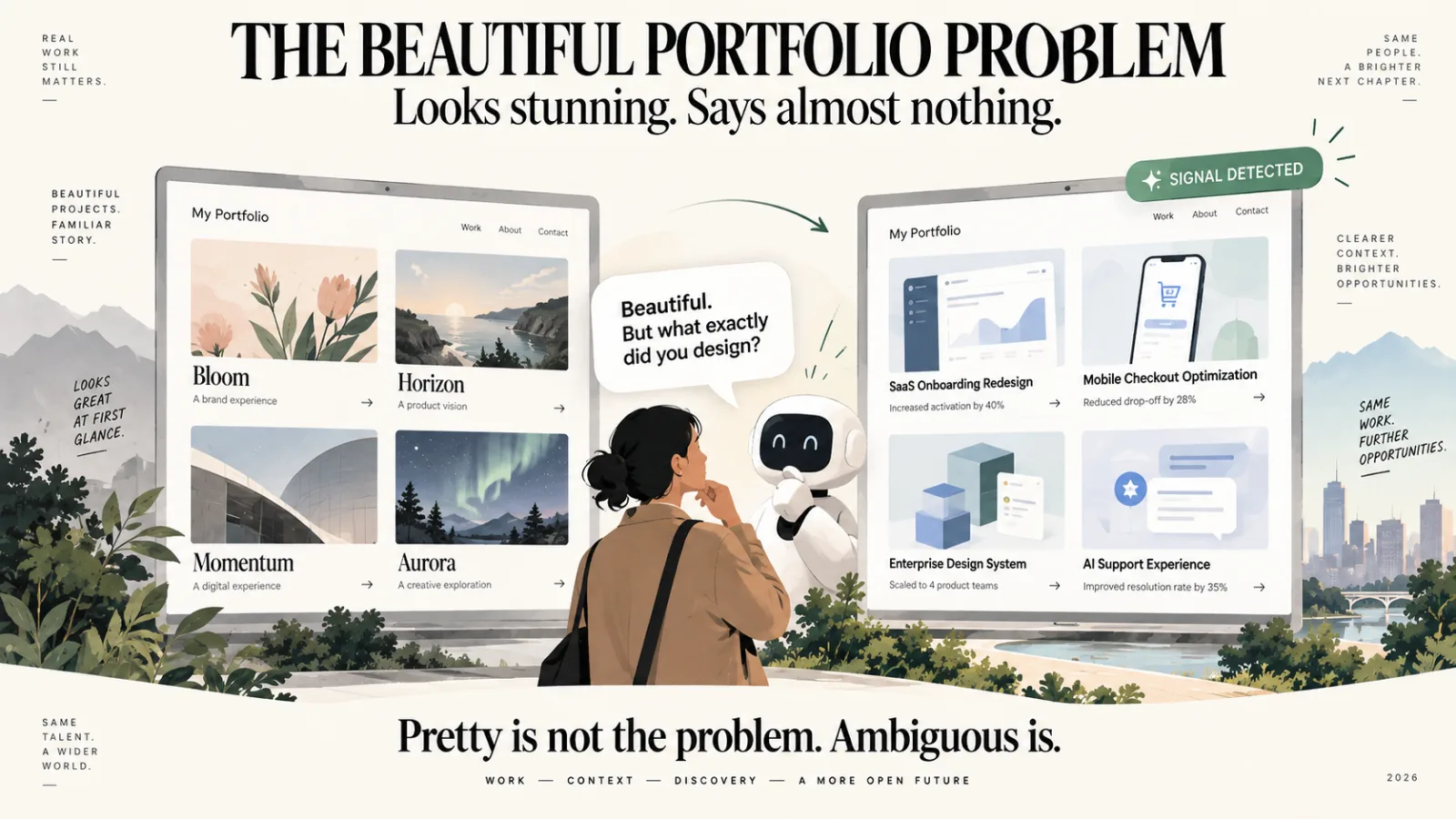
This is Maya's site, further down the same page. It is genuinely lovely. The kerning is better than mine will ever be. An agent reads it in full and comes away knowing the names of four things and the nature of none of them.
Nothing about the work changed between these two screens. Only the captions did.
maya—studio.design / work
Selected Work
Design, thoughtfully.
Project A
Horizon
Rebuilt first-run activation for a B2B analytics product: 11 screens to 4, self-serve trial to first dashboard without a call.
Project B
Bloom
Single-thumb checkout for a marketplace app: address, payment and review collapsed into one scrollable surface with real error states.
Project C
Momentum
64 components, 9 product teams, one accessibility contract. Adoption measured, not assumed.
Project D
Lumen
Agent-assisted support console: suggested replies a human can edit, with the confidence and the source always visible.
✓ Signal detected.
🤖
Wonderful names. I still don't know whether you design banking apps or refrigerators.
The machine's honest shortlist of what “Bloom” might be
a wellness appa candle companya fertility startupa Scandinavian furniture linea garden centre rebranda mobile checkout flow
One of those is correct. The agent has no way to know which, so it ranks Maya below a weaker designer whose page says the boring word checkout.
Section 05 · What machines need from humans
Five signals. Switch them on and watch a stranger become a person.
This is not a checklist and there is no score at the end. It is closer to a chord: each signal on its own is thin, and together they resolve into something a machine can hold, compare and recommend.
Five signals in. One sentence out. That sentence is the one that gets forwarded.
Professional fingerprint
Unidentified professional. Present in the index. Retrievable by nobody in particular.
Switch all five on. Notice that the resulting sentence is something you could say out loud to a colleague — which is exactly the point.
Section 06 · The digital shadow
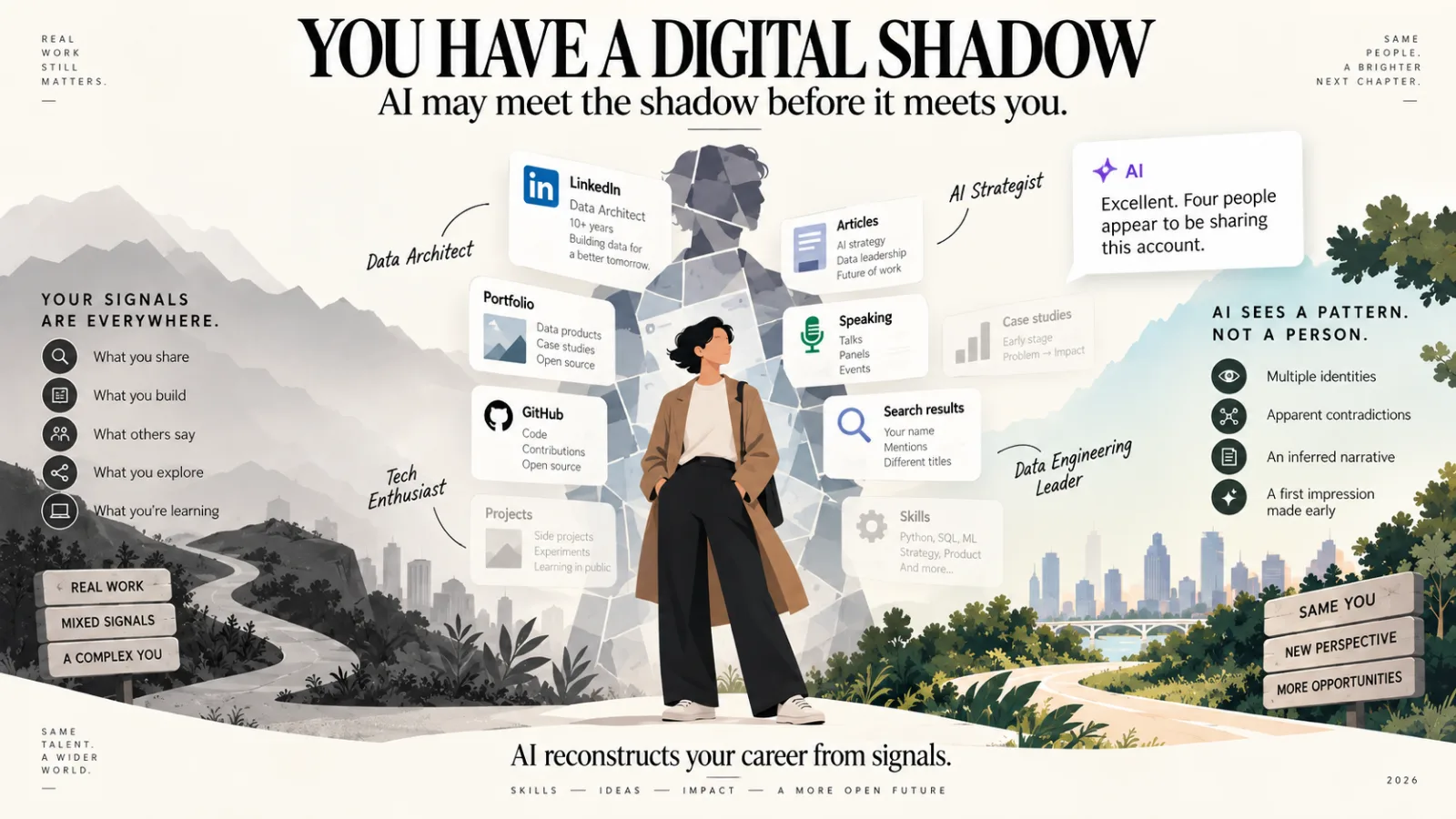
Something walks into the room before you do.
It is assembled from every public fragment with your name on it — a headline you wrote in eleven seconds in 2019, a repository you never documented, a bio someone else wrote for a panel. You did not design it. It represents you anyway.
The shadow is assembled from whatever is public, including the parts that disagree with each other.
You have a digital shadow.
AI may meet the shadow before it meets you.
And the shadow does not always agree with itself
LinkedIn
Data Architect
Résumé
Data Engineering Leader
Website
AI Strategist
Bio
Technology Enthusiast
🤖
Excellent. Four people appear to be sharing this account.
A human reads those four and sees one career with a bit of drift. A machine reads four weak claims, none corroborated by the others, and does what it always does with contradictory evidence: it lowers its confidence in all of them.
Section 07 · Machine search vs human résumé
A résumé compresses. A machine query expands.
Résumé writing taught a whole generation to shorten: fit the page, trim the detail, keep the bullet punchy. Machine retrieval rewards the exact opposite. The detail is the retrievable part.
The recruiter asks
“Find someone who has designed executive analytics interfaces for complex operational data.”
The candidate's résumé says
“Created dashboards.”
Weak signal
Two words that are true of an intern, a finance analyst and a principal designer. Nothing in them touches executive, operational or complex — the three words the brief actually turns on.
The same work, said publicly
“Designed an executive operations dashboard consolidating supply-chain, revenue and customer-risk metrics into one decision surface.”
Strong signal
Audience, domain, data complexity and design intent, in one sentence. It now answers a brief nobody had written when the page went up — which is the entire trick.
The recruiter asks
“Find an engineer who has handled real-time streaming data.”
The candidate's profile says
“Kafka”
Weak signal
A word in a list of thirty words. It could mean nine years of production ownership or one weekend tutorial, and the machine has no way to tell those apart. Neither, to be fair, does a human.
The same word, in context
“Built a Kafka-based event pipeline processing high-volume customer events for near-real-time fraud detection.”
Strong signal
Now the tool sits inside a system, the system sits inside a use case, and the use case carries its own difficulty. One word became a demonstrated capability.
Technology is a word.
Context makes it evidence.
Skills lists were built for a world where a human scanned them and asked follow-up questions. There is no follow-up question in machine retrieval. There is only what the page already says.
Section 08 · Ask the machine
Your turn. Brief the agent and watch it decide.
Six fictional people sit in this index. All six are real practitioners in every way that matters — except in what they have left in public. Describe who you would hire, and see which of them the machine can actually stand behind.
Six profiles indexed.
No numeric scores, no percentages, no 92-out-of-100. A real agent reports what it can and cannot support — and so does this one.
Try the last preset. Watch every single profile fall to unclear, including the excellent ones. A brief made of adjectives retrieves nobody, for exactly the same reason a profile made of adjectives is retrieved by nobody.
One question, and then you can go
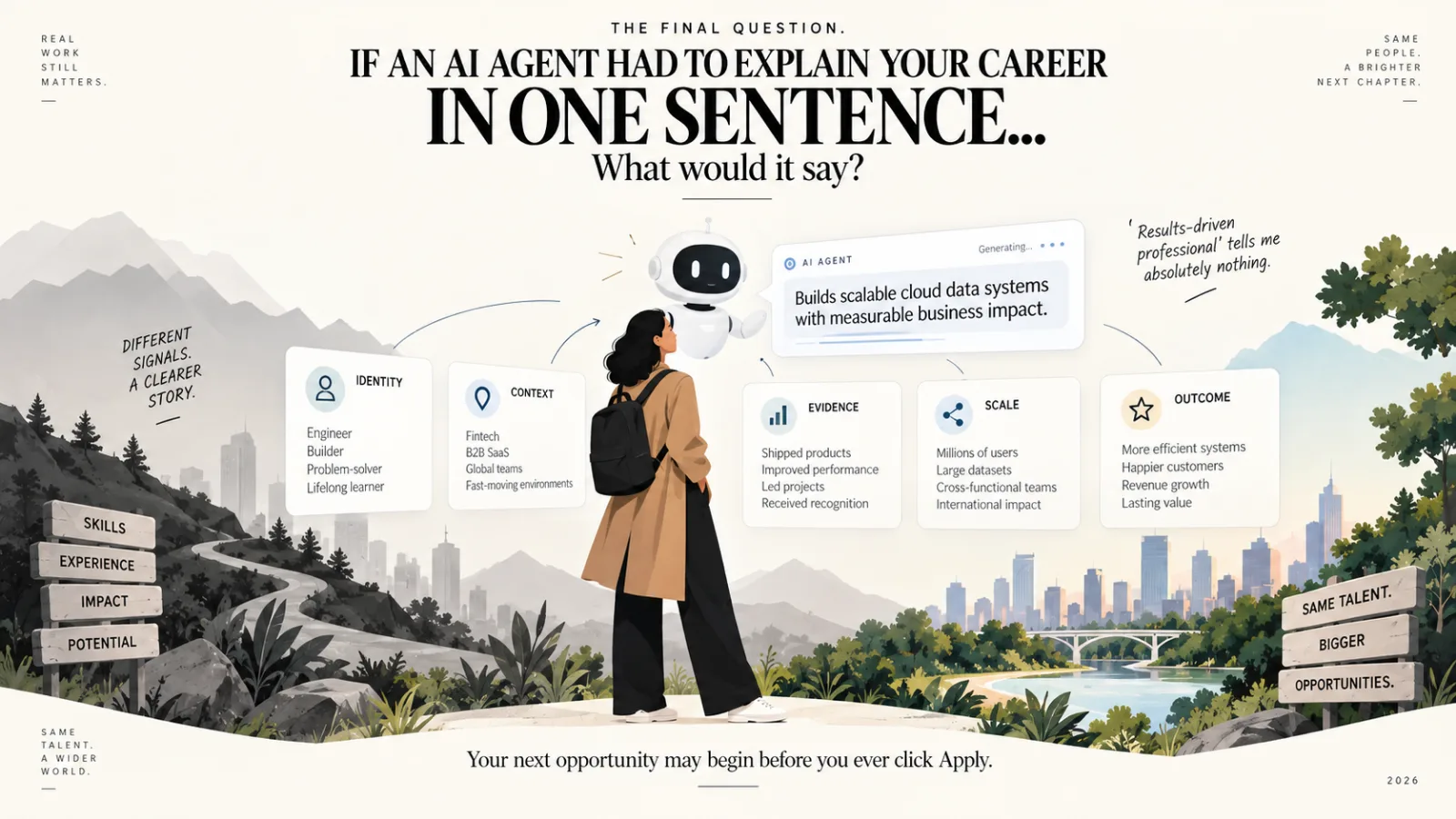
If an AI agent had to explain your career in one sentence…
What would it say?
Your next opportunity may begin before you ever click “Apply.”
🤖
By the way — “results-driven professional” tells me absolutely nothing.
Everyone and everything in this story is invented: Arun, Maya, Leo and the three profiles in the index. The mechanism is not. If you want to test it, open a private window and search for yourself the way a stranger with a problem would.