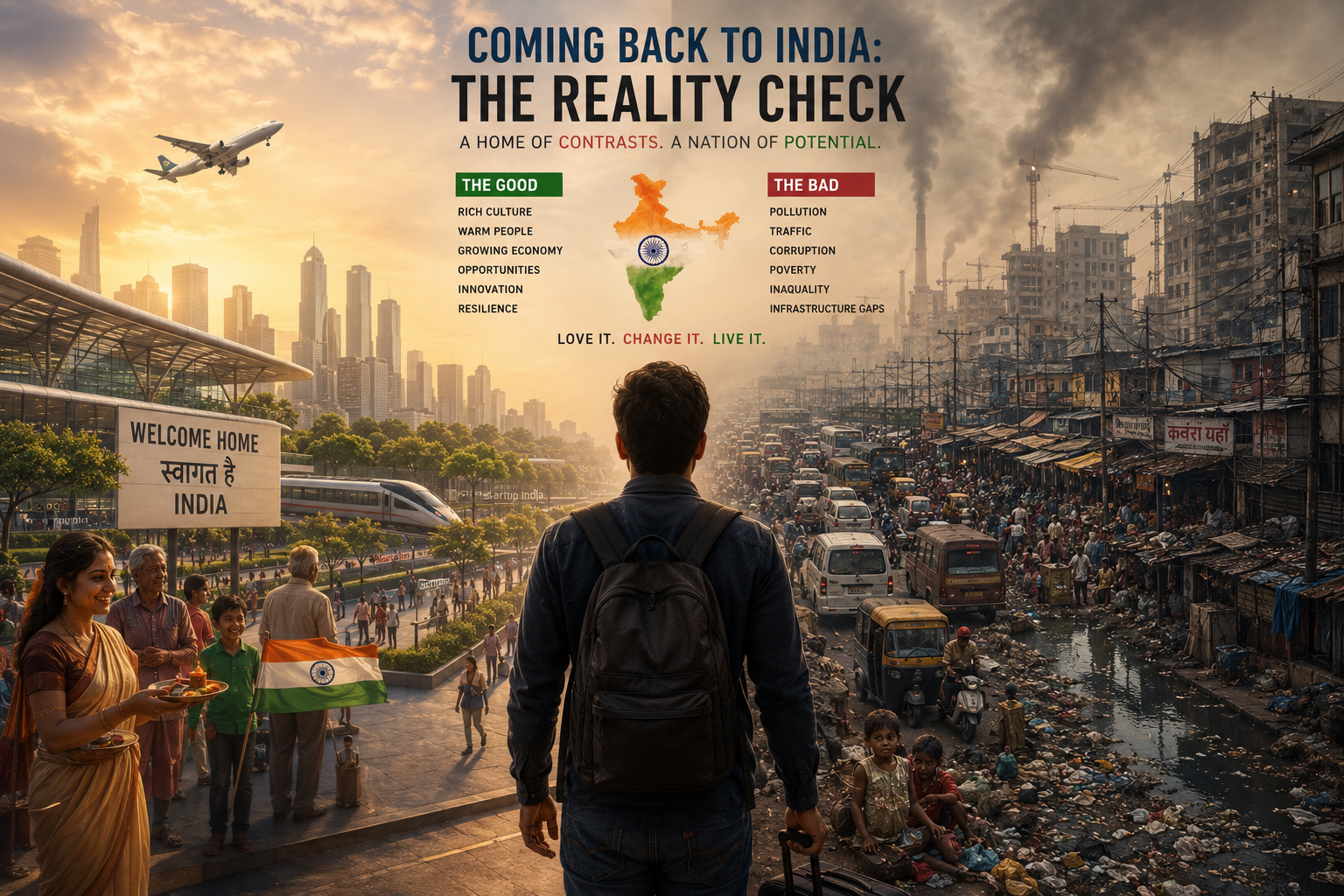
DISCLAIMER · This is a love letter to India wrapped in honesty. Every frustration mentioned comes with deep affection for a country that is messy, loud, warm, and unforgettable. The companion piece, "From Bay Area to Bangalore — The Math Nobody Shows You", handles the spreadsheet. This one handles everything the spreadsheet leaves out.
Numbers below reflect Bangalore Tier-1 pricing as of early 2026, with explicit Tier-2 callouts (Pune, Kochi, Coimbatore, Mysore, Chandigarh). Help wages from urbancompany / Housejoy / Bookmyhelp public listings; school fees from school websites (Indus, TISB, Inventure, Greenwood High); OCI/Aadhaar/PAN fees from the relevant government portals.[MHA · UIDAI · IT Dept · MoRTH] Costs vary by city, vendor, and season — the structure matters more than the exact rupee.
Cold Open · 3:14 AM at Kempegowda
The flight from SFO lands at 2:30 AM. By 3:14 you are pushing a luggage cart through the green channel, half-asleep, and the first thing that hits you is the smell. Diesel, jasmine, distant rain, and something fried — all at once. The cart's wheel sticks. A porter materializes. "Sir, I will help, sir." You don't need help. He's already lifting your bag.
Outside the terminal, the heat hits like an open oven door even at 3 AM. A small crowd of relatives — your aunt, two cousins, the cousin's husband, a neighbor you do not recognize, and your driver Murugan whom you have not met yet but who has been instructed by your mother to call you "Saar" — surrounds you. Garlands appear. A camera flash. Your kids blink, half terrified, half charmed.
You came back with $1.5M in the bank and a plan. The plan, you will discover over the next year, does not survive contact with India. Something better will replace it. But not yet.
It is 3:14 AM. The chaos has begun.
The First 90 Days
The bureaucratic gauntlet · paperwork before everything elseThe Identity Carousel
Every ID requires another IDIn America, you had a driver's license and a social security number. Two cards. In India, identity is a portfolio. By month three you will be carrying eight different documents, three of which exist only to prove the existence of the other five.
The Eight You Will Eventually Carry
OCI Card · $275 · ~30 days
Lifetime visa-free entry. Re-issued every time your passport changes if you're under 20 (and once after age 50).[MHA Gazette] Carry the physical card; the e-OCI lookup is unreliable at smaller airports.
Aadhaar · Free · 12 digits
The biometric national ID. Enrollment is free; biometric updates ₹100.[UIDAI] Required for almost every transaction over ₹50,000. OCI holders can also get one as residents after 182 days.
PAN Card · ₹107 (₹1,017 foreign)
Permanent Account Number. Mandatory for any banking, mutual fund, or tax filing. Apply via NSDL / UTIITSL within the first week.[IT Dept]
Indian Driver's License · ~₹700 total
Learner's license ₹150 + permanent ₹200 + smart card ₹200 + medical ₹150.[Parivahan / MoRTH] An International Driving Permit issued in the US is honored for one year. After that, get the Indian one.
Bank Account · NRO / Resident
While you're still NRI for tax purposes (per FEMA's 182-day rule), keep an NRO/NRE pair. Convert to resident savings once you cross the threshold. Wire transfer costs from US: $30-50 per transaction at most US banks.
Voter ID, Ration Card, Gas Connection
The tier-2 holy trinity. None mandatory, all useful as address proof and for state-level subsidies you may or may not want to claim. Apply only if you intend to stay long-term.
Friend lands in Bangalore mid-July. Tries to open an HDFC NRO account on day 3. HDFC: "Sir, we need Indian address proof." He: "I have a notarized rent agreement." HDFC: "We need a utility bill in your name." He: "I cannot get a utility bill without a bank account to pay it from." HDFC, blinking: "Yes sir." Six weeks of paperwork, three bank visits, one tearful phone call to his cousin who knew "a friend at the branch." Account opened on day 47.
The OCI Maze
Lifetime visa, lifetime paperworkThe OCI ("Overseas Citizen of India") card is the closest thing India offers to dual citizenship — and it is not dual citizenship. You can live and work indefinitely, own most kinds of property, and walk through the Indian Citizen lane at immigration. You cannot vote, hold most government jobs, buy agricultural land, or work in certain restricted professions without specific permission.[Citizenship Act §7A-D]
Re-issuance fee: $25 (US) per miscellaneous service.[CGI San Francisco] 21-day rule: Send old OCI booklet for re-stickering within 21 days of getting the new passport. 180-day rule: Stay beyond 180 days in a year and you may need FRRO registration depending on your purpose. Aadhaar eligibility: OCI holders qualify for Aadhaar after 182 days of continuous Indian residence.[UIDAI · Aadhaar Act §3]
The Big OCI Decisions
Keep OCI · Stay an Overseas Citizen
- Lifetime visa-free entry; no annual renewal
- Buy residential / commercial property; not agricultural land
- Most jobs open; some government roles restricted
- Cannot vote, run for office, or hold constitutional posts
- US citizenship preserved → easy back-and-forth
- Your kids retain US citizenship by birthright
Re-acquire Indian Citizenship
- Required to renounce US citizenship (one-way door)
- US exit tax may apply if net worth > $2M[IRC §877A]
- Vote, hold public office, buy agricultural land
- Tax becomes simpler (single jurisdiction)
- Kids born after must be naturalized separately
- No return-to-US safety net
The School Equation
Capitation, curriculum, and the July intakeThe single most consequential decision of your first year is school. Not where to live — where the kids go to school. Everything else flexes around it. Three things make this harder than the equivalent decision in the Bay Area: the board choice matters more, the admission process happens in March-July for the next academic year (so a mid-year landing means a wasted year or a homeschool gap), and the capitation fee is a real number that's never on the brochure.
The Four Boards
CBSE · The Default
Central Board, used by ~70% of urban schools. Math-and-science heavy, well-mapped to engineering/medical entrance exams. Best if your kid will stay in India for college (IIT-JEE, NEET).
ICSE · The Balanced
Council for Indian School Certificate Examinations. Stronger English and humanities, more analytical writing. Best for a kid who might pivot to international colleges or arts/social sciences.
IGCSE / Cambridge · The Bridge
British system, internationally recognized. Easier transition for a returning US 4th-8th grader. Fees typically 2-3× CBSE/ICSE. Smaller school network outside Tier-1 cities.
IB · The International
International Baccalaureate. Project-based, second-language requirement, internal assessment heavy. Best for a kid heading to US/UK/Canadian universities. Most expensive — ₹8-15L/year tuition in Bangalore.
The Real Cost Stack (Bangalore Tier-1, 2026)
Capitation fees are illegal under the Karnataka Educational Institutions (Prohibition of Capitation Fee) Act 1984 and analogous laws in other states.[KEIPC Act 1984] They are also universal at top schools — collected as "building fund," "alumni endowment," "infrastructure development," or simply via a sister trust. Range: ₹2L (good Tier-2 ICSE) to ₹30L (top Bangalore IB). Negotiable; sometimes waivable for legacy / NRI / alumni families. Paid in cheque, never cash.
The Five Rules of Re-Entry Schooling
- Don't switch boards in Class 9, 10, 11, or 12. The board exam in Class 10 and 12 is curriculum-locked. Switching mid-stream costs a year.
- Apply by November-December for July admission. Start the file in October. Visit the campus, meet the principal, get your kid interviewed.
- The curriculum jump is asymmetric. A returning US 4th-grader is typically 1-2 years ahead in reading and 1-2 years behind in math. Hire a tutor for the math gap; the reading gap closes itself in 6 months.
- Regional language is mandatory in CBSE/ICSE. Your kid will study Hindi or Kannada or Tamil as a second/third language. Tutoring help: ₹500-1,500/hour.
- Visit 5 schools before deciding. The brochure is identical at every school. The principal, the corridor smell, the way the security guard speaks to a parent — those tell you everything.
The Daily Friction
What nobody warns you about · the texture of ordinary lifeThe Pedestrian Does Not Exist
A category error, infrastructurallyIn the Bay Area you walked to coffee. To the grocery store. To pick up your kid from school. You took it for granted that a "footpath" was a paved surface, six feet wide, dedicated to people on foot. In India that assumption fails on day one.
The footpath situation has structural causes — encroachment is informal but tolerated, municipal sweepers don't reach side lanes, the electrical box is the BESCOM transformer and cannot move, and the vendor with the chaat cart has been there since 1987 and pays no rent. None of this is your problem to fix. Your problem is getting to the grocery store without breaking an ankle.
1. The car. You become a 200-metre-trip driver. Yes, even for the dosa shop next door. 2. The gated community. Buy or rent inside a society compound; you walk inside, drive outside. 3. The strategic walk. Master your three "good" routes — typically inside a park, along an arterial road with a recently re-built footpath, or between residential lanes that haven't been encroached.
The Traffic Coliseum
A driver is the best ₹20,000 you will ever spendYour Tesla autopilot will refuse to engage on Indian roads. The reason is structural: the algorithm assumes lanes, predictable trajectories, and signaled intent. Indian traffic has none of those. The cow does not signal. The auto-rickshaw does not stay in the lane. The school van stops in the middle of the road because the kid lives there, and the driver behind starts honking the moment the brake lights come on. Honking, here, is not anger; it is sonar.
The Road-Sharing Hierarchy
Pedestrians, cyclists, and tricycles inhabit a parallel dimension acknowledged by nobody on the hierarchy above.
The Driver Decision
Drive Yourself
- ₹0 ongoing cost (after car purchase)
- Full schedule control
- ~90 min daily commute consumed at the wheel
- Blood pressure / cortisol penalty (real, measurable)
- Insurance still negligible vs. US (₹15-25K/yr comprehensive)
- Parking: a daily contact sport
Hire a Driver
- ₹18,000-25,000/month (full-day Bangalore)
- 10-12 hour day, 1 day off/week
- Diwali bonus + festival bonuses ~₹15K extra/year
- Reclaim ~3 hours/day = 750 hours/year
- Read, take calls, take a nap, plan the week
- Driver becomes part of the family within 6 months
Hourly value of a driver: ~₹35/hr. Hourly value of your time: whatever you earn. The math is not close.
The Auto Rickshaw Negotiation Arc
You pay 2-3× the meter, every time
Google Maps says ₹40. He says ₹150. You hand over ₹150 because you don't know better and your kids are tired. He goes home and tells his wife about the American.
You negotiate, badly but honestly
"₹60 final." "₹100." "₹70." He walks. You walk. He comes back. ₹70 it is. You feel a small surge of pride. Your auto driver feels a small surge of respect.
You have three drivers on speed dial
Murugan knows your kid's school. Rashid attended your housewarming. Anil has named his new tuk-tuk after your daughter. The negotiation is over. You are family. They charge you fair rates and refuse tips because "we are family only, sir."
The Animal Kingdom
Stray dogs, monkeys, cows, mosquitoesIndia has roughly 60 million stray dogs.[WHO India / State of Pet Homelessness Index] Bangalore alone has an estimated 3 lakh stray dogs in the BBMP municipal limits. They are largely friendly, mostly vaccinated under the Animal Birth Control rules, and absolutely not shy of barking at 11 PM at a passing leaf.
The Midnight Bark Conference
Dog #1 spots shadow
"INTRUDER ALERT." Shadow was a leaf. Dog #1 commits to the alarm anyway.
Dog #2, two streets away, joins
Without context. Without information. Pure FOMO solidarity.
Dogs #4-15 join the agenda
The shadow is gone. The conference is now self-sustaining, driven entirely by social dynamics within the pack.
Adjournment
No resolution. High energy. Everyone agrees the meeting was Very Important. Reconvenes at 2 AM and 5 AM.
The Other Animals That Will Affect Your Life
Monkeys · Bonnet macaques + Rhesus
Common in Bangalore foothills, Mysore palace surrounds, Shimla, Vrindavan. Will enter your kitchen if the balcony door is open. Don't make eye contact. Don't carry food in your hand. Lock balcony doors during fruit season.
Cows · Bovine royalty
You yield. They don't. A cow standing in your driving lane is not a problem to solve — it is a temporal constraint to wait out. Average wait: 4-7 minutes. Average horn count from cars behind you: 200.
Mosquitoes · Dengue / Chikungunya
Peak season July-October (post-monsoon). Bangalore had ~12,000 reported dengue cases in 2024.[BBMP Health Dept] Use nets, repellents (Goodknight / Mortein), keep no standing water. The fogging truck arrives the day after you complain.
Lizards · Geckos · House friend
Wall-climbing, harmless, eats insects. Will live in your kitchen ceiling. Indian house tradition treats them as auspicious. Your kids will name them.
Aggressive stray dog: BBMP Animal Husbandry helpline + your society manager. ABC program will sterilize and re-release. Monkey troop: Forest Department; in Bangalore, monkey catchers are private contractors at ₹3-5K per relocation. Snake in compound: WildlifeSOS, FRIENDS of Snakes, or local rescuer (every Indian city has one — your maid will know the number).
The Doorbell Symphony & The Free Advice Economy
Community as both gift and taxYour Bay Area doorbell rang twice a week. The Amazon driver and the UPS guy. Your India doorbell will ring 20-25 times a day. Two of those will be Amazon. The other 23 are people you did not invite.
A Typical Tuesday
- 6:30 AM — Newspaper boy throws the Hindu over the gate. Bell anyway (he wants the monthly to be paid).
- 7:00 AM — Milkman with two litres of toned milk. Cash. ₹120.
- 7:45 AM — Maid arrives. Bell + door knock.
- 8:30 AM — Cook arrives. Bell.
- 9:15 AM — Maintenance guy: "Sir, water motor checking only."
- 10:00 AM — Postman with a registered letter (your OCI re-issue, finally).
- 10:45 AM — Sales agent: "Madam, only 2 minutes! New broadband offer!"
- 11:20 AM — Gas cylinder delivery. Two flights, no elevator help.
- 12:30 PM — Zomato. Lunch.
- 2:00 PM — Press wala (ironing guy) collecting clothes.
- 3:30 PM — Garbage collector. Wet/dry sorted? Sometimes inspected.
- 4:45 PM — School van drops off kids. Driver rings to confirm.
- 5:30 PM — Neighbor aunty: "I heard your daughter is going to take violin classes — my sister-in-law teaches!"
- 6:00 PM — Swiggy delivery boy. You did not order. Wrong floor.
- 6:45 PM — Tutor for Class 7 math.
- 7:30 PM — Yoga instructor (for Mother-in-Law).
- 8:15 PM — Society security guard: "Sir, your car parked wrongly, can you adjust?"
- 9:00 PM — Friend from Mumbai who is "just in town for a day," definitely staying the night.
The Free Advice Economy
You sneeze. Three diagnoses. Five remedies. One baba's phone number. You park your car. Uncle from balcony: "LEFT! MORE LEFT! STOP!" You're three feet from the wall. Your daughter says "thank you" instead of "thanks." Aunty notes the Americanism with visible concern.
VATSALA AUNTYSo! Back from America! Call your children, let me see.
YOUR KIDSHello aunty.
AUNTY (face: disappointment)They don't speak Tamil?
YOUThey understand some —
AUNTYSOME? My friend's daughter came from Dubai, her children speak perfect Malayalam. You should have sent them to language school. Now they are like foreigners only. How will they talk to their grandparents?
YOUMy parents speak English fluently —
AUNTYYes yes, but it is not the same. (walks away shaking head)
MOTHER-IN-LAW (calling next day)Vatsala told me about the language thing. We should think about a tutor.
The annoying truth: this nosiness comes from caring. In the US, your neighbor would not have known you returned. Would not have asked about your kids. Would not have offered her sister-in-law's violin classes. The flat affect of American suburban privacy is one thing the US gets exactly right and exactly wrong at the same time.
1. The Head Wobble. The all-purpose Indian gesture that means yes, no, maybe, I hear you, I don't agree, and please go away — all at once. Practice it. 2. "Thank you uncle / aunty, I'll think about it." Sincere tone, zero commitment. 3. "Yes, my parents told me the same thing." The cheat code. Disarms most aunties because they cannot disagree with your parents.
The Indian Upside
What your money actually buys · and what it cannotThe Help Economy
The luxury that buys back your weekendsThis is the line item that's hardest to explain to your Bay Area friends. For ₹50,000-1,00,000 per month — roughly $600-1,200 — a returning family of four can offload almost every domestic chore to people who genuinely want the work and are skilled at it. Cleaning, cooking, ironing, errands, driving, child care, garden, plumbing. The category "weekend chore" largely disappears.
The Bangalore Tier-1 Cost Stack (2026)
Family of four, full-stack help: ~₹60-90K/month. About what one part-time Bay Area nanny costs in a week.
The Bai Relationship Arc
Stiff. Polite. Transactional.
She does her work. You do yours. Communication via short instructions. She thinks you are stingy and aloof. You think she is suspicious and over-paid.
The first real conversation
Her son's school admission. Your help with the form. The thank-you the next morning, plus a banana from her village. The relationship enters phase two.
You are now in her life and she in yours
She knows your kid is anxious about exams. She knows you're trying to lose weight. She quietly serves less rice. She tells you the gardener is stealing your mangoes. She asks for an advance for her daughter's wedding. You give it.
She is family. Difficult, complicated, indispensable family.
She has opinions about your wife's saree choices and your daughter's career. She also locked the gas valve before leaving for her village, watered the plants without being asked, and called you at midnight when there was a water leak. The math is not even close.
Pay on the 1st of the month. Salaries are tighter than yours; lateness compounds emotionally. Diwali bonus = one month's salary. Plus a saree / clothing piece. Sick leave is paid. Always. Provide tea + a meal during the workday. Most households do; not doing it marks you. Festivals: time off + a small gift. Pongal, Eid, Christmas — calibrated to her tradition. The advance. Most help ask, eventually. Wedding, hospital, child's exam. Give it; deduct over months; never call it a loan.
Living With (or Near) Parents
The grandparent dividend, the kitchen turf warThis is the deep one. The reason most NRIs return. The reason most NRIs cannot quite explain why they returned.
Bay Area life: your parents age 8,000 miles away. Zoom calls (they're on mute). You miss the gradual decline. You arrive after the heart attack. You write a check that nobody asked for, the only currency you still have. India life: your father teaches your son chess every evening. Your mother tells your daughter stories you forgot. You're there for the doctor visits — not video-calling in from Cupertino, sitting in the waiting room reading the Hindu in Tamil for the first time in twenty years.
This is the line item that is genuinely priceless. The corpus is just money. Your father teaching your son chess is the inheritance.
The Living Arrangement Spectrum
Same House · Joint Family
Closest. Cheapest. Highest friction. Kitchen turf wars (your wife's biryani vs. your mother's biryani), parenting disagreements (the school van vs. the auto), generational TV/AC/light-switch politics. Works if all four parents (your two + spouse's two) genuinely like each other.
Adjacent Flats · Same Building
The sweet spot most successful returners land on. Daily contact, shared meals, easy childcare, separate kitchens, separate bathrooms. ₹2-4 Cr per flat in a good Bangalore society.
Same City · 15-Minute Drive
Loose enough for autonomy, close enough for emergencies. Sunday lunches at their place. Festival visits. Doctor appointments with you. Works best when parents are independent and active.
Same Compound · Independent Cottage
The Tier-2 / suburban model. A plot with two structures. Parents in the older one, you in the newer one. Garden in the middle. Often the lowest-conflict, highest-quality version of intergenerational living.
The Friction You Underestimate
- The kitchen war is real. Two daughters-in-law cannot share one kitchen. Two mothers-in-law definitely cannot. Solve it before you arrive, not after.
- Parenting styles will diverge. Grandparents indulge. You discipline. The kid figures out who to ask.
- Money becomes ambient. Your parents will pay for groceries, refuse reimbursement, then mention it three months later in front of your aunt.
- The role reversal is sudden. One hospital visit changes the dynamic forever. You are no longer their child; you are their caregiver. Be ready.
The Wider Family Network
Difficult, demanding, indispensableYou arrive back into a network you forgot existed. Three uncles, four aunts, eleven first cousins, twenty-three second cousins, and a maternal cousin's husband's brother who runs a paint business and will keep mentioning it. This is the network. Everyone is in it. You cannot opt out.
The Three Kinds of Relative
Cousins · The Friends You Didn't Know You Had
The cousins you grew up with, briefly, on summer trips — now in their forties with kids your kids' age. They will become your closest friends. Same humor, same nostalgia, no explanation needed. WhatsApp group started day one.
The Helping Uncle · Quiet, Patient
Every family has one. The aunt who shows up when your father is hospitalized and stays the night. The uncle who finds a school principal who finds a seat. He will refuse all repayment.
The Difficult Relative · Loud, Borrowing
The cousin who needs ₹2L "just for three months." The uncle who keeps mentioning your "successful brother in Boston." The aunt who has an opinion about your wife's career. They are also family. They will also show up at the hospital.
You are back. You are available. You attend weddings. You contribute to engagements. You show up at funerals — within the city for sure, often outside it. The contract is non-negotiable and largely unspoken. Try to break it and the family memory is long. Honor it and the network closes around you in your hour of need.
The Wedding Math
An average urban Indian attends 8-12 weddings per year in their 30s and 40s. NRI returners attend more, because everyone they meet for the first time in twenty years has a daughter / son / niece getting married next month. Budget:
The Indian Food Restoration Project
Twenty-five years of culinary deprivation, undoneThe first dosa is the moment you realize what you had been doing in California — eating "Indian food" at restaurants that were imitating other restaurants imitating restaurants. The first idli in Madras (or Bengaluru, or Coimbatore) collapses two decades of compromise.
What Daily Life Tastes Like
Breakfast · ₹0-100
Filter coffee, fresh idli, hot sambar, three chutneys. Your cook learned the recipes from your grandmother. The dabba-wala neighbor sends over uppittu on Saturdays.
Lunch · ₹40-300
Office meals at ₹120 unlimited. Street food at ₹40. Sit-down Tamil "meals" with banana leaf and 12 courses at ₹250. Swiggy / Zomato delivers in 12 minutes for ₹150-400.
Dinner · ₹50-2000
Home-cooked by your cook for ₹0 (already in monthly salary). Mid-range restaurant ₹600-1,500 per couple. The Taj's Karavalli or ITC's Dakshin: ₹4,000 a couple if you want to remember why fine dining matters.
Coffee · ₹30-450
Tier-1 darshini filter coffee ₹30. Third-wave cafe (Blue Tokai, Subko) ₹250-450. Both excellent, for very different reasons. The decision between them is character-defining.
The Seasonal Calendar
- Mar-May: Mango season. Alphonso (Konkan), Imam Pasand (Tamil Nadu), Banganapalli (Andhra). Eat them before they end.
- Apr-June: Jackfruit. Tender (curry) and ripe (dessert). Kerala's signature summer ingredient.
- Jun-Sep: Monsoon. Bhajji, hot chai, corn on the cob, ginger-everything. Comfort calories.
- Oct-Nov: Festival season feasts. Diwali sweets, Onam sadya, Dussehra bondas.
- Dec-Feb: Winter greens, ghee, makki di roti + sarson da saag (in North India). The ghee-and-warm-food season.
Most returning NRIs gain 4-8 kg in year one. The reason is the same as why year one is delicious: ghee, sugar, oil, white rice, and the relentless social food culture (someone offers you something to eat in every interaction). Counter-protocol: walk every day even on bad-air days, restrict sweets to actual festivals, fast on Mondays or Saturdays (some traditions do).
Culture, Cricket & The Calendar
Six months of festivals, two months of IPL, twelve months of weddingsThe Indian calendar is overpacked. There is no quiet month. October through February is the wedding-festival-cricket triple-stack: Navaratri → Dussehra → Diwali → Karthik → Christmas → New Year → Pongal/Sankranti → Republic Day, with at least three weddings per weekend through most of it. March-May: heat, exams, mango. June-September: monsoon, Onam, Ganesh Chaturthi, Janmashtami. There is always something on. The Bay Area's "weekend calendar" tradition — empty weekends as the default — does not exist.
The Festival Stack
Pongal · Sankranti · Lohri · Jan 14
Harvest festival. Three days of sweet pongal, kite-flying (in Gujarat), bonfires (in Punjab), and visiting elderly relatives. Tier-2 cities still cook it on actual wood fires.
Holi · March
Festival of colors. Loud, messy, intoxicating in North India. Quieter and more devotional in the South. Bangalore: somewhere in between, mostly in apartment building compounds.
Onam · August / September
Kerala's harvest festival. Ten days, culminating in the Sadya: a 26-dish lunch on a banana leaf. Most NRI Malayalis come back for this specifically.
Ganesh Chaturthi · August / September
Maharashtra signature. Eleven days of pandals, processions, music. Mumbai gets transformed. Smaller versions in Bangalore and Pune.
Navaratri · Dussehra · September / October
Nine nights of dance (Gujarat: Garba), kolu (Tamil Nadu doll arrangements), and Durga puja (Bengal). Climaxes in Vijayadashami / Dussehra — the burning of Ravana effigies in the North.
Diwali · October / November
The biggest. Lights, sweets, gifts, gambling, fireworks (now somewhat regulated for air quality). Office and family bonuses align with this. Your help expects a one-month-salary Diwali bonus.
Cricket as Social Glue
Cricket is the only thing 1.4 billion people watch at the same time. The 2023 ODI World Cup final between India and Australia drew an estimated 518 million viewers in India alone.[BARC India] The IPL season (March-May) is two months of nightly games at 7:30 PM. Conversations stop. Restaurants put up TVs. The auto driver mid-trip suddenly says "Sir, score?" and you stop being a passenger and start being a fan.
Don't skip this. ₹250 a seat in a PVR multiplex. Reclining chairs, full meals brought to you, intermission with samosa-coffee combo for ₹150. A South Indian movie release night (Vijay, Rajinikanth, NTR Jr., Yash) is a religious event. Whistles, claps, dancing in the aisles. Nothing in Bay Area cinemas matches this. It cannot be exported.
The Healthcare Buffet
Five medical systems, one country, one-tenth the US costIndia is the rare country where allopathic medicine (Western), Ayurveda, Siddha, Unani, naturopathy, and homeopathy all have official government recognition, dedicated medical colleges, and large urban patient bases.[Ministry of AYUSH] The returning NRI's instinct is to default to allopathy because that is what the Bay Area trained you to do. Within two years, you will be doing what most urban Indians do: combine modalities by condition.
Cost Comparison That Will Surprise You
US Cost (Self-Pay, No Insurance)
- Coronary bypass (CABG): $70,000-200,000
- Hip replacement: $40,000-100,000
- Knee replacement: $50,000-90,000
- MRI (brain): $1,000-3,500
- ICU per day: $5,000-10,000
- GP visit: $150-400
- Birth (vaginal, hospital): $13,000-20,000
India Cost (Top Tier-1 Private Hospital)
- Coronary bypass (CABG): ₹2-5 L (~$2.3-6K)[Apollo / Medanta]
- Hip replacement: ₹3-6 L
- Knee replacement: ₹2.5-4 L
- MRI (brain): ₹3,000-10,000
- ICU per day: ₹15,000-30,000
- Specialist consult: ₹600-1,500
- Birth (vaginal, top hospital): ₹80,000-2 L
The Five Modalities · A Field Guide
Allopathy · Apollo, Manipal, Fortis, AIIMS
World-class corporate hospitals in Tier-1. Cardiac, oncology, transplant, ICU, trauma. Best in the country, often best per dollar globally. Telemedicine on Practo / Apollo 247.
Ayurveda · Kerala / Coimbatore tradition
5,000-year-old herbal + lifestyle system. Best for chronic conditions, joint pain, skin, digestive, sleep. Panchakarma (detox) at Kerala centers: ₹40K-2L for a 14-day program. Vaidyaratnam Oushadhasala and AVN Coimbatore are reputable national chains.
Siddha · Tamil tradition
Indigenous Tamil herbal-mineral system. Strong for skin, mental wellness, lifestyle conditions. Govt institutes in Chennai (NIS) and Tirunelveli. Less commercialized than Ayurveda; harder to find good practitioners outside Tamil Nadu.
Naturopathy · Fasting + lifestyle
Diet-and-fasting-based. Jindal Naturecure (Bangalore), SDM (Ujire) are residential retreat centers. ₹2-8K/day. Best for lifestyle disease — weight, BP, early-stage diabetes, stress.
Homeopathy · cheap, gentle, popular
German-origin, widely practiced in India. Highly debated efficacy, broad cultural acceptance. Best for mild chronic conditions and emotional/stress symptoms. Consultations ₹300-1,500.
Most urban Indian families maintain: one trusted allopath (your "family doctor"), one Ayurveda practitioner (knees, digestion, post-pregnancy), and at least one alternative they consult occasionally (Siddha or homeopathy for chronic skin / sleep / immunity). The systems are not in competition; they cover different ranges of the human condition.
The 24-Month Test
Year 1 is chaos · Year 2 is when real life beginsThe single most useful piece of advice anyone can give a returning NRI is this: don't decide if it worked until you have lived through two complete monsoons. Year one is chaos by design. Documents, schools, friction, the constant comparison to the life you left. Year two is when the friction becomes background noise and the joy becomes foreground.
Who Thrives · Who Returns to the US
You'll Thrive If
- You can laugh at chaos instead of fixing it
- You value family proximity over infrastructure
- You're flexible — Plan B is always required
- You have sufficient corpus (money reduces 70% of friction)
- You give it 24 months before judging
- You find your NRI tribe early
- You accept unsolicited advice as community care
- You master the head wobble + "I'll think about it"
- You choose Tier-1.5 or Tier-2 over pure Tier-1
- You build a routine that includes both modes — Western and Indian
You'll Struggle If
- You need systems to work perfectly
- You can't tolerate noise or crowds
- You expect Western standards everywhere
- You're rigid about routines and plans
- You're on a tight corpus — stress multiplies friction
- You isolate yourself or refuse to join networks
- You constantly compare every interaction to US
- You take aunty's commentary personally
- You chose Delhi or Bangalore for "maximum culture"
- You give up at month 8 (or 11, or 13 — see the curve)
What You'll Become
- You'll develop a sixth sense for potholes
- You'll learn the head wobble that commits to nothing
- You'll know three auto drivers personally and never check Google Maps for fares
- You'll have an Ayurveda practitioner and an allopath, and you'll know which condition belongs to which
- You'll drink filter coffee at 6 AM and a Blue Tokai cortado at 11 AM with equal seriousness
- You'll skip a wedding only for an emergency, and you'll know which kind of emergency counts
- You'll learn to negotiate with aunty, the auto driver, and the building society in one fluid motion
What You'll Have
- Filter coffee at sunrise, made by a cook who learned from your grandmother
- Your parents in the next room, or down the road, in their final decade
- Your kids learning Tamil/Hindi/Kannada/Bengali by osmosis
- Real festivals with real chaos and real joy — not a Diwali pooja in a Cupertino conference room
- A help economy that gives back 20 hours of your week
- Healthcare at one-tenth the US cost and one-third the wait
- Friends in their forties who remember you in your twenties
- Cricket — the kind that stops the country at 7:30 PM
- The strange ongoing miracle of being, finally, home
India is not a country you visit. It is a relationship you negotiate. Every. Single. Day. For life. And the longer you stay, the better the trade looks.
The Honest Closing
Year one is the tax. Documents, dogs, traffic, advice, aunties, monsoons, dengue, the cook who quits, the maid who shows up late, the OCI form that bounces back, the school admission that almost fails, the moment in month 8 when you stand in your half-set-up Bangalore kitchen at 11 PM and think "What have I done?"
Year two is the dividend. The driver who knows your kid's school. The Ayurveda doctor who knows your knees. The cook who knows your grandmother's recipe. The cousin who is now your best friend. The festival night when your father teaches your son how to light a diya, the way your father once taught you. The Sunday morning when you walk to the temple and run into three people you knew thirty years ago and they all ask, the same way they did then, "Have you eaten?"
Your corpus can buy comfort. It cannot buy cultural adaptation. That part is paid in time and patience and the small daily decision to stay one more day, then one more month, then long enough that the country becomes home again — not because the friction disappeared, but because you stopped counting it.
Welcome home. It's loud here. The dosas are excellent. Don't decide until month 24.
Sources & References
- [MHA] Ministry of Home Affairs — OCI gazette notifications, OCI re-issuance rules for minors (mha.gov.in / ociservices.gov.in).
- [UIDAI] Unique Identification Authority of India — Aadhaar enrollment, update fees, and residency rules under the Aadhaar Act 2016 (uidai.gov.in).
- [Citizenship Act §7A-D] Sections governing Overseas Citizen of India status and restrictions.
- [CGI San Francisco] Consulate General of India San Francisco — OCI miscellaneous service fees and processing timelines (cgisf.gov.in).
- [IT Dept] Income Tax Department, India — PAN application fees and processing (incometax.gov.in / NSDL / Protean / UTIITSL).
- [Parivahan · MoRTH] Ministry of Road Transport and Highways — driver's license fee schedule and procedure (parivahan.gov.in).
- [KEIPC Act 1984] Karnataka Educational Institutions (Prohibition of Capitation Fee) Act, 1984. Similar laws exist in Tamil Nadu, Maharashtra, and other states.
- [IRC §877A] US Internal Revenue Code Section 877A — covered expatriate / exit tax provisions for those renouncing US citizenship with net worth above $2M or high income.
- [Ministry of AYUSH] Government of India ministry overseeing Ayurveda, Yoga & Naturopathy, Unani, Siddha, Sowa Rigpa, and Homeopathy (ayush.gov.in).
- [Apollo · Medanta] Published price lists from Apollo Hospitals and Medanta Medicity for cardiac, orthopedic, and imaging procedures; figures rounded.
- [BBMP Health Dept] Bruhat Bengaluru Mahanagara Palike — dengue surveillance and case reporting for 2024.
- [BARC India] Broadcast Audience Research Council — 2023 ICC Cricket World Cup final India viewership measurements.
- [WHO India / State of Pet Homelessness Index] Estimates of stray dog population in India and per-city densities.