
As data continues to be a cornerstone of modern business operations, the challenges surrounding data privacy have become more complex. Data architects, tasked with designing secure and compliant data ecosystems, face a myriad of obstacles. This article explores key challenges in data privacy, ranging from compliance issues to the integration of AI, scalability concerns, and the design of data lakes. It also provides solutions and practical tools for data architects to navigate these challenges, with a focus on AWS, Azure, and GCP, and includes code examples for data privacy in Python. Additionally, the article introduces OneTrust, a leading provider of trust intelligence software, and explores alternatives in the data privacy and security space.
Brace yourselves, because the era of unfettered data collection is over. Your online life – every click, scroll, and purchase – is a veritable bazaar where your personal information is the hottest commodity. The culprits? Cookies, trackers, and targeted ads: a nefarious triumvirate conspiring to monetize your digital footprint.
But you - the data architect, hold the key to breaking free from this privacy purgatory. Here's how:
Challenge:
Unprecedented data harvesting: Cookies and trackers lurk everywhere, meticulously weaving a tapestry of your online behavior. These digital breadcrumbs are then fed to the ad-targeting monster, creating eerily accurate profiles used to bombard you with personalized ads (and manipulate your choices).
Solution:
Empowering users: Architect data systems that put user control at the heart. Implement robust consent mechanisms, granular data access controls, and clear data deletion pathways. Respecting user autonomy isn't just ethical, it's good business: trust translates to loyalty and engagement.
Challenge:
Balancing personalization and privacy: Targeted ads offer undeniable benefits – relevant recommendations and streamlined experiences. But at what cost? Striking a balance between personalization and privacy requires careful consideration.
Solution:
Contextual relevance over invasive tracking: Architect systems that utilize contextual cues, like browsing history or current website content, to deliver relevant ads without relying on intrusive personal data collection. This win-win approach satisfies users' desire for information without sacrificing their privacy.
Challenge:
Compliance complexity: A labyrinth of data privacy regulations, like GDPR and CCPA, poses a formidable challenge for data architects.
Solution:
Proactive compliance: Embed privacy regulations into the very fabric of your data architecture. This means data minimization, secure storage, and robust breach notification systems. Remember, compliance isn't just a tick-box exercise; it's a fundamental pillar of building trust.
The future of the internet lies in your hands. Embrace the responsibility of protecting user privacy, not just as a regulatory necessity, but as a moral imperative.
Let's rewrite the narrative – from "Your Online Life on Sale" to "Your Data, Your Power." The choice is yours.
Key Challenges for Data Architects in Data Privacy
Compliance and Regulatory Landscape:
Navigating complex regulations: GDPR, HIPAA, CCPA, and others have different requirements for data collection, storage, and access.
Keeping up with evolving regulations: Data privacy laws are constantly changing, requiring ongoing adaptation.
Demonstrating compliance: Data architects need to prove adherence to regulations, which can be complex and time-consuming.
Data Security and Privacy by Design:
Data minimization: Collecting and storing only the minimum amount of data necessary for legitimate purposes.
Pseudonymization and Anonymization: Reducing re-identification risk by obfuscating personal data.Access control and data governance: Implementing robust systems to control data access.
Data security measures: Encryption at rest and in transit, vulnerability management, and incident response planning.
Data Lake Design for Privacy:
Data classification and labeling: Categorizing data based on sensitivity for security and access controls.
Data segregation and isolation: Storing sensitive data in separate environments with strict access controls.
Data masking and tokenization: Replacing sensitive data with non-identifiable representations for analytics.
Auditing and logging: Tracking data access for accountability and compliance.
AI and the Privacy Landscape:
Algorithmic bias and fairness: Ensuring AI algorithms are unbiased against specific groups.
Explainable AI: Making AI models transparent to understand decision-making processes.
Privacy-preserving AI: Developing AI techniques for data analysis without compromising privacy.
Scalability and Complexity for Large Organizations:
Managing massive datasets: Balancing data lakes that handle enormous volumes of data while maintaining privacy.
Centralized vs. decentralized data governance: Balancing flexibility with control in large, distributed organizations.
Data lineage and traceability: Tracking data flow for accountability and compliance.
Solutions and Tools for Data Architects
Data Governance Frameworks:Implement frameworks like NIST SP 800-53. Utilize data governance tools for automation.
Data Security Technologies:Deploy encryption technologies like AES-256. Implement access control solutions like RBAC and ABAC. Use DLP tools to prevent unauthorized data exfiltration.
Privacy-Enhancing Technologies (PETs):Utilize anonymization and pseudonymization techniques. Implement differential privacy. Explore secure multi-party computation (MPC) for collaborative data analysis.
AI for Privacy:Leverage AI for anomaly detection and threat identification. Develop privacy-preserving AI algorithms. Utilize AI-powered data governance tools.
Third-Party Tools and Services: Consider platforms like OneTrust for data privacy management. Utilize cloud-based data lake solutions with built-in security. Engage data privacy consultants for expert guidance.
Design Fundamentals and Code Examples
Focus on data minimization: Collect and store only the data necessary for specific purposes.
Implement data access controls: Restrict access to sensitive data based on the principle of least privilege.
Encrypt data at rest and in transit: Use strong encryption algorithms to protect data from unauthorized access.
Implement data masking and tokenization: Replace sensitive data with non-identifiable representations for authorized use.
Log and audit data access: Track who accessed what data and for what purpose for accountability and compliance.
Code Examples:
Python code for data anonymization:
Terraform configuration for data lake security:
SQL queries for data auditing:
Data Privacy Solutions and ETL Implementation in AWS, Azure, and GCP
Data privacy challenges are a major concern for organizations, and cloud platforms like AWS, Azure, and GCP offer various tools and services to address them. Here's a breakdown of solutions and ETL implementation using Glue, Lambda, and Synapse:
Amazon Web Services:
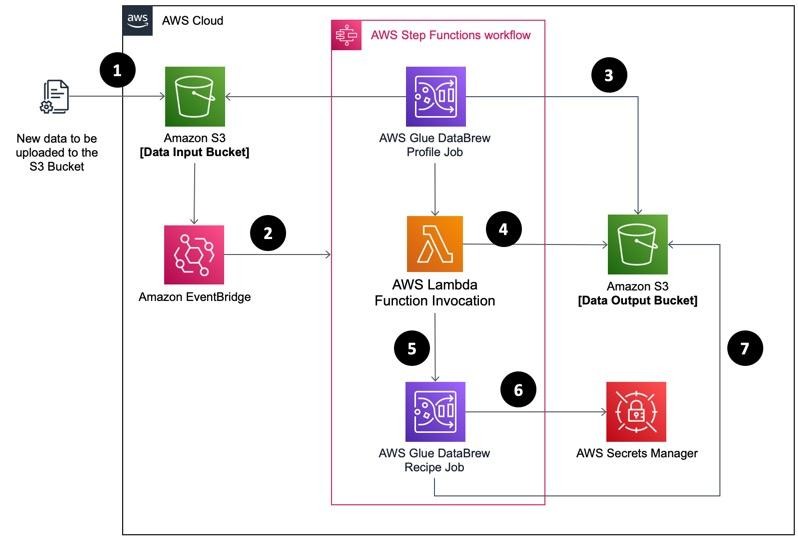 Copyright - Amazon
Data Governance:
AWS Glue Data Catalog: Centralized catalog for data assets, enabling tagging, lineage tracking, and access control.
AWS Lake Formation: Creates a unified data governance ecosystem across data lakes and data warehouses.
AWS Security Hub: Aggregates security posture from various AWS services and provides remediation recommendations.
Data Security:
AWS KMS: Manages encryption keys for data at rest and in transit.
AWS S3 Server-Side Encryption: Encrypts data automatically when stored in S3 buckets.
Amazon Inspector: Analyzes applications for vulnerabilities and recommends security hardening measures.
Privacy-Enhancing Technologies:
AWS Data Lifecycle Manager: Automates data retention and deletion based on policies.
AWS Rekognition: Performs facial recognition and redaction in images and videos.
Amazon Comprehend: Extracts entities and sentiments from text data, enabling anonymization and de-identification.
ETL with Glue and Lambda:
AWS Glue orchestrates ETL workflows using Spark and Python scripts.
AWS Lambda can be used for serverless data transformations within Glue jobs.
Example: An ETL pipeline using Glue extracts sensitive data from on-premises sources, masks it using Lambda in AWS Glue, and loads it into an Amazon Redshift data warehouse for analysis.
Example 1: Encrypting and Decrypting Data at Rest
This example demonstrates how to use AWS KMS to encrypt and decrypt data at rest. In this case, we'll use a simple text file.
Example 2: Encrypting and Decrypting Data in Transit
This example shows how to use AWS KMS to encrypt and decrypt data in transit using the aws-encryption-sdk library.
Make sure to replace 'your-region' and 'your-key-id' with your actual AWS region and KMS key ID.
Azure:
PII detection and masking using Azure template.
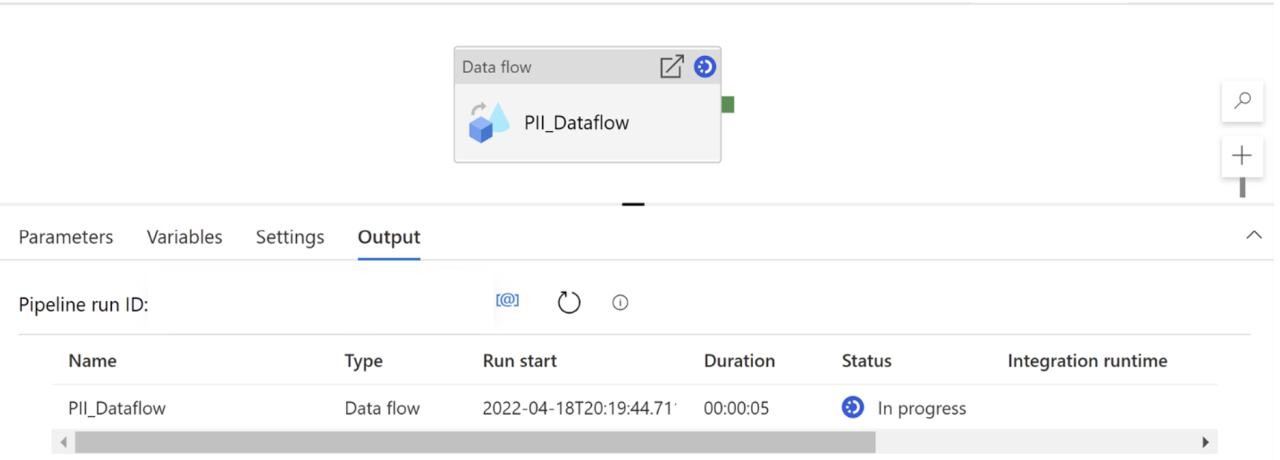 Copyright - Microsoft
Data Governance:
Azure Purview: Catalogs and governs data across on-premises, cloud, and multi-cloud environments.
Azure Data Factory: Orchestrates data pipelines and integrates data from various sources.
Azure Policy: Creates and enforces data governance policies across Azure resources.
Data Security:
Azure Key Vault: Manages encryption keys for data at rest and in transit.
Azure Security Center: Continuously monitors and assesses the security posture of Azure resources.
Azure Defender for SQL: Provides advanced threat protection for Azure SQL databases.
Privacy-Enhancing Technologies:
Azure Data Loss Prevention (DLP): Identifies and protects sensitive data in Azure.
Azure Cognitive Services: Offers various AI-powered services for anonymization and de-identification.
Azure Digital Twins: Creates virtual models of physical systems, enabling privacy-preserving data analysis.
ETL with Synapse:
Azure Synapse Analytics combines data integration, enterprise data warehousing, and big data analytics into a single service.
Synapse integrates seamlessly with Azure Data Factory for building ETL pipelines.
Example: A Synapse pipeline extracts data from Azure Blob Storage, transforms it using built-in data flows, and loads it into Azure SQL Database for analytics.
Google Cloud Platform:
Visual representation of GCP Cloud Dataflow with Cloud Functions:
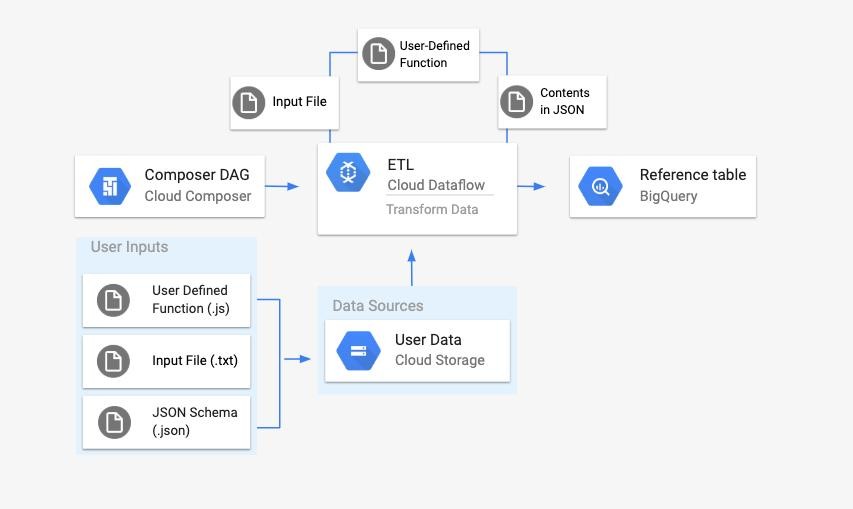 Copyright: Google
Data Governance:
Cloud Data Catalog: Catalogs and labels data assets for discovery and lineage tracking.
Dataflow: Orchestrates data pipelines with serverless processing.
Cloud Key Management Service (KMS): Manages encryption keys for data at rest and in transit.
Data Security:
Cloud Identity & Access Management (IAM): Controls access to GCP resources with granular permissions.
Cloud Security Command Center: Provides security insights and recommendations for GCP.
Cloud Data Loss Prevention (DLP): Identifies and protects sensitive data in GCP.
Privacy-Enhancing Technologies:
BigQuery Data Anonymization: Anonymizes data within BigQuery datasets for privacy-preserving analysis.
Vertex AI: Offers various AI-powered tools for data de-identification and privacy compliance.
Cloud Spanner: Provides globally distributed relational database with strong data consistency and access control.
ETL with Cloud Dataflow and Cloud Functions:Cloud Dataflow orchestrates serverless data pipelines using Apache Beam. Cloud Functions can be used for serverless data transformations within Cloud Dataflow jobs.
Example: A Cloud Dataflow pipeline extracts data from Cloud Storage, transforms it using Cloud Functions for anonymization, and loads it into BigQuery for analysis.
Choosing the right platform depends on specific needs, existing cloud infrastructure, data volume, budget, and desired control levels.
Code Snippets:
These examples provide a starting point for implementing data privacy solutions using Glue, Synapse, and Cloud Dataflow, along with Lambda and Cloud Functions for additional processing. Please use it with caution.
AWS Glue Job with Lambda for Data Masking:
Azure Synapse Data Flow with Masking:
GCP Cloud Dataflow with Cloud Functions for Anonymization:
Data Privacy in Healthcare and Finance using Python:
Here are examples of Python code snippets related to data privacy in healthcare insurance and financial institutions:
Data Masking in Healthcare:
Data Masking in Finance:
Pseudonymization in Healthcare:
Pseudonymization in Finance:
Differential Privacy in Healthcare:
Differential Privacy in Finance:
Privacy Tools and Libraries:
1. Data Masking:
- Healthcare: MedPy (https://pypi.org/project/MedPy/) - This library provides tools for anonymizing and de-identifying medical data, including functions for masking names, IDs, and diagnoses.
- Finance: pycryptodomex (https://pypi.org/project/pycryptodomex/) - This library contains various encryption algorithms and tools for secure data handling, including masking sensitive financial information.
2. Pseudonymization:
- Healthcare: pyhealth (https://pypi.org/project/pyhealth/0.0.6/) - This library offers functionalities for pseudonymizing healthcare data, including generating unique identifiers and managing mapping tables.
- Finance: tokenizer (https://pypi.org/project/tokenizer/) - This library provides functionalities for tokenizing sensitive data like account numbers and social security numbers, generating and managing temporary tokens.
3. Differential Privacy:
OpenDP (https://github.com/opendp) - OpenDP is a popular library for implementing differential privacy algorithms in Python.
PyDiffPriv (https://github.com/pq-yang/PGDiff) - PyDiffPriv offers another set of tools for differential privacy with various algorithms and utilities.
Healthcare: Healthcare Data GitHub Repository (https://github.com/topics/healthcare-data) - This repository contains sample datasets and code for anonymizing and analyzing healthcare data with differential privacy.
Finance: Fintech GitHub Repository (https://github.com/topics/fintech) This repository explores differential privacy techniques for analyzing financial data while preserving individual privacy.
Additional Resources, Credits and Guidelines:
Here are some additional resources such as GitHub links and useful documentation:
AWS:
Data Governance with Glue Data Catalog:
GitHub repository: https://github.com/topics/glue-catalog
Blog post: https://docs.aws.amazon.com/glue/latest/dg/catalog-and-crawler.html
Data Security with KMS and S3 Server-Side Encryption:
GitHub repository: https://github.com/aws/aws-sdk-java/blob/master/aws-java-sdk-sts/src/main/java/com/amazonaws/services/securitytoken/AWSSecurityTokenService.java
Documentation: https://docs.aws.amazon.com/cli/latest/reference/kms/encrypt.html
Privacy-Enhancing Technologies with Rekognition and Comprehend:
GitHub repository: https://github.com/aws-ia/
Blog post: https://docs.aws.amazon.com/rekognition/latest/dg/faces.html
Azure:
Data Governance with Azure Purview:GitHub repository: https://github.com/Azure/Purview-Samples
Documentation: https://learn.microsoft.com/en-us/purview/
Data Security with Azure Defender for SQL:GitHub repository: https://learn.microsoft.com/en-us/azure/azure-sql/database/azure-defender-for-sql?view=azuresql
Documentation: https://learn.microsoft.com/en-us/azure/azure-sql/database/azure-defender-for-sql?view=azuresql
Privacy-Enhancing Technologies with Azure Cognitive Services:GitHub repository: https://github.com/Azure-Samples/cognitive-services-speech-sdkBlog post: https://azure.microsoft.com/en-us/products/ai-services
GCP:
Data Governance with Cloud Data Catalog:GitHub repository: https://github.com/googleapis/gcp-metadata
Documentation: https://cloud.google.com/data-catalog/docs
Data Security with Cloud KMS and IAM:
GitHub repository: https://github.com/googleapis/python-kms
Documentation: https://cloud.google.com/security/products/security-key-management
Privacy-Enhancing Technologies with BigQuery Data Anonymization:GitHub repository: https://github.com/googleapis/python-bigquery
Documentation: https://google.github.io/starthinker/solution/anonymize/
GitHub repository for data privacy tools: https://github.com/4ndersonLin/awesome-cloud-security
Data Privacy Compliance Resources: https://www.pcisecuritystandards.org/
The Open Privacy Foundation: https://openprivacy.it/
National Institute of Standards and Technology (NIST) (https://www.nist.gov/cybersecurity) - NIST provides cybersecurity and privacy guidelines, including SP 800-53, which offers a comprehensive framework for securing information systems and data.
GDPR Guidance (https://gdpr.eu/) - Resources and guides on the General Data Protection Regulation (GDPR) to help organizations comply with European data protection laws.
HIPAA Security Rule (https://www.hhs.gov/hipaa/for-professionals/security/index.html) - The U.S. Department of Health & Human Services provides information on the Security Rule under the Health Insurance Portability and Accountability Act (HIPAA).
OneTrust (https://onetrust.com/) - OneTrust is a leading provider of trust intelligence software, offering solutions for data privacy, security, and compliance.
Privacera: Privacy platform specifically focused on data governance and access control.
BigID: Data discovery and classification platform for identifying and managing sensitive data.
IBM Security Guardium: GRC platform for managing compliance with various regulations, including data privacy.
McAfee Data Loss Prevention: DLP solution for preventing unauthorized data exfiltration.