Jean Buridan never wrote about a donkey. The 14th-century philosopher was working through Aristotle's question: can a rational will, faced with two options of exactly equal merit, move at all? Later critics sharpened it into the image that stuck — a donkey, equally hungry, at the exact midpoint between two identical bales of hay, starving for lack of a reason to prefer either.
It's the most accurate diagnosis available for a stalled decision. Not "too many options." Not "not enough data." A tie no amount of analysis can break — because the analysis produced it.
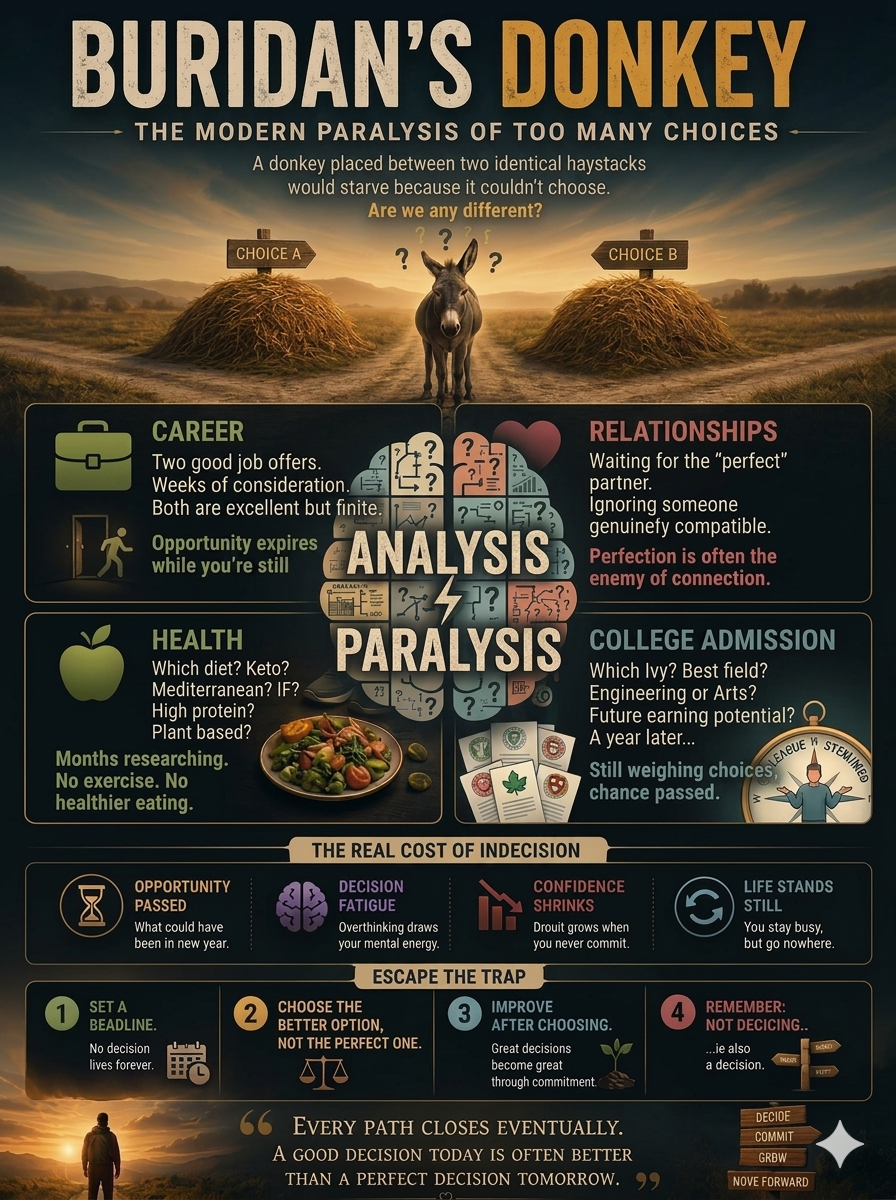
01The Donkey Never Left
Modern clothes, same shape:
Two offers, ~2% apart on paper.
Offer expiredSomeone compatible waits while the checklist grows.
Still waitingMonths picking a diet, zero days on one.
No changeA year weighing schools; the deposit deadline decided.
Calendar wonParalysis starts after the analysis, not before. The donkey had perfect information. It produced the tie, not the decision.
02Why More Data Doesn't Help
Herbert Simon called it satisficing: stop once an option clears "good enough." Optimizing is a calculator's job.
Some rooms punish satisficing. Enterprise architecture is one — nobody's grilled for a 40-slide comparison, only for skipping it. So the deck grows: cost, latency, ecosystem, hiring, lock-in. More axes doesn't mean more clarity. It means more ties.
Five axes, same tie, priced higher. Schwartz's paradox of choice found the same shape in individual psychology — past a point, more options buy more regret, not better decisions. The absence of a tiebreaker was always the constraint.
03What Frozen Decisions Cost
The spreadsheet feels like progress. It isn't — the price compounds, rarely itemized:
Opportunity Passed
What was on the table stopped being on the table while it was still being weighed.
Decision Fatigue
Every hour re-weighing the same two options draws down the budget the decision itself needs.
Confidence Shrinks
Doubt compounds the longer a choice stays open — each undecided day reads as evidence it's hard.
Life Stands Still
Staying busy re-analyzing isn't moving. The clock keeps running on everything the decision blocks.
04A Problem Older Than Any Answer
The frozen decision-maker isn't modern. Every tradition below reaches the same exit, from a different door:
Strip the theology: the paralysis was never about which option was better. It needed proof a genuine tie can't supply.
The donkey's real error isn't indecision. It's believing a decision needs a provably superior outcome before it can be made. Remove that requirement, and equidistance stops being a trap — it becomes irrelevant. If both haystacks are genuinely equal, the choice was never won on the merits. It's won on a deadline, a bias toward motion — the walking, not the destination.
05Escape the Trap
This is for the residue: the close calls that survive the spreadsheet, still unresolved.
Set a Deadline
An open date behaves like the donkey's midpoint: stable, going nowhere.
Choose Better, Not Perfect
Needing a third axis to separate two options confirms a tie, not a gap.
Improve After Choosing
Commitment and iteration make a decision great — not certainty beforehand.
Not Deciding Is Also Deciding
Deferral is a choice for the status quo, made by default.
The part worth sitting with
Every path closes eventually — the second offer, the other haystack, stop being available whether or not a choice was made. A good decision today outperforms a perfect one that arrives after the option is gone. The donkey didn't need a better haystack. It needed permission to walk toward one without a guarantee.
