Summary:
Terraform is the secret weapon for conquering the complexities of data infrastructure across diverse cloud platforms like AWS, GCP, and Azure. Whether you're building sprawling data lakes, intricate data vaults, or dynamic data meshes, Terraform streamlines your journey with:
Unified Control: Manage your entire data ecosystem with a single, consistent codebase.
Automated Efficiency: Automate infrastructure provisioning, configuration, and updates, freeing you from manual toil.
Cloud-Agnostic Freedom: Build and deploy your data infrastructure across any cloud platform without vendor lock-in.
Modular Magic: Break down your data architecture into reusable components for effortless scaling and collaboration.
Version Control Confidence: Track changes, roll back mistakes, and collaborate seamlessly with Terraform's infrastructure-as-code approach.
Terraform, is an infrastructure as code (IaC) tool, from HashiCorp and it can significantly streamline the provisioning and management of your data infrastructure across major cloud providers like AWS, GCP, and Azure. It lets you define your desired infrastructure state in configuration files, allowing Terraform to handle the heavy lifting of resource creation, configuration, and updates. This can be particularly beneficial when dealing with complex data architectures like data lakes, data vaults, and data meshes.
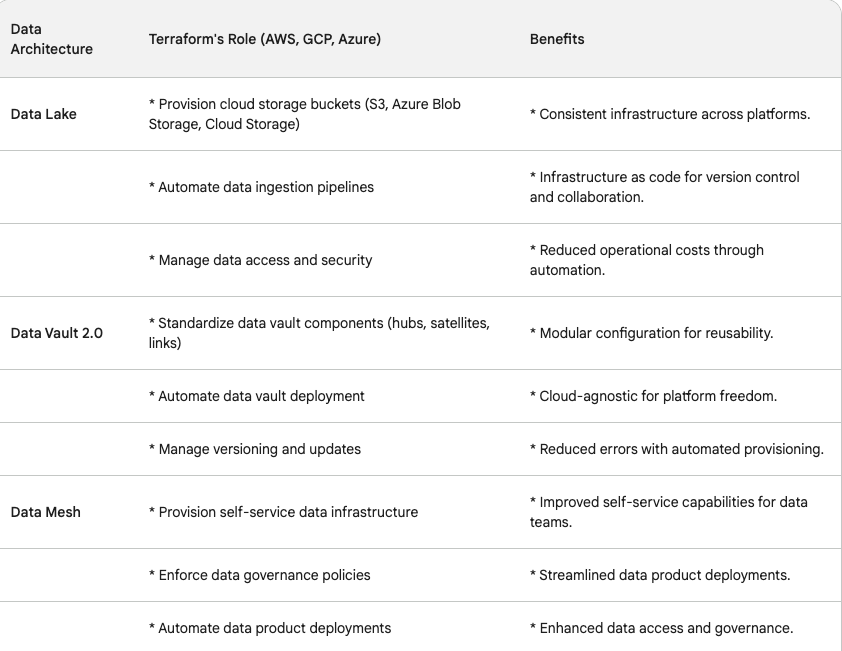 Terraform for Data Lakes, Vaults, and Meshes: A Tabular Comparison
Benefits across Cloud Providers:
Terraform's cloud-agnostic nature offers several advantages regardless of your chosen platform:
Consistent infrastructure management: Use the same Terraform codebase to manage your data infrastructure across AWS, GCP, and Azure, reducing complexity and maintenance overhead.
Infrastructure as code: Treat your data infrastructure as code, enabling version control, collaboration, and easier rollbacks compared to manual configuration.
Reduced operational costs: Automate repetitive tasks and infrastructure provisioning, freeing up IT resources for higher-level tasks and potentially reducing cloud provider costs.
Additional Advantages:
Modular configuration: Define reusable modules for common data infrastructure components.
Cloud-agnostic: Use the same Terraform code across AWS, GCP, and Azure with minimal changes.
Infrastructure as code: Track changes, collaborate easily, and rollback changes if needed.
Reduced errors: Automate infrastructure provisioning and configuration to minimize manual errors.
Use cases
1. Infrastructure Provisioning:
Terraform enables the definition and provisioning of infrastructure resources in a declarative manner. For data platforms utilizing cloud services such as Azure Synapse or AWS, Terraform can be employed to define the necessary infrastructure components, ensuring consistency across different environments.
Example:
2. Automated Deployment:
Terraform facilitates automated and repeatable deployments of infrastructure. This is crucial for deploying and updating data platforms consistently, reducing the likelihood of configuration errors and ensuring that the infrastructure is always aligned with the desired state.
Example:
3. Infrastructure as Code (IaC):
By adopting Terraform as an IaC tool, infrastructure configurations become version-controlled and can be stored alongside the application code. This practice ensures that changes to the infrastructure are tracked, documented, and can be rolled back if necessary.
4. Modularization:
Terraform allows for modularization of infrastructure code, promoting reusability and maintainability. This is particularly beneficial for data platforms that consist of various components, such as databases, storage, and analytics services.
Example:
5. Environment Consistency:
Data platforms often involve multiple environments, such as development, testing, and production. Terraform ensures that these environments are provisioned consistently, reducing the chances of environment-related issues.
6. Integration with CI/CD Pipelines:
Terraform can be seamlessly integrated into continuous integration/continuous deployment (CI/CD) pipelines. This allows for automated testing and deployment of infrastructure changes, promoting a streamlined and efficient development workflow.
7. Scaling Resources:
For data platforms requiring scalability, Terraform simplifies the process of scaling resources up or down based on demand. This is especially relevant for cloud-based data solutions that may need to handle varying workloads.
Example:
Here are key code examples for each architecture on cloud platforms:
1. AWS:
Data Lake on AWS S3:
Data Vault 2.0 on AWS Redshift:
Data Mesh on AWS Glue:
2. GCP:
Data Lake on GCP Cloud Storage:
Data Vault 2.0 on GCP BigQuery:
Data Mesh on GCP Data Catalog:
3. Azure:
Data Lake on Azure Storage:
Data Vault 2.0 on Azure Synapse Analytics:
Data Mesh on Azure Data Factory:
Additional resources:
Official Resources:
Terraform Documentation: The comprehensive guide to Terraform syntax, modules, providers, and best practices. It covers everything you need to know to get started and become a Terraform pro
Terraform Registry: Discover and share Terraform modules for common infrastructure configurations and patterns. You can find modules for data lakes, data vaults, data meshes, as well as countless other cloud services
Terraform by Example: Learn Terraform through practical examples and tutorials covering various cloud providers and infrastructure patterns
HashiCorp Learn: Enhance your Terraform skills with free online courses, interactive labs, and guided learning paths
Community Resources:
Terraform subreddit: Join the active Terraform community on Reddit to ask questions, share knowledge, and stay updated on the latest developments
Terraform blog: Stay informed about the latest Terraform announcements, releases, and insights from the HashiCorp team
Terraform podcast: Listen to expert discussions and interviews about Terraform best practices, use cases, and future directions:
Terraform Discord server: Chat with other Terraform users in real-time, get help with your projects, and participate in a friendly community:
Cloud-Specific Resources:
AWS Terraform Documentation: Dive deeper into using Terraform with AWS services. This documentation provides specific examples and best practices for managing your AWS infrastructure with Terraform:
GCP Terraform Documentation: Learn how to use Terraform with Google Cloud Platform services. This documentation covers various GCP resources and how to manage them effectively with Terraform:
Azure Terraform Documentation: Explore using Terraform with Microsoft Azure services. This documentation provides examples and guidance for managing your Azure infrastructure with Terraform
Other resources:
Github Repositories: