🌳 Ripen With Grace: Why Every Child Deserves Their Own Season 🌳
— A lesson in patience from mango trees, cucumbers, and mantras
🍃 The Modern Problem: Comparison Masquerading as Motivation
In today’s achievement-obsessed world, children are quietly collapsing under the weight of comparison.
“Why am I not scoring like her?”
“He’s already coding at 12, what am I doing?”
“Everyone else seems to be winning…”
Parents mean well. Schools mean well. But in trying to mold excellence, we often forget to honor uniqueness.
This isn’t just a modern crisis. It’s a timeless tension—between being and becoming, between nature and nurture. And both nature (the mango tree) and scripture (the Bhagavad Gita) hold the answers.
🥭 The Mango Tree and the Myth of Uniform Ripening
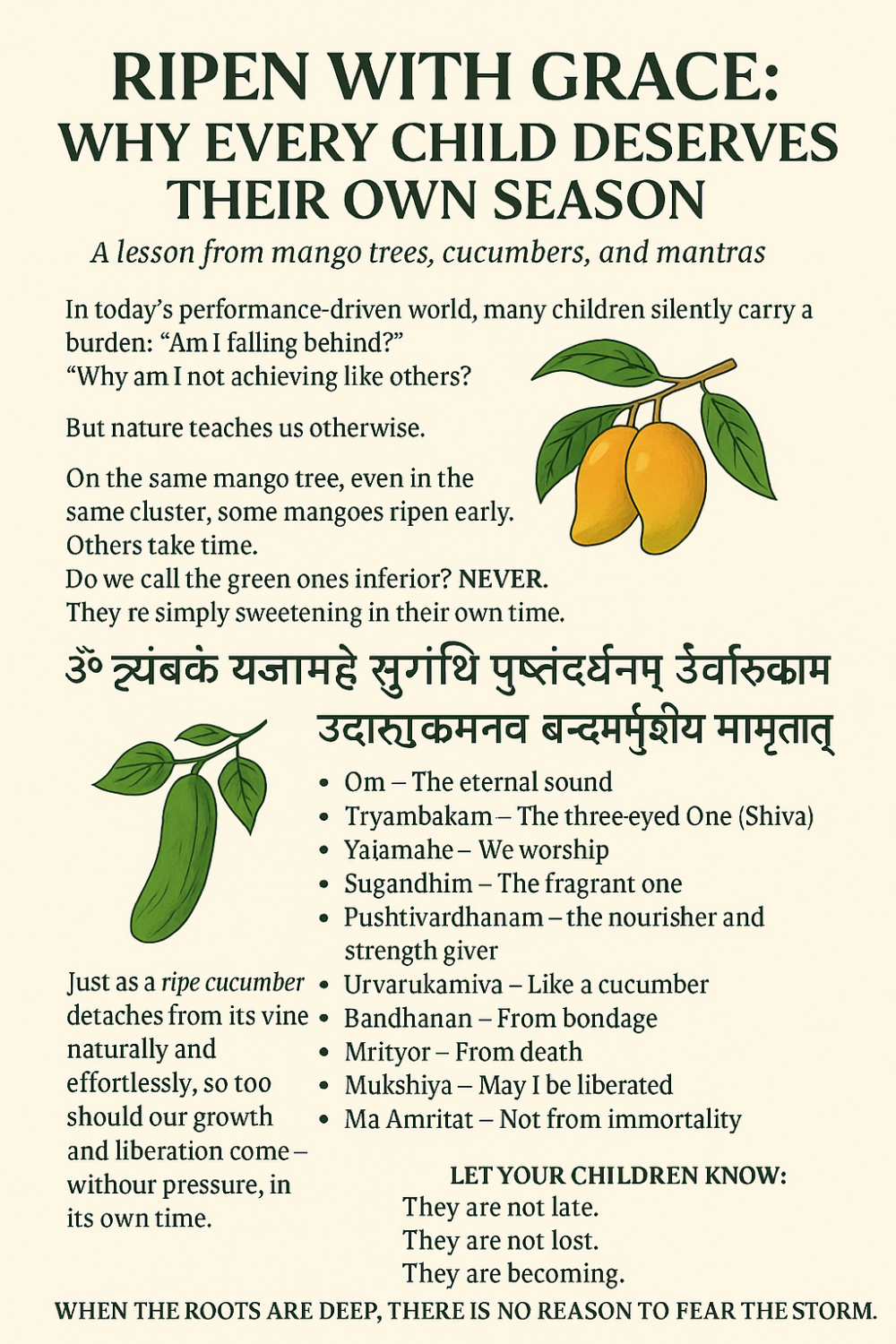
On a single mango tree, even on the same branch, some fruits ripen early, others later. Are the green mangoes failures? Are they inferior?
Not at all.
Each mango follows its own rhythm. Its ripening depends on sunlight, soil, inner chemistry, and divine timing. No amount of shouting, comparing, or rushing can sweeten it prematurely.
Likewise, every child has a unique internal clock. Some shine early. Some bloom in their twenties. Some awaken at forty. And all are valid.
🥒 Enter the Cucumber: A Mantra’s Message on Timing
Our sages understood this truth long ago and embedded it in one of the most sacred Vedic verses — the Mahāmṛtyunjaya Mantra, also called the Tryambakam Sloka:
🕉️ "Om Tryambakam Yajamahe Sugandhim Pushtivardhanam Urvarukamiva Bandhanan Mrityor Mukshiya Maamritat"
Let’s pause and understand this — word by word:
Om (ॐ): The primal sound; the eternal vibration of life
Tryambakam (त्र्यंबकम्): The three-eyed One — Lord Shiva, who sees past, present, and future
Yajamahe (यजामहे): We worship, we surrender
Sugandhim (सुगंधिम्): The fragrant one — whose presence is uplifting and pure
Pushtivardhanam (पुष्टिवर्धनम्): The nourisher, the one who enhances fullness, well-being, and strength
Urvarukamiva (उर्वारुकमिव): Like a cucumber…
Bandhanan (बन्धनान्): From bondage — attachments, fears, limiting beliefs
Mrityor (मृत्योर्): From death and decay
Mukshiya (मुक्षीय): May I be liberated
Ma (मा): Not
Amritat (अमृतात्): From immortality — the eternal Self
💬 The symbolism is profound: Just as a cucumber (urvaruka) detaches from its vine naturally and effortlessly when it is ripe, may we — and our children — be freed from the binds of pressure, fear, and comparison when the time is right.
Growth should not be forced. Liberation should not be rushed.
🌱 When the Roots Are Deep, the Wind Doesn’t Matter
In moments of fear and self-doubt, we must remember this simple truth:
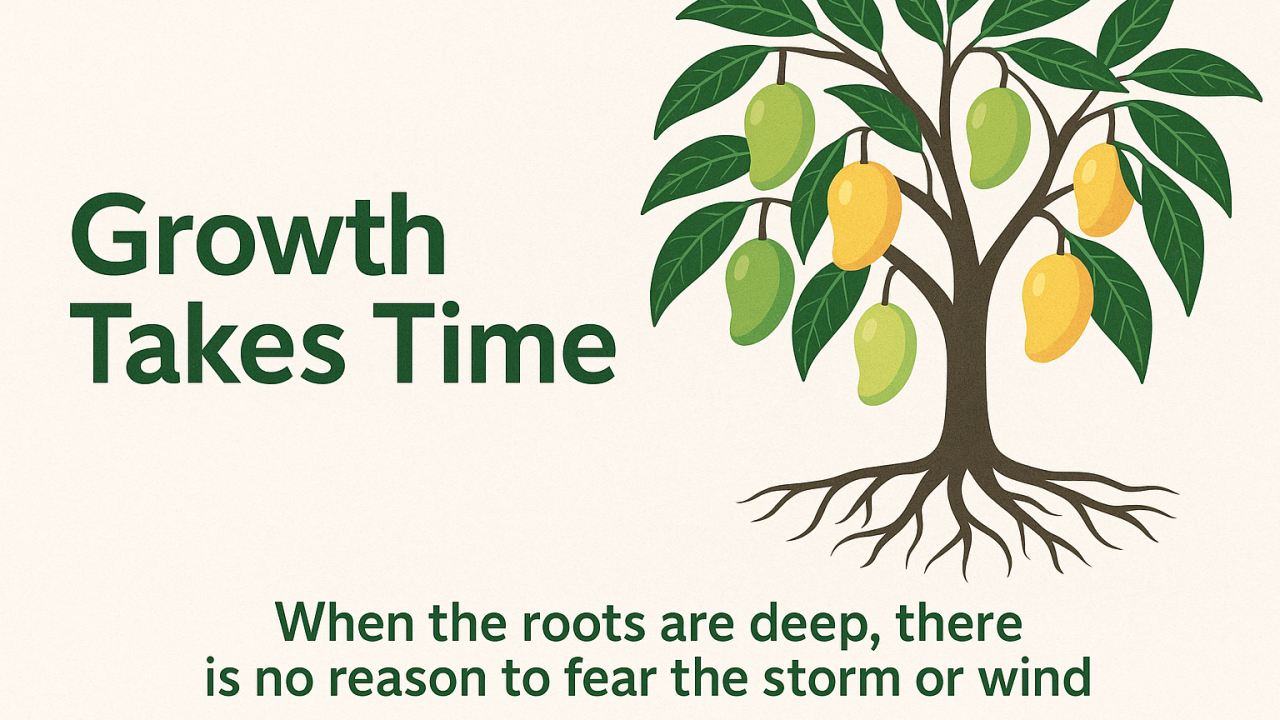
“When the roots are deep, there is no reason to fear the storm.”
Children who are anchored in love, acceptance, and inner strength will not be shaken by the gusts of peer pressure or delayed success.
Let them deepen their roots — in values, in self-belief, in the slow joy of becoming.
📖 The Bhagavad Gita and Inner Psychology – Verses 3.34 to 3.36
In Chapter 3 of the Bhagavad Gita, Lord Krishna delves into the complex dance between inherited nature, free will, and emotional discipline.
🔹 3.34 – Rāga and Dveṣa
“Likes and dislikes dwell in the senses toward their objects. One should not come under their sway, for they are obstacles.”
Rāga (attraction) and Dveṣa (repulsion) are emotional reflexes — not sins. But acting on them impulsively leads to bondage.
We may like praise and dislike failure.
But chasing one and avoiding the other is slavery.
These forces must be observed, not obeyed.
🔹 3.35 – Swadharma vs Paradharma
“Better is one's own duty (swadharma) performed imperfectly, than another’s (paradharma) done perfectly. Performing another’s duty brings fear and ruin.”
This verse isn’t about nationalism or conservatism. It’s about authenticity.
Swadharma = Your natural role, rooted in svabhava (inner nature)
Paradharma = Someone else’s script, no matter how glamorous
A child forced into engineering when her heart beats for art is a spiritual casualty, even if she wins awards.
🔑 Doing your dharma clumsily is far better than doing someone else’s beautifully.
🔹 3.36 – The Psychology of Sin
Arjuna asks: “Why do we do wrong even when we know it’s wrong?” Krishna replies: Desire and anger, arising from raga-dvesha, are the culprits.
They hijack the mind, cloud the buddhi (intellect), and derail action.
Thus begins the internal battle:
Manas (mind): reactive, emotional
Buddhi (intellect): discerning, ethical
Spiritual maturity = Letting Buddhi drive the chariot.
🧭 Dharma Shastras + Self-Effort = Navigating Growth
Impulse is automatic. Action is a choice.
To help buddhi prevail, Krishna offers two pillars:
Dharma Shastras – Ethical scriptures that define what is right
Prayatna – Self-effort to live that right
Regular study, reflection, and personal discipline train us to pause between urge and action.
Like mangoes needing sun, patience, and rain— we too need clarity, effort, and grace.
💡 How to Apply This Today
🎯 For Children
Don’t force your child to “keep up.”
Recognize their unique svabhava.
Support their swadharma, not your expectations.
🧘♀️ For Adults
Notice your rāga and dveṣa patterns.
Choose authenticity over applause.
Read Dharma Shastras—not for rules, but for reflection.
Let your intellect lead. Let your ripening be slow, sacred, and yours.
💛 What Can We Do as Parents, Teachers, and Mentors?
✨ Stop comparing timelines.
✨ Celebrate effort, not just outcomes.
✨ Quote nature, not just report cards.
✨ Tell them, often and clearly: “You are enough.”
✨ Remind them that they are not late — they are just becoming.
🪴 Final Thought: Let Ripening Be Sacred
“Let every child ripen in peace and its pace.”
Don’t tug at the fruit. Don’t cut the cucumber before it’s ready. Don’t uproot the tree to speed up the blossom.
When the roots are deep, there is no need to fear the wind. And when the Self is anchored, there’s no need to fear someone else’s timeline.
#ParentingWithPatience #LetThemRipen #BhagavadGita #TryambakamMantra #Swadharma #NoComparison #RootsBeforeFruits #SpiritualPsychology #AncientWisdomModernParenting #RightAction #RipenWithGrace #Urvarukamiva #EveryChildIsEnough