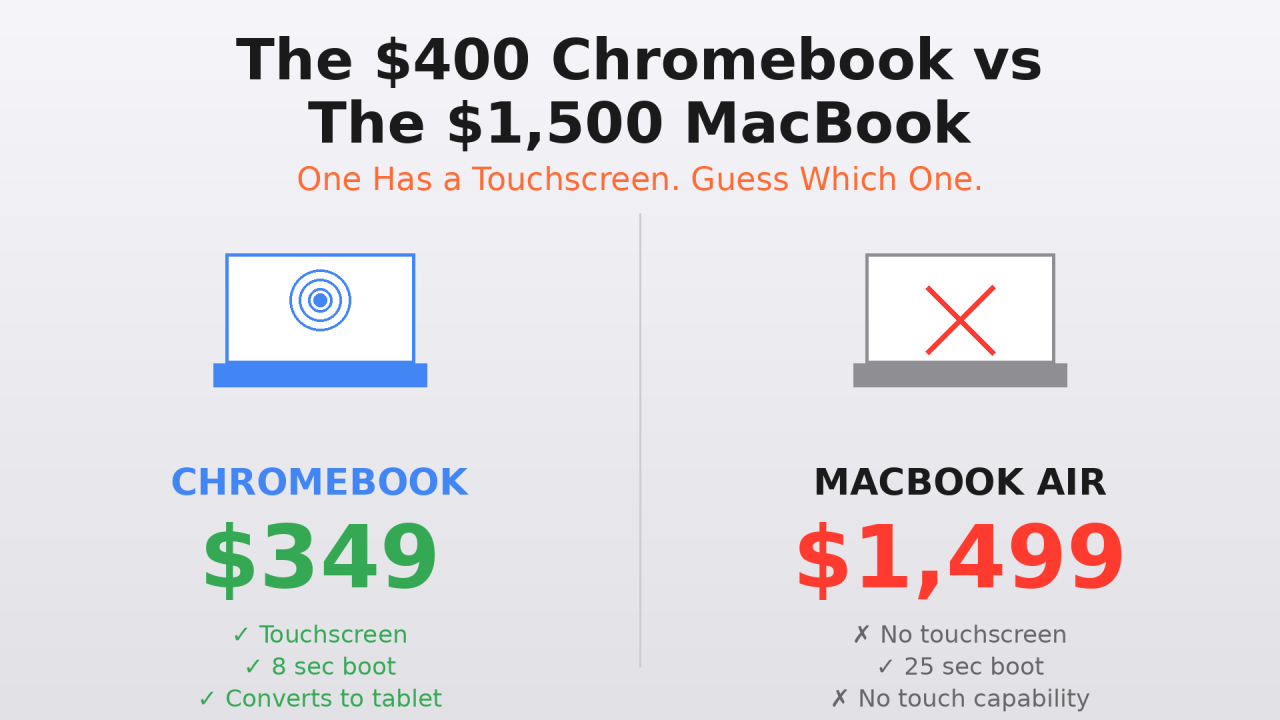
Let's Start With the Embarrassing Part
A $349 Chromebook has a touchscreen.
A $1,499 MacBook Air does not.
Apple's explanation? "Vertical touchscreens cause arm fatigue."
You know what else causes fatigue? Paying $1,500 for a laptop that pretends it's still 2010.
Meanwhile, Apple sells an iPad Pro with Magic Keyboard for $1,299—a device whose entire job description is "touch me."
This isn't ergonomics. This is product line protection theater.
The same disease that killed BlackBerry (refusing touchscreens) and Nokia (denying apps mattered) is now infecting Apple.
Hard truth: Touchscreens are standard on every laptop brand except the most expensive one. That's not design philosophy. That's organizational paralysis.
Hard Fact #1: ChromeOS Doesn't Suck Anymore—The App Store Does
Modern #ChromeOS is fast, efficient, and boringly reliable:
Boots in 8 seconds
Updates without interrupting your work
Never gets infected with malware
Runs 15+ hours on a charge
The fatal flaw? Android apps on ChromeOS are a catastrophe.
You've experienced this firsthand:
Sonos, Inc. crashes on repeat
Apps aren't optimized for laptop screens
Performance is wildly inconsistent
The Play Store feels abandoned
This isn't a technical limitation. This is Google being Google—too distracted building 47 messaging apps nobody wants while the core product rots.
But here's what matters: The app problem is fixable. The hardware problem Apple created by refusing touchscreens? That's stubbornness, not strategy.
Hard Fact #2: 80% of People Pay MacBook Prices for Chromebook Workflows
Let's audit what most people actually do on their laptop:
Gmail
Google Docs
Zoom/Meet
Slack
Notion
Spotify
YouTube
Web browsing
All of this runs in Chrome.
You don't need a $1,499 M4 or M5-powered spaceship to check email. You're paying Ferrari prices to drive in a school zone.
The dirty secret Apple hopes you never realize: Most MacBook buyers are just running Chrome with extra steps.
Yes, hard core video editors and developers need MacBooks. Everyone else is paying for features they'll never use.
Hard Fact #3: Apple Survives on Ecosystem Addiction, Not Innovation
People don't buy MacBooks because macOS is revolutionary.
They buy because:
Their iPhone unlocks their Mac
Their AirPods switch seamlessly between devices
Their Apple Watch requires an iPhone that "prefers" a Mac
iMessage only works in the Apple universe
Leaving means everything stops talking to everything
It's not an ecosystem. It's a digital hostage situation.
But ecosystems aren't immortal:
Nokia had one (Symbian)
BlackBerry had one (BBM)
Internet Explorer had one (Windows integration)
One compelling alternative can collapse the entire tower.
Hard Fact #4: Google Has Every Piece to Destroy Apple—But No Spine
Google's hardware graveyard:
Pixelbook (killed)
Pixel Slate (killed)
Nexus Q (killed instantly)
Google+ (killed after forcing it on everyone)
Stadia (killed after people bought controllers)
Inbox (killed even though it was better than Gmail)
This isn't lack of talent. It's lack of commitment.
Google has:
✅ Tensor chips (Pixel phones prove they work)
✅ ChromeOS (60% of US education market)
✅ Chrome browser (70% market share)
✅ Workspace dominance (billions of users)
✅ Gemini AI (ahead of Apple Intelligence)
✅ Pixel phones (finally competitive)
✅ Pixel Watch (decent)
✅ Nest ecosystem (smart home leader)
They have every ingredient. They just cook like a chef who keeps abandoning recipes halfway through.
The Product That Would Give Apple Nightmares (That Google Will Never Build)
The Pixelbook Ultra
Hardware:
Tensor G4 chip (optimized for ChromeOS + Gemini)
16GB RAM standard (32GB option)
512GB-2TB NVMe SSD
3:2 touchscreen (better for documents than 16:10)
Convertible 2-in-1 design
20+ hour battery life
Premium aluminum unibody
Best-in-class keyboard and trackpad
Price: $1,099 (undercut MacBook Air by $400)
Software:
ChromeOS (obviously)
Kill Android app support entirely (it's broken and unfixable)
Make Linux apps first-class citizens (VSCode, GIMP, Blender—install with one click)
Curate a ChromeOS-native app ecosystem (pay developers to build quality apps)
ChromeOS Certified Program (strict quality standards—no crashes, no jank)
Gemini built into everything (search files, summarize emails, draft documents)
Ecosystem Integration:
Instant unlock with Pixel phone in pocket
Universal clipboard (copy on phone, paste on Chromebook—and have it actually work)
Full Android phone mirroring (like Samsung DeX but good)
Seamless hotspot (Chromebook auto-connects to Pixel's data)
Cross-device notifications that don't feel like an afterthought
The pitch: "Everything you actually do on a MacBook. $400 less. With a touchscreen. And AI that actually works."
Why This Would Work (Numbers Don't Lie)
The Switchable Market
Students graduating from school Chromebooks: 10M/year
Currently buying budget Windows laptops or iPads
Already know ChromeOS
Price-sensitive
Small business Google Workspace users: 50M potential buyers
Already live in Chrome/Drive/Docs
Don't need Final Cut or Xcode
Paying for MacBooks they don't need
Android phone owners with no ecosystem lock-in: 1B+ globally
Not invested in Apple ecosystem
Open to Google integration
Value-conscious
Revenue potential at $1,099 average: $20-30B annually
Investment required: $3-5B over 3 years (R&D, marketing, app incentives)
Break-even timeline: 2-3 years
After that: Pure profit center and ecosystem expansion
This isn't fantasy. This is basic business math.
Hard Fact #5: A Whole Generation Grew Up on Touchscreen Chromebooks
Kids in school today don't know a world without:
Touchscreens as standard
Stylus support for notes
Instant-wake laptops
Chrome as the operating system of life
Google Docs as the only word processor
They won't accept laptops without touch.
And they don't worship MacBooks the way millennials do. To them, a Mac is just "that expensive laptop without a touchscreen."
Apple is betting on ecosystem inertia in a generation that has none.
The Tables That Tell the Real Story
Table 1: What You Pay For vs. What You Get
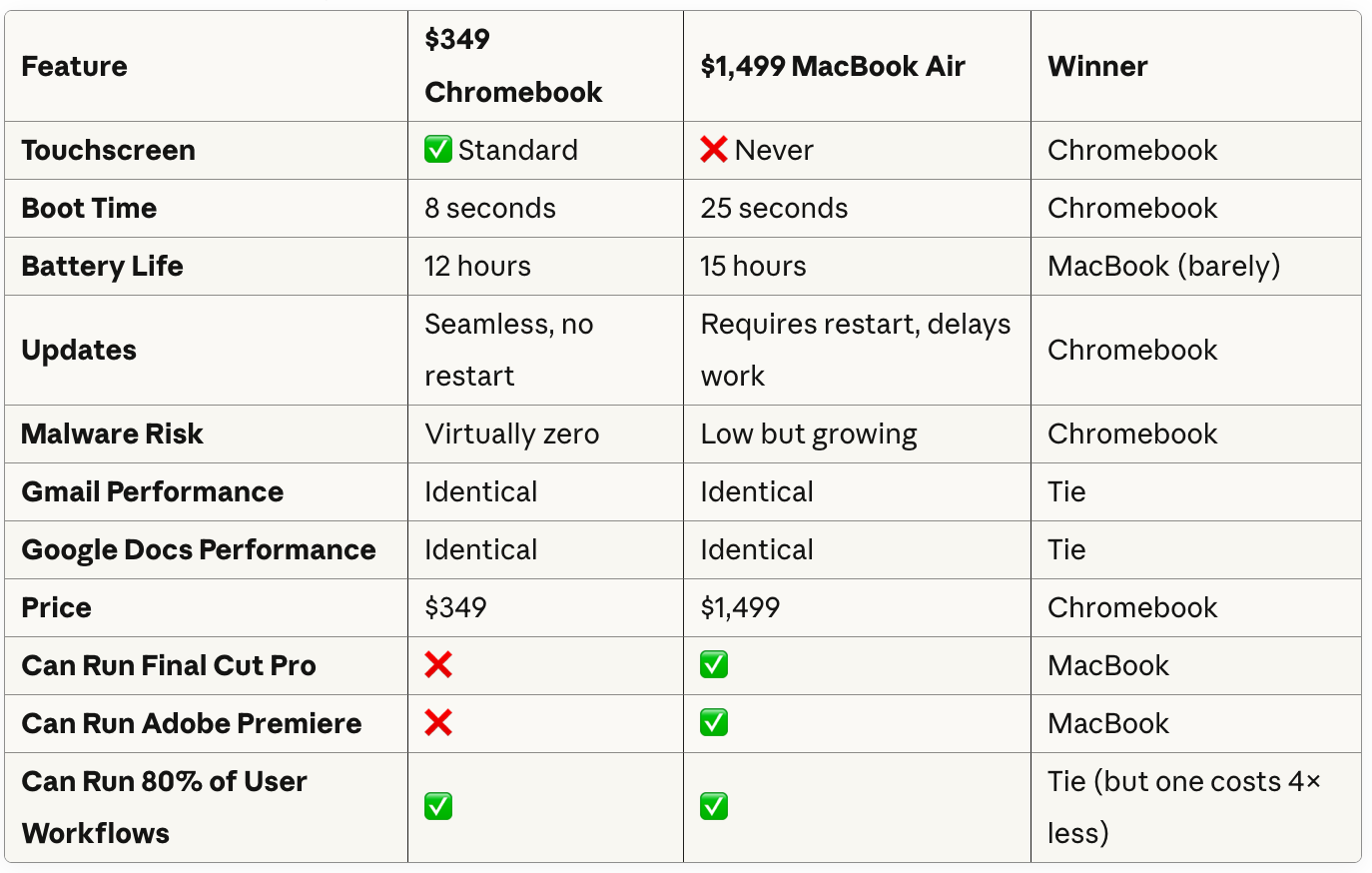
Reality check: For most people, you're paying $1,150 extra for the Apple logo and ecosystem lock-in.
Table 2: OS Architecture (The Stuff That Actually Matters)
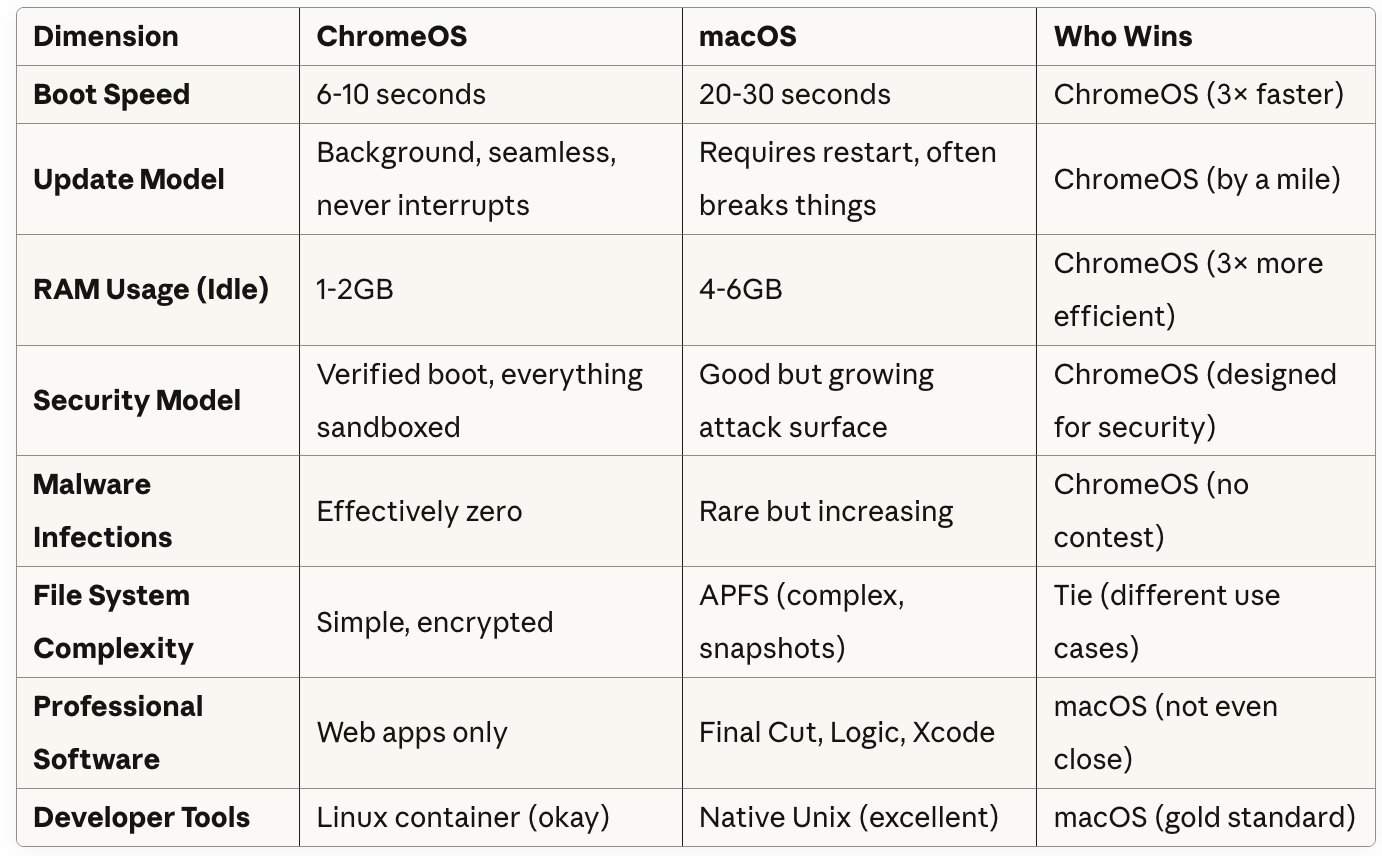
Bottom line: ChromeOS wins on speed, security, and efficiency. macOS wins on professional software. For everyone else, ChromeOS is over-qualified.
Table 3: The App Ecosystem Disaster
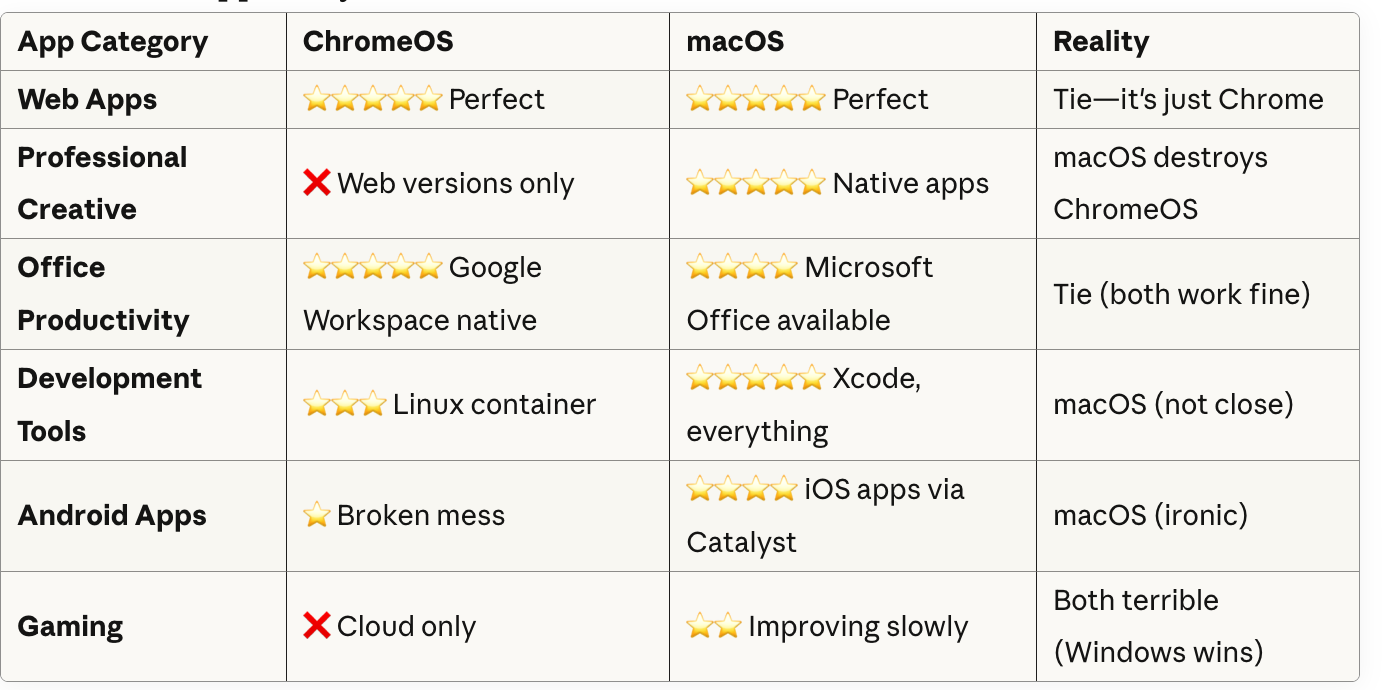
The existential problem: ChromeOS can't run professional software. This is the gap Google must solve or accept permanent niche status.
The fixable problem: Android apps on ChromeOS are garbage. Google should delete this feature entirely and start over.
Table 4: Ecosystem Integration (Where Apple Actually Wins)
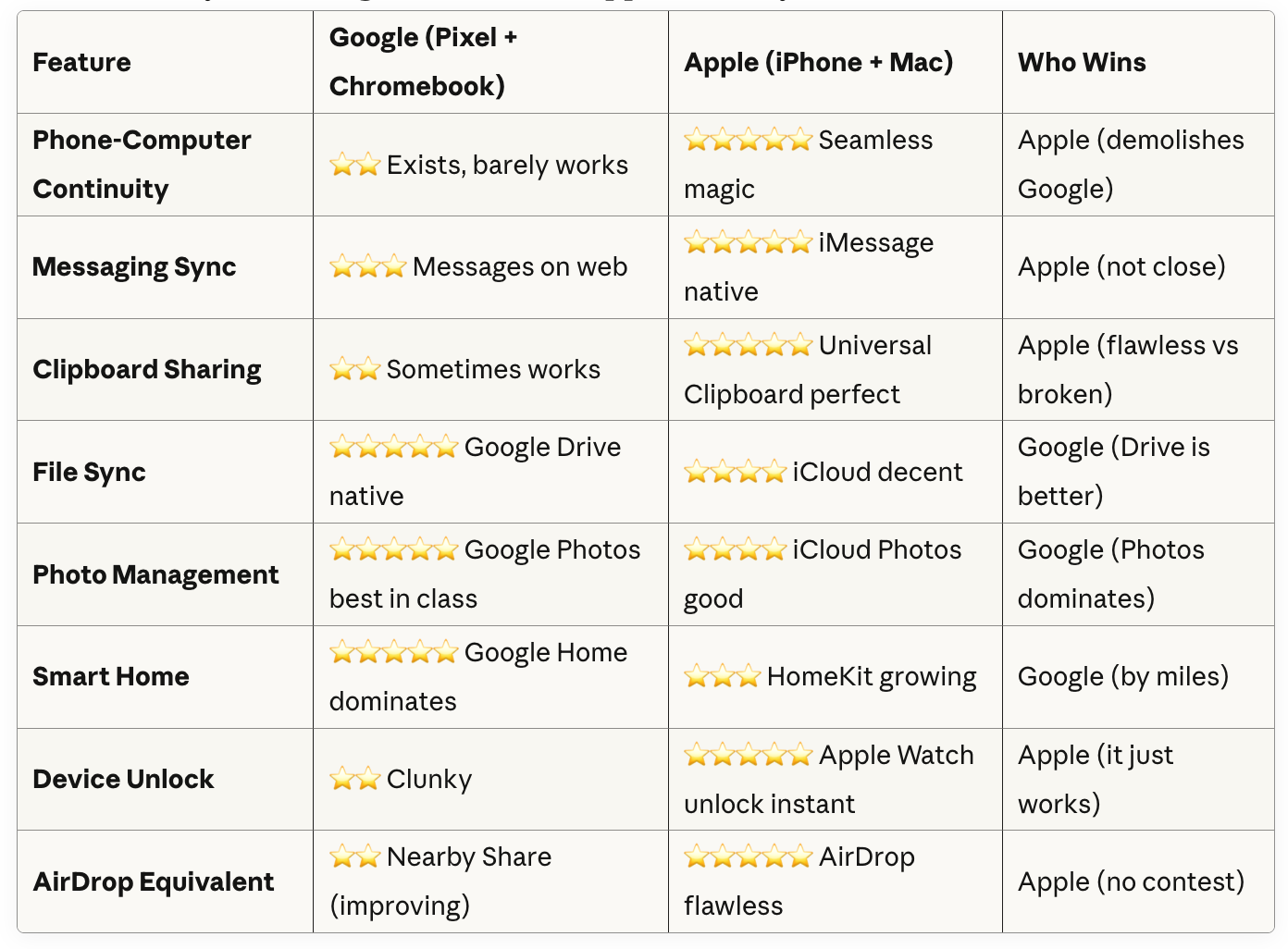
Brutal truth: Apple's device-to-device integration is in another universe. Google has the cloud services but none of the magic that makes devices feel connected.
This is fixable—but requires Google to care.
Table 5: AI Capabilities (Google's Wasted Advantage)
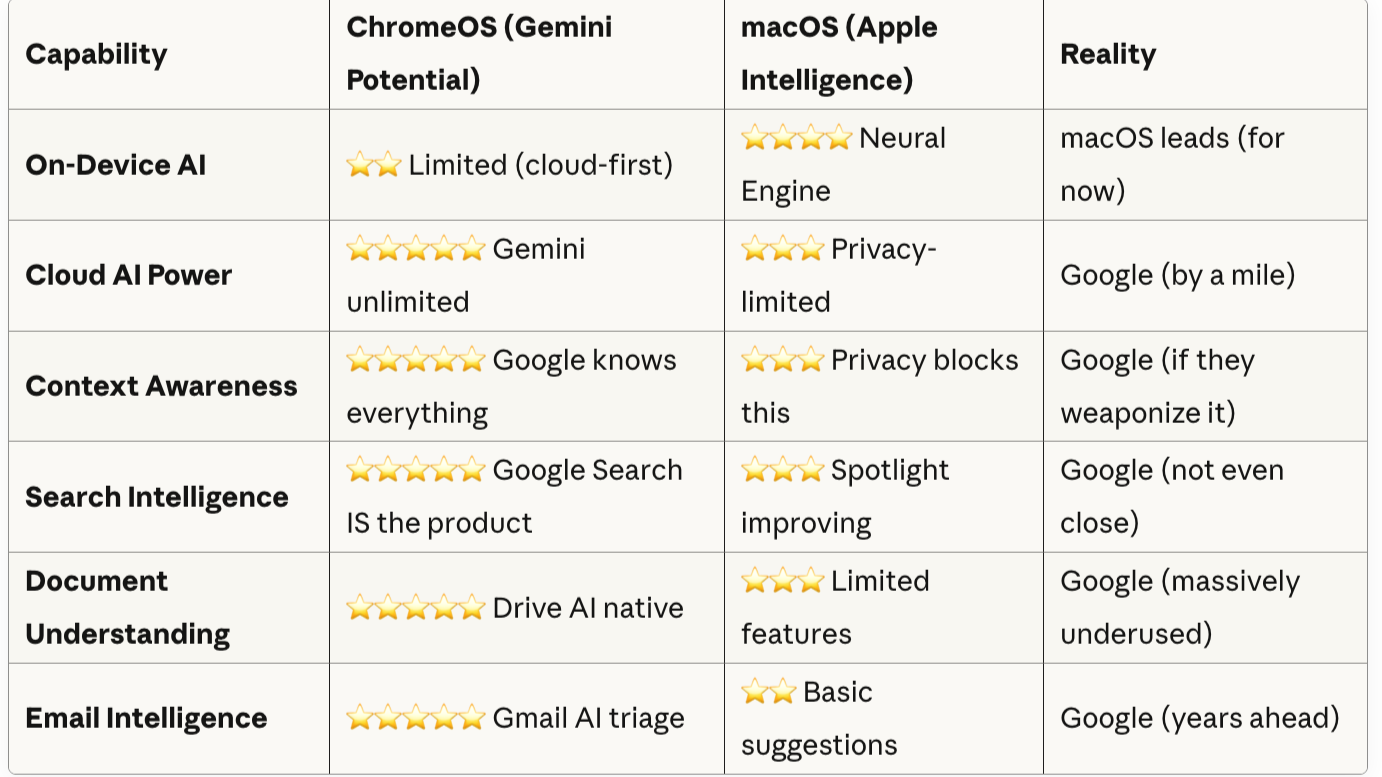
This is Google's nuclear option: They have Gemini, DeepMind, Search, Gmail, Drive, and complete user context. They're just not weaponizing it in ChromeOS.
Apple Intelligence is playing catch-up. Google is asleep at the wheel.
Table 6: Security (Where ChromeOS Quietly Dominates)
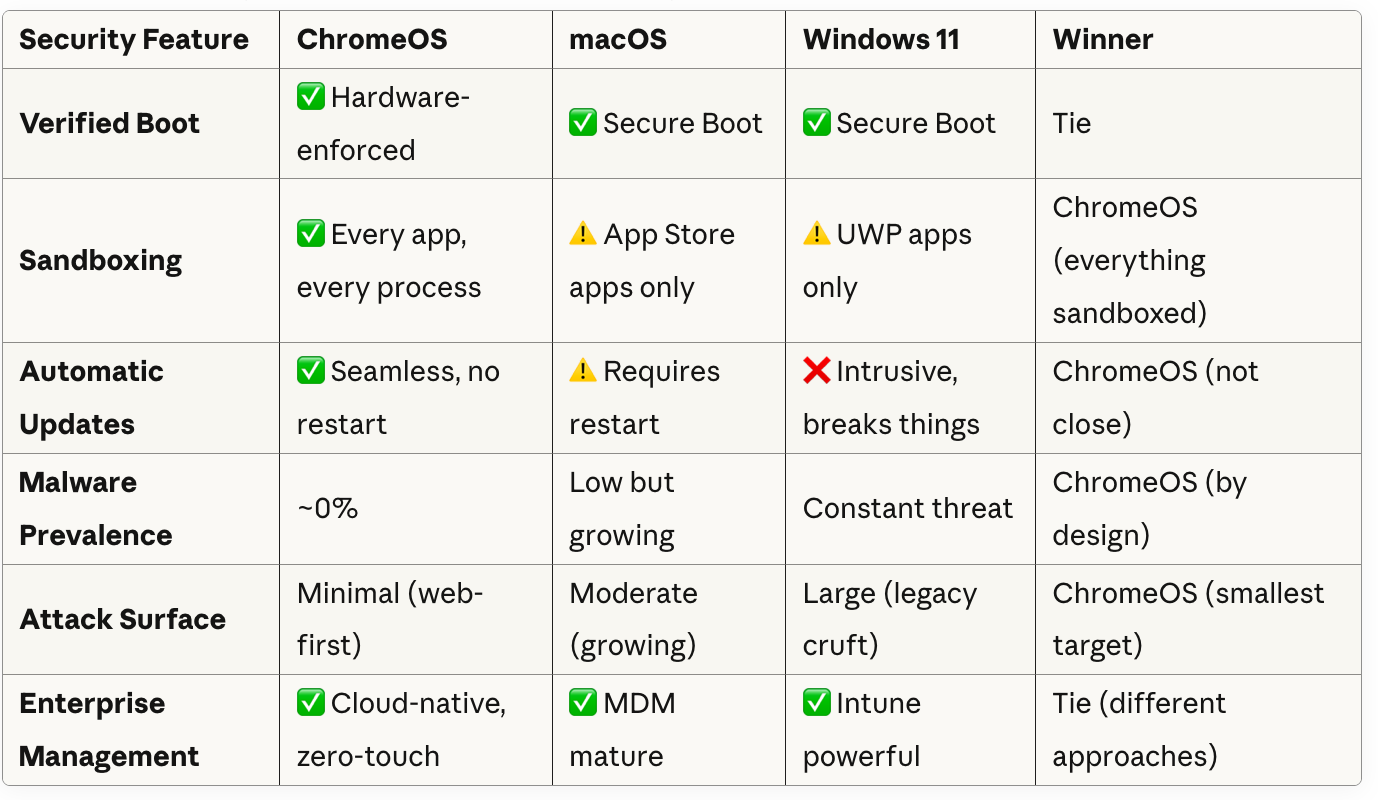
Security winner: ChromeOS isn't just more secure—it's secure by architecture. You can't get infected with what can't run.
Table 7: Total Cost of Ownership (5 Years, Real Numbers)
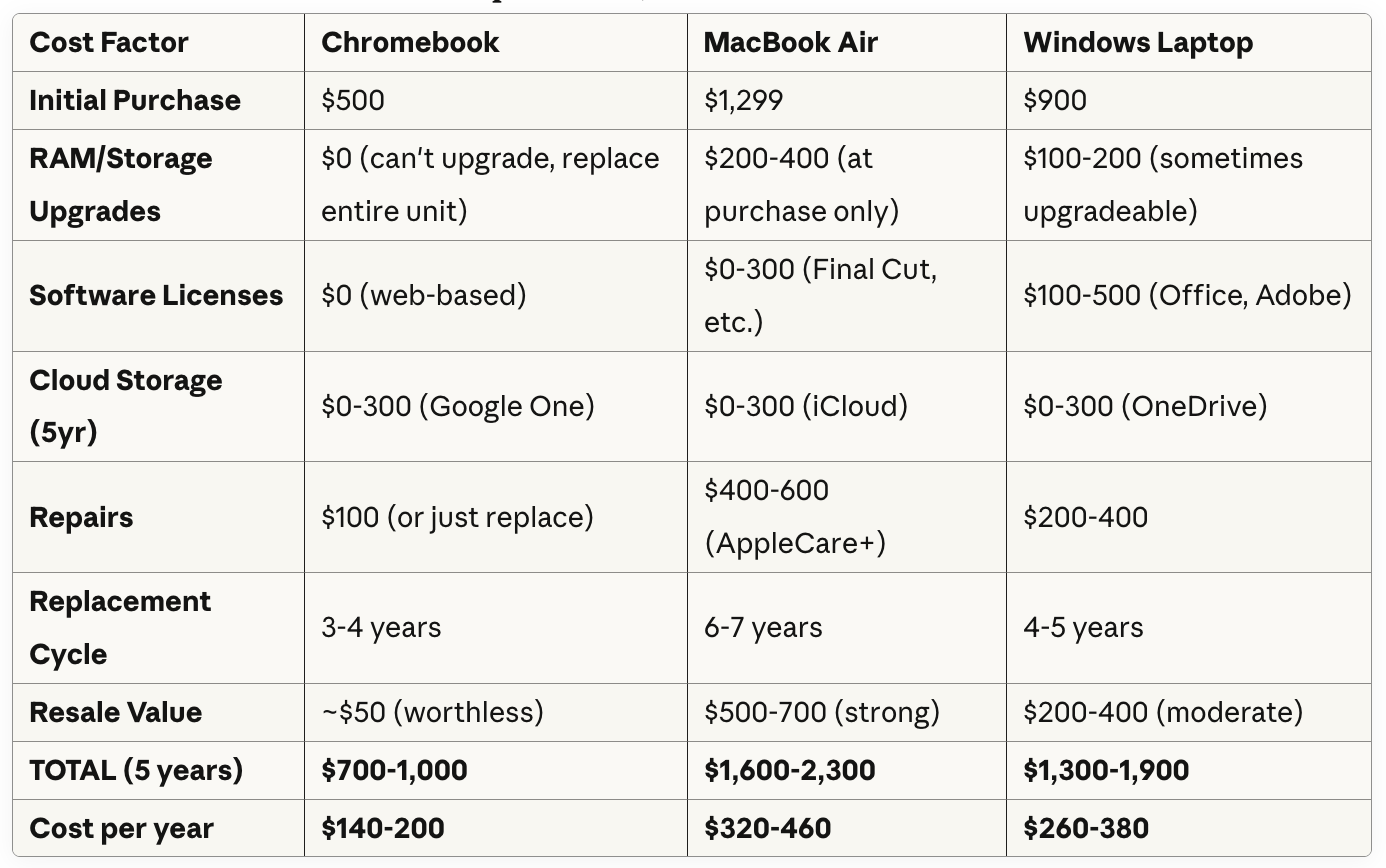
Reality: Chromebooks are 60% cheaper over their lifetime. MacBooks hold resale value but require 2-3× upfront capital. Windows is the middle ground.
Table 8: What You Should Actually Buy (No BS Guide)
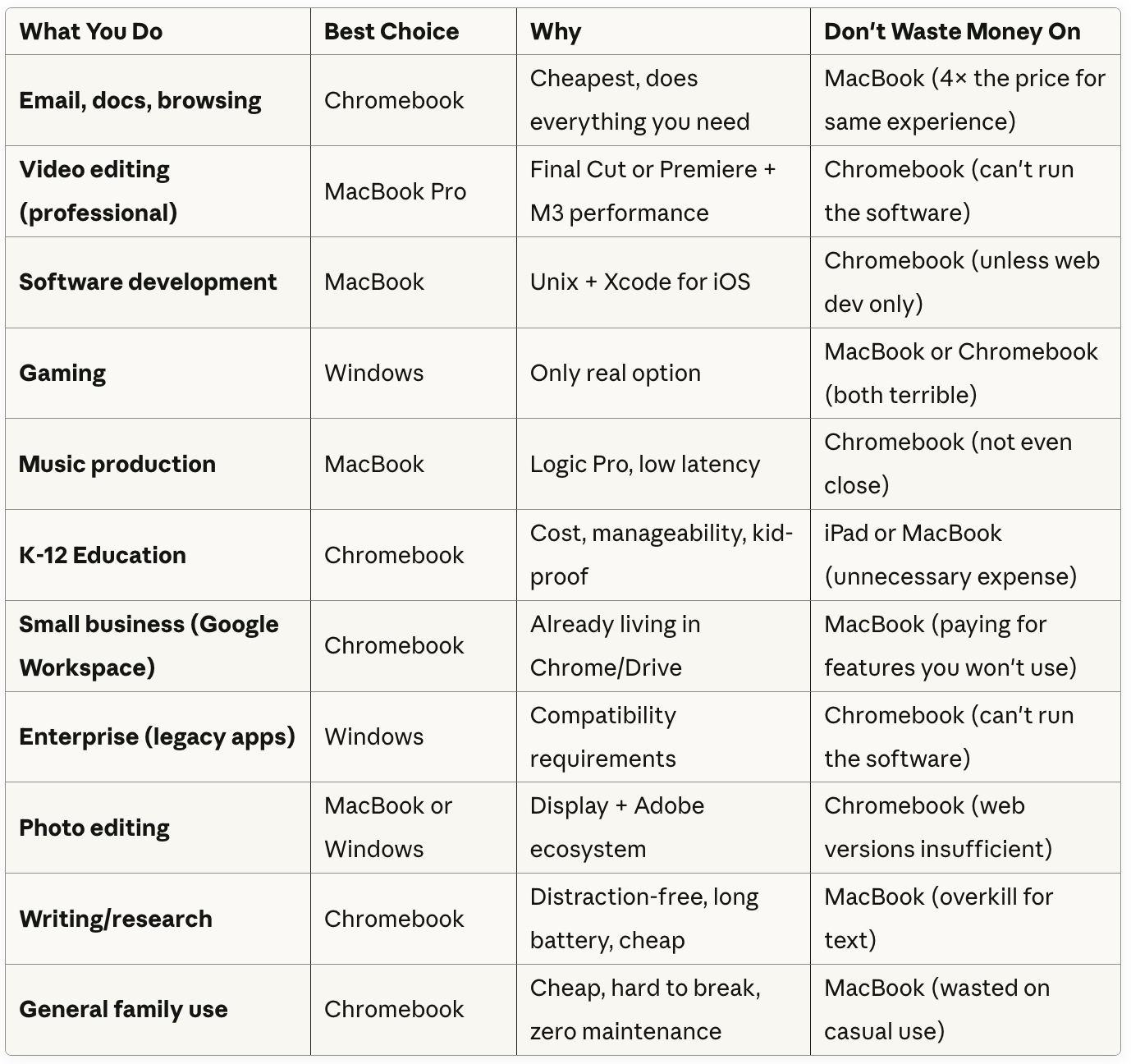
The pattern: If your job title includes "editor," "producer," or "developer," buy a MacBook. Everyone else should question why they're paying MacBook prices.
Why Apple Should Be Worried (But Isn't)
The Switching Cost Illusion
Apple thinks ecosystem lock-in is permanent.
But look closer:
Most people's "ecosystem" is just an iPhone (Watch and AirPods are optional)
Google services work better on Android (Gmail, Maps, Photos, Drive sync faster)
Professional apps are increasingly web-based (Figma, Notion, Linear, Airtable)
The lock-in is psychological, not technical.
If Google builds a Chromebook that's:
Genuinely premium ($1,099 but feels like $1,500)
$400 cheaper than MacBook Air
Has a touchscreen (because it's 2025, not 2010)
Integrates seamlessly with Pixel phones
Has Gemini AI that actually solves problems
...the switching cost looks reasonable.
The Generational Cliff
Gen Z and Gen Alpha grew up on Chromebooks in school.
They don't have MacBook nostalgia. They don't worship Apple's design language. They expect touchscreens. They live in Chrome.
To them, a MacBook is just an expensive laptop that can't do what the cheap one at school could.
Apple is selling to millennials' memories. But memories don't create new customers.
The M-Series Chip Moat Is Shrinking
Yes, M3-M5 chips are impressive.
But:
Most users will never stress an M3-M5 (you're not rendering 8K video)
Qualcomm Snapdragon X Elite is competitive (ARM efficiency, getting faster)
MediaTek and others are catching up (for 90% of workloads, indistinguishable)
Software optimization beats raw power (ChromeOS needs 1/4 the RAM of macOS)
The chip advantage is real but diminishing as the ARM race heats up.
What Apple Won't Do (And That's the Opening)
Apple will not:
❌ Add touchscreens (protecting iPad sales)
❌ Lower prices meaningfully (margin preservation über alles)
❌ Open the ecosystem (lock-in is the business model)
❌ Stop the upgrade price gouging ($200 for 8GB more RAM is insulting)
❌ Prioritize AI over privacy theater (Gemini > Apple Intelligence for now)
These are strategic choices, not technical limitations.
And they're all vulnerabilities.
What Google Won't Do (And That's the Tragedy)
Google will not:
❌ Commit to premium hardware (every Pixelbook was half-hearted)
❌ Fix the Android app disaster (too distracted by new projects)
❌ Invest $5B over 5 years (Wall Street won't reward it)
❌ Stop killing products (graveyard too big to ignore)
❌ Make ecosystem integration work (requires caring about details)
Google has the talent. They lack the discipline.
Apple is complacent. Google is distracted. And consumers pay the price.
The Bottom Line (No Hype, Just Math)
Can Apple Survive?
Yes. They're printing money and will continue to.
Should Apple Be Worried?
Yes. But not about current Chromebooks.
About the Chromebook Google refuses to build.
Will Google Ever Build It?
Probably not.
They'll make another compromised $600 device that tries to be everything and excels at nothing.
They'll kill it in 3 years.
And the cycle continues.
What This Means for You
If you're a professional (editor, developer, producer): Buy the MacBook. You need the software.
If you're everyone else: Ask yourself what you actually do on your laptop. Then ask if you're paying $1,500 for features you'll never use.
A $400 Chromebook with a touchscreen does what an $1,500 MacBook Air won't.
That's not a feature gap.
That's a reality check wrapped in aluminum.
The Article Apple Doesn't Want You to Share
The moment Google stops behaving like a hobbyist side-project factory and commits to premium hardware with ecosystem integration and AI that works, Apple has to compete on merit instead of lock-in.
Until then, we live in this absurd timeline where:
The cheaper laptop does more
The expensive laptop costs 4× as much
And neither company cares enough to fix it
That's not innovation.
That's complacency dressed up as brand loyalty.
The $400 touchscreen Chromebook is a mirror.
It shows what Apple refuses to build.
And what Google refuses to perfect.
Somewhere between those two failures is the laptop everyone actually wants.
But neither company will build it.
Because one is too arrogant.
And the other can't commit to anything.
Welcome to 2025(6).
Where your cheapest option has features your most expensive option refuses to add.
And where the only winners are the shareholders betting you won't notice.