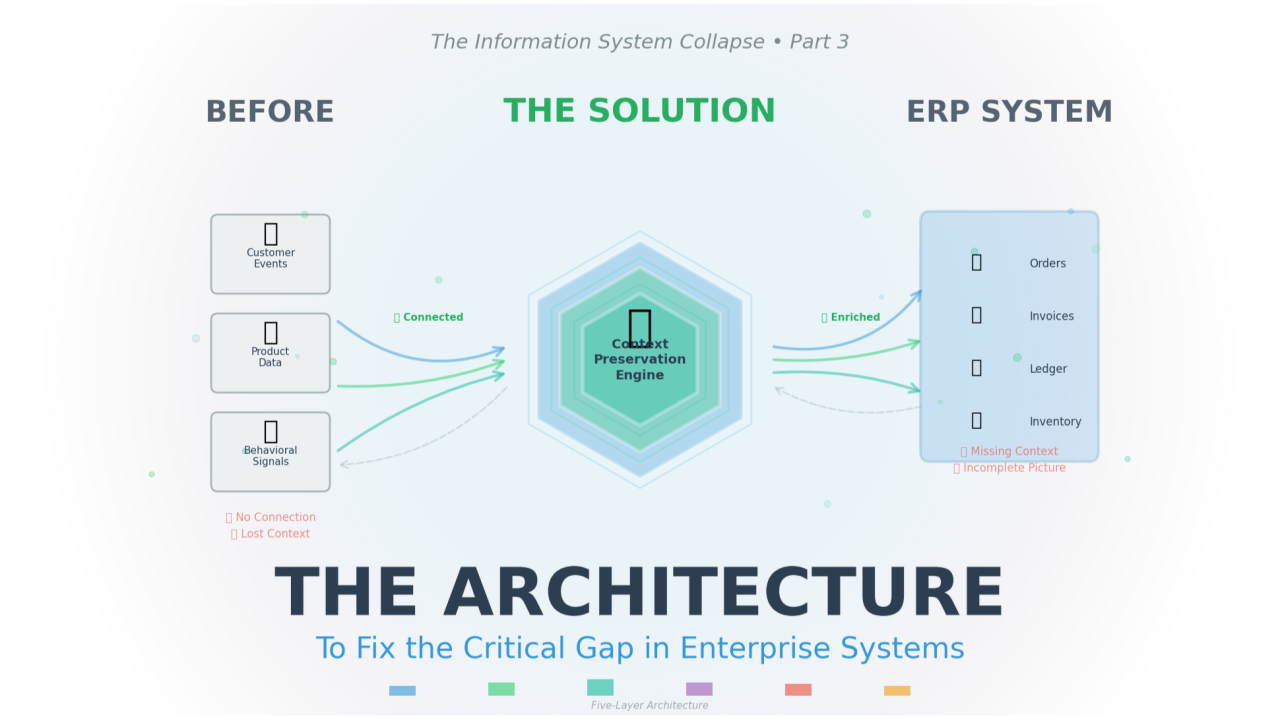
The Critical Gap in Enterprise Architecture
What Your ERP Captures
When your ERP system records a sale, it captures these fields:
What Your ERP Misses
All the context that led to that transaction is lost:
The Business Impact
Without this context, critical business questions remain unanswered:
"Why did this customer convert?" Unknown
"What's our true CAC by attribution?" Guesswork at best
"Which touchpoints actually matter?" Last-click only (misleading)
"What's the revenue impact of slow checkout?" Cannot measure
"How do behavioral signals predict churn?" No data available
The Five-Layer Architecture
This architecture preserves event context through five distinct layers, each serving a specific purpose in the journey from customer interaction to financial record.
Layer 1: Event Sources
Every customer interaction generates events that flow into the system. These sources include:
Web/Mobile Events: Page views, clicks, scrolls, time on page
Customer Behavior: Product views, search queries, comparisons
Cart Activity: Adds, removes, modifications, abandons
Checkout Process: Form interactions, hesitation signals, errors
Payment Gateway: Transaction attempts, success, failures
Fulfillment: Shipping, delivery, returns
Example Event Structure
LAYER 1: Event Sources (Customer Touchpoints)
Web/Mobile Events
Customer Behavior
Cart Activity
Layer 2: Event Streaming Platform
Events flow into a streaming platform (Apache Kafka, Pulsar, or AWS EventBridge) organized by topic. This layer provides:
Scalability: Handle millions of events per day
Durability: Events are persisted and can be replayed
Decoupling: Producers and consumers operate independently
Real-time Processing: Immediate availability for downstream systems
Topic Organization
customer-journey (15M events/day)
product-catalog (2M events/day)
order-lifecycle (500K events/day)
payment-events (450K events/day)
inventory-changes (1M events/day)
financial-events (400K events/day)
Layer 3: Context Preservation Engine (The Critical Bridge)
This is the breakthrough layer that solves the context gap. The Context Preservation Engine sits between raw events and ERP systems, enriching, correlating, and aggregating events before they're reduced to transactional records.
Five Components of the Context Engine
1. Session Aggregator: Groups all events within a user session to create complete journey context. Tracks page views, product interactions, cart modifications, and timing across the entire session.
2. Journey Reconstructor: Rebuilds the complete customer journey across multiple sessions, potentially spanning days or weeks. Links first touch to last touch, tracking all intermediate interactions.
3. Context Enricher: Adds attribution metadata, performance metrics, and behavioral signals to each order. Calculates metrics like time-to-conversion, hesitation indicators, and quality scores.
4. Event Correlator: Links related events across systems using correlation IDs. Ensures that upstream events (customer behavior) can be traced to downstream events (payment, fulfillment) and back again.
5. State Machine: Tracks order lifecycle and state transitions with full context at each stage. Records how long orders spend in each state and what triggered state changes.
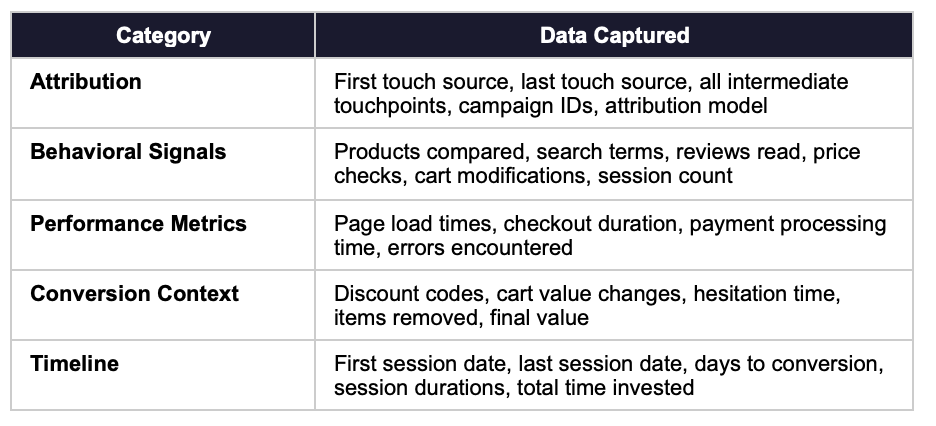
What the Context Engine Produces
For every order, the Context Engine creates an enriched context record that includes:
Layer 4: Contextual Data Store
Enriched context records are stored in a high-performance time-series database (Apache Pinot or ClickHouse) and a data lake (Parquet on S3). This dual storage strategy provides:
Fast Query Performance: Time-series DB for real-time lookups
Cost-Effective Storage: Data lake for long-term retention
Analytics Capability: Parquet format enables efficient big data analysis
Audit Trail: Complete event history available for compliance
Layer 5: ERP Integration with Context References
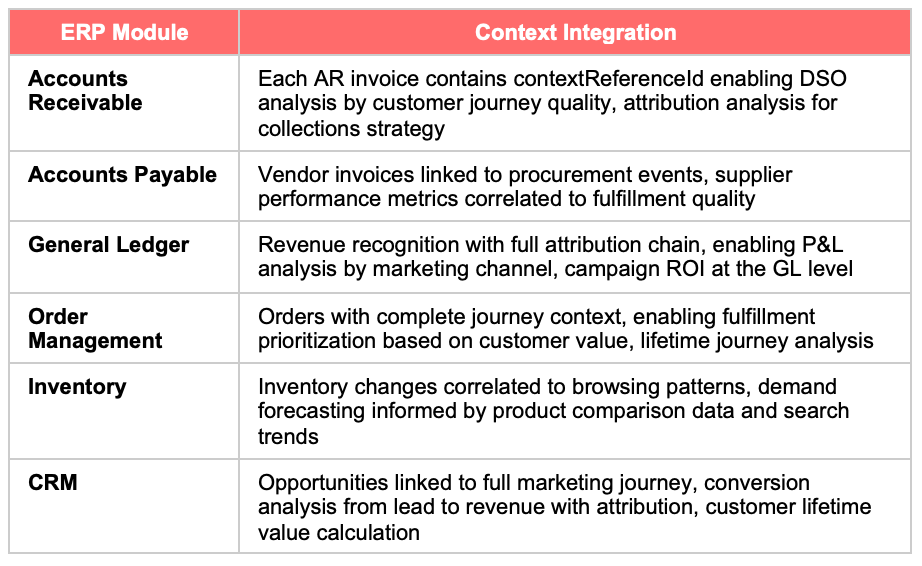
The Critical Link: Every ERP record contains a contextReferenceId field that points back to the enriched context in the data store. This single field creates bidirectional connectivity between transactional records and behavioral context.
Integration Across ERP Modules
Bidirectional Query Patterns
The architecture enables queries in both directions: from ERP to context (drill down) and from context to ERP (roll up). This bidirectional capability unlocks unprecedented analytical power.
Pattern 1: ERP → Context (Drill Down)
Use Case: "Show me the complete customer journey for Order #12345"
Start with an order in the ERP, follow the contextReferenceId to the enriched context store, retrieve the full behavioral history including all sessions, touchpoints, and signals.
What You Discover
Customer had 5 sessions over 3 days
First touch: Google Ads campaign (3 days ago)
Abandoned cart twice before completing purchase
Compared 7 products across sessions
Read 3 reviews and spent 12 minutes on product pages
Checkout page loaded in 4 seconds (above threshold)
Used discount code discovered in third session
Pattern 2: Context → ERP (Roll Up)
Use Case: "Find all orders where checkout took > 5 seconds and calculate revenue impact"
Query the context store for performance issues, get contextReferenceIds, lookup corresponding ERP orders, aggregate revenue, and compare against baseline.
Business Impact Analysis
Found: 1,247 orders with slow checkout (>5 seconds)
Total Revenue: $623,500
Average Hesitation: 4.7 minutes at checkout (2.3x baseline)
Comparison: Fast checkout (<2 seconds) average order value: $547
Opportunity: Slow checkout average order value: $500 (-$47 per order)
Recommendation: Optimize checkout page load time. Estimated revenue gain: $58,609/month
Bidirectional Query Patterns
Pattern 1: ERP → Context (Drill Down)
Query: "Show me the full customer journey for Order #12345"
Pattern 2: Context → ERP (Roll Up)
Query: "Find all orders where checkout took > 5 seconds and calculate revenue impact"
Pattern 3: Cross-Module Analytics
Query: "Revenue attribution by marketing campaign across AR, GL, and CRM"
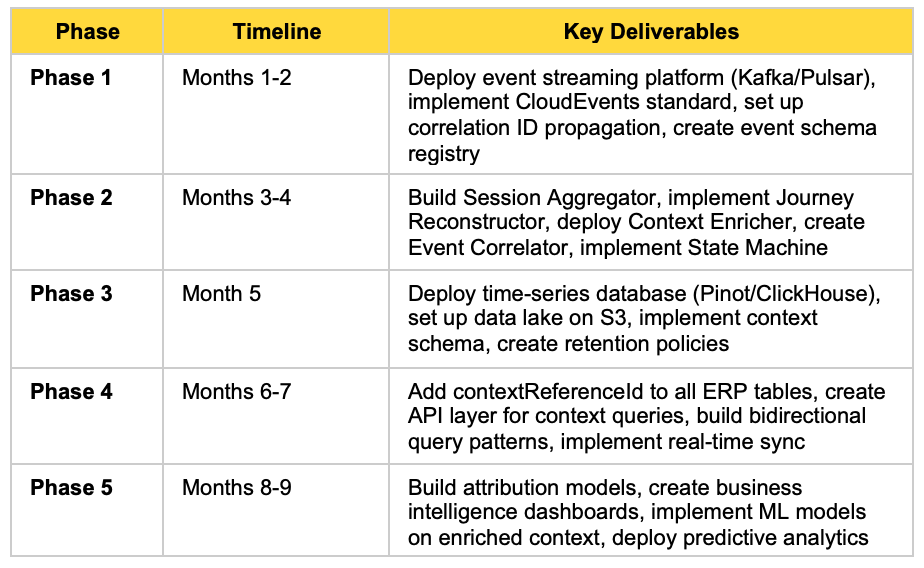
Implementation Roadmap
Rolling out this architecture requires a phased approach over 9 months:
LAYER 2: Event Streaming Platform
Kafka Topics Structure
Event Schema (CloudEvents Standard)
LAYER 3: Context Preservation Engine (THE CRITICAL BRIDGE)
This is where the magic happens. The Context Engine aggregates, correlates, and enriches events BEFORE they hit the ERP.
Component 1: Session Aggregator
Component 2: Journey Reconstructor
Component 3: Context Enricher
Component 4: Event Correlator
Component 5: State Machine
LAYER 4: Contextual Data Store
Schema Design (Time-Series Database - Apache Pinot/ClickHouse)
Data Lake Storage (Parquet on S3)
LAYER 5: ERP Integration with Context References
The Critical Link: Context Reference ID in ERP
Order Management (OM) Table Schema
Accounts Receivable (AR) Integration
General Ledger (GL) Integration
CRM Integration
The Architecture That Survives
This is not just about connecting events to ERP. It's about building a system where:
Context Never Dies - Every transaction carries its full story
Questions Get Answered - Drill down or roll up, any direction
Attribution Is Real - Not guesswork, actual causal chains
Performance Matters - Direct line from UX to revenue
Future-Proof - Add new sources, they integrate automatically
The architecture survives because it preserves context, maintains causality, and enables understanding at every level of the business.