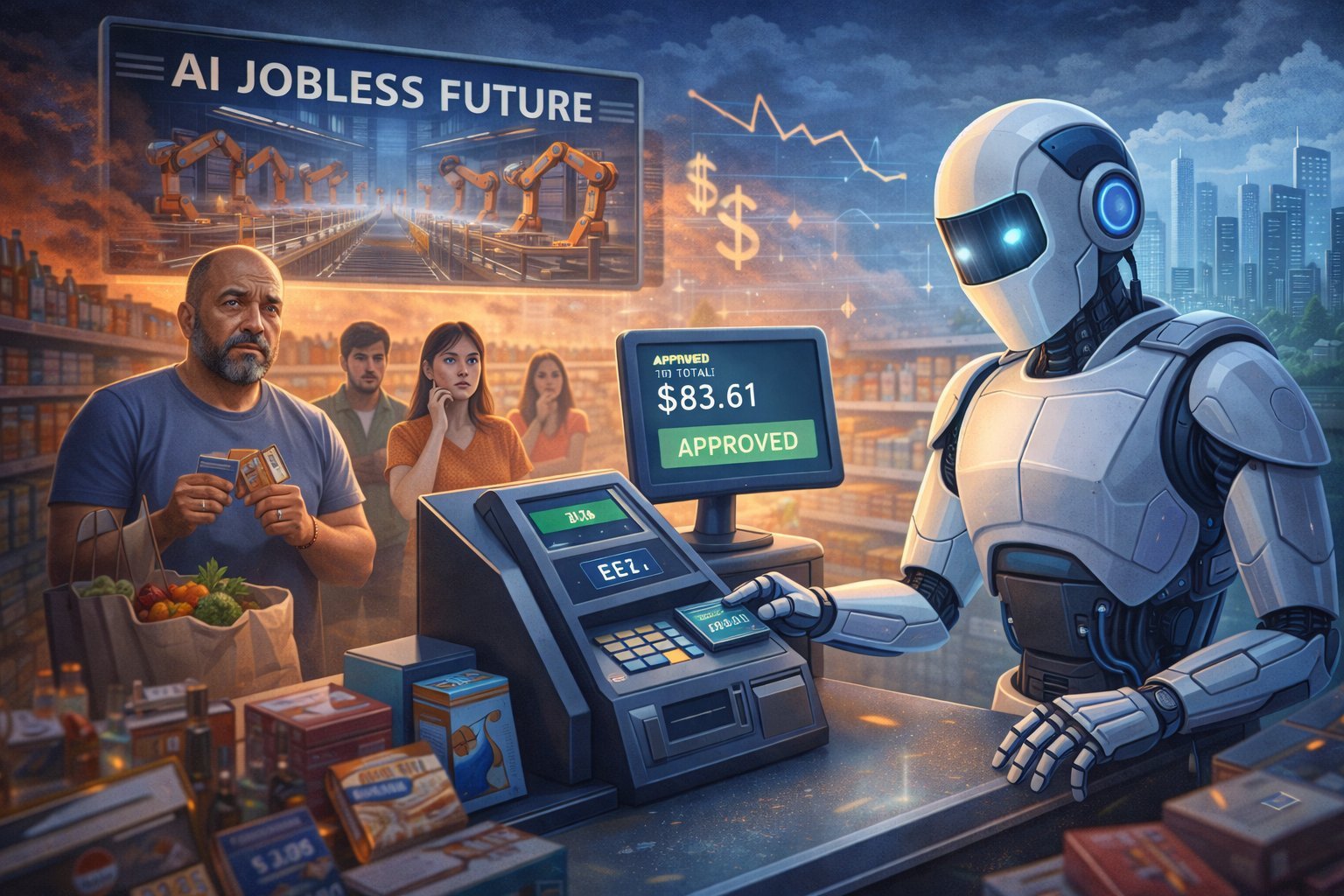
Everyone is screaming: "In 1-5 years, 50% of entry-level jobs will vanish!" Okay, fine. Let us assume AI eats 20-40% of jobs, robo-taxis replace drivers, robots replace warehouse workers, and consulting decks get generated by a chatbot in 4 seconds. Great.
But then tell me something —
Who exactly is going to buy the products?
You will have perfect supply chains producing infinite inventory for an economy with zero demand. Peak efficiency meets peak stupidity.
Are robots going to order groceries? Will GPT-9 take its girlfriend to Paris and post "#EiffelTowerVibes"? Will Optimus subscribe to Netflix Premium and cry watching The Notebook?
The Economy Runs on Humans
The economy does not run on automation. It runs on human salaries, human insecurity, human EMI payments, and human impulsive spending.
If you remove the paycheck, you do not just kill jobs — you kill the customer. Congratulations, you built the world's most efficient machine… to sell nothing to nobody. All your fancy AI widgets are of zero use.
The Doomsday Prophets
And the funniest part? The loudest doomsday prophets are usually CEOs sitting on mountains of stock options saying, "People must adapt."
Adapt to what?
What They Say
"People must adapt to the new economy"
"Reskill and embrace change"
"The future belongs to the agile"
"AI creates more jobs than it destroys"
What They Mean
Become prompt engineers for the system that replaced you
Drive Uber… for robo-taxis
Do internships… for AI managers
These speeches come with zero real plan
The Voice of Reason
That is why I respect Sundar Pichai's cautious take: do not overreact, do not panic, and definitely do not treat transformation like a light switch you flip overnight.
He gets it — societies need time to adapt, not TED talks about disruption.
Because if AI replaces humans faster than society can absorb it, it will not be "the future." It will be a self-inflicted recession with a fancy interface.
The Bottom Line
You cannot fire your customer base and expect quarterly growth. The AI revolution will be fine — but only if we remember one simple truth:
The customer is not an inefficiency to be optimized away.
Unless, of course, the real disruption is discovering that robots do not impulse-buy at 2 AM, and bankruptcy looks terrible in quarterly earnings reports.