PaddySpeaks Editorial
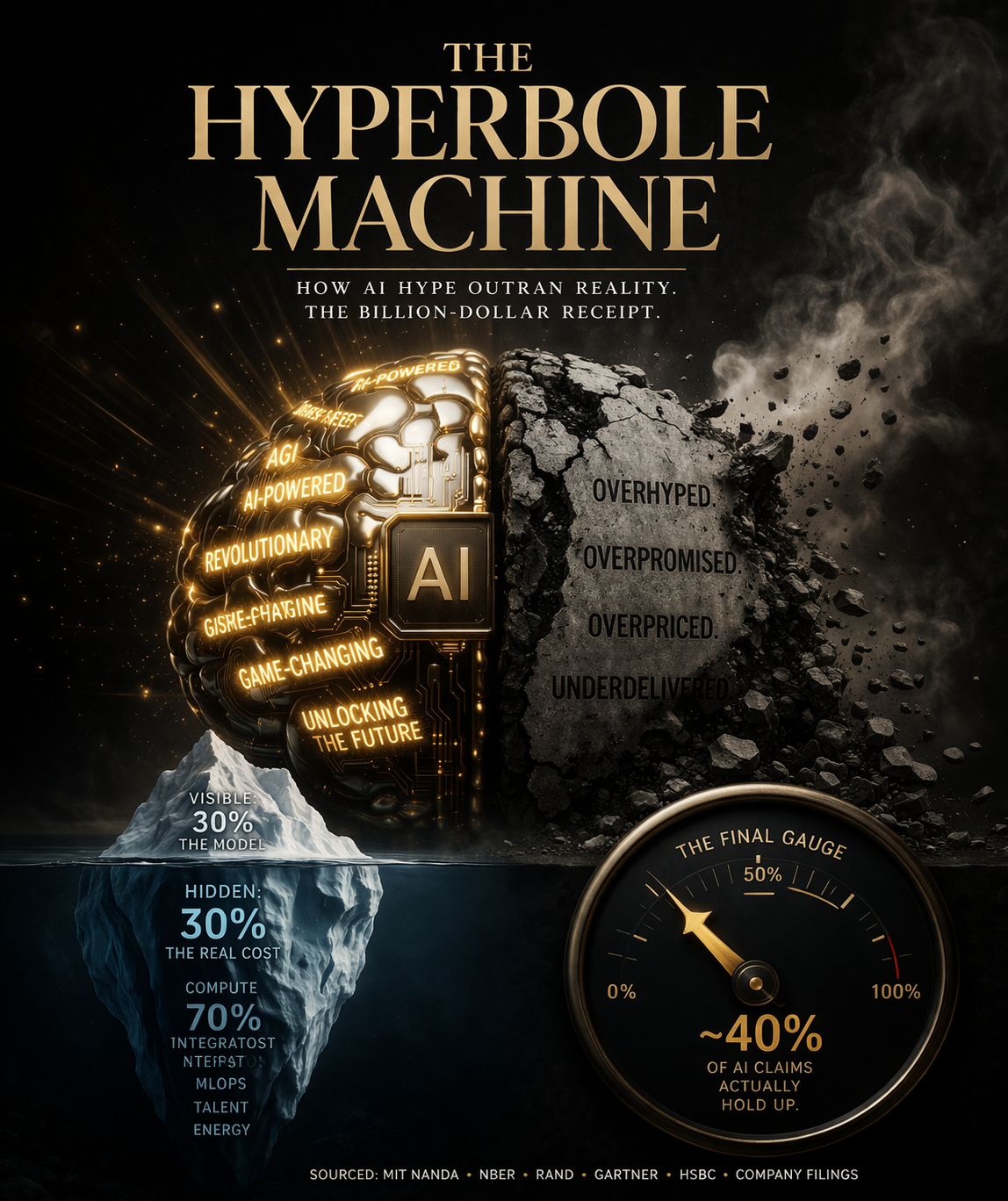
The Hyperbole Machine — How AI Hype Outran Reality. An infographic showing AI buzzwords like 'Revolutionary' and 'Game-Changing' on an iceberg, with hidden costs beneath, and a gauge showing only ~40% of AI claims hold up.

The Hyperbole
Machine

$684 billion spent. 80% failed. Zero accountability.
A forensic visual guide to everything AI promised — and didn't deliver.

80%
AI Projects Failed
$547B
Wasted in 2025
95%
GenAI Pilots Stalled
90%
Firms: No Productivity Impact

The Burn Ledger

These aren't projections. These are real dollars, burned by real companies, with real shareholders watching. The AI gold rush has its own body count — measured in billions.

OpenAI
$14B projected loss in 2026 alone
$44B cumulative by 2029
Volkswagen / Cariad
€14B+ sunk · 1,600 jobs cut
€14B+ total
Anthropic
$19B spend vs $18B revenue target
~$20B to profitability
Microsoft (AI Infra)
$35B in one quarter on AI infrastructure
$85B+ annualized
Meta (AI Capex)
Tens of billions · data centers + chips
$40B+ annually
Alphabet (AI Capex)
$85B+ in 2025 alone
$85B+
Project Stargate
$500B pledged · 7GW data center capacity
$500B pledged
Sources: HSBC, Morgan Stanley, Bain & Company, company filings 2025–2026

OpenAI had a 10% gross profit margin in 2024. Saudi Aramco — the comparison for its $40 billion funding round — has a business model and profitability. OpenAI has neither.

— The Financial Ouroboros

Buzzword Bingo:
A Taxonomy of AI BS

Every hype cycle manufactures its own language. This one is no different. Here's the field guide: what's real technology, what's marketing jargon, what's pure hype, and what's a genuine paradox the industry refuses to discuss.

Pure Hype
AGI
No agreed definition, no benchmark, no timeline. Fundraising narrative disguised as engineering roadmap.
Jargon
Agentic AI
Impressive demos. Fragile in production. Error rates compound across multi-step chains. Human-in-the-loop isn't optional — it's structural.
Pure Hype
AI-Powered
The "organic" label of tech. Slapped on everything from toasters to toothbrushes. Usually means "has an if-else statement."
Real Tech
LRM / Reasoning
Step-by-step problem-solving models. Real gains in math and code. But "reasoning" is still marketing sparkle on statistical pattern matching.
Pure Hype
AI Transformation
What consultants sell. What enterprises buy. What 80% of organizations fail to achieve. Usually means "bought a license and held a workshop."
Paradox
AI Washing
Greenwashing's tech cousin. Products labeled "AI-powered" to inflate valuations. Even OpenAI's Sam Altman admits firms use it to mask layoffs.
Jargon
Vibe Coding
Describe what you want, AI writes the code. Lowers the floor for simple tasks. The ceiling is very low. Debugging is still a human job.
Real Tech
RAG
Retrieval-Augmented Generation. Actually useful. Connects AI to real data instead of hallucinated knowledge. But needs clean data — which nobody has.
Pure Hype
Superintelligence
Science fiction marketed as engineering timeline. Current models can't reliably count the letters in "strawberry."
Paradox
AI Slop
Merriam-Webster's 2025 Word of the Year. Low-quality AI-generated content flooding every inbox, feed, and search result. The pollution nobody budgeted for.
Jargon
Prompt Engineering
Typing carefully. Elevated to a job title to justify AI adoption budgets. Useful skill. Not an engineering discipline.
Pure Hype
AI-First Company
Usually means "we added a chatbot to our support page." Being AI-first without being data-first is like being a chef without a kitchen.

The Billion-Dollar Graveyard

Real companies. Real budgets. Real wreckage. These aren't startups that failed to find product-market fit. These are household names that burned billions on AI and software ambitions that never materialized.

🪦
VW Cariad
2020 – 2025 (Effectively Shelved)
€14B+
"One unified AI-driven OS for all 12 brands." Got 20 million lines of buggy code, delayed Porsches, and 1,600 job cuts. VW eventually paid Rivian $5.8B to do what Cariad couldn't.
🪦
OpenAI Sora
2024 – Mar 2026 (Discontinued)
$15M/day burn
Text-to-video model that burned $15 million per day. Discontinued March 2026. The inference cost economics simply never worked.
🪦
McDonald's AI Hiring
2019 – 2025 (Breach Exposed)
64K records exposed
"Olivia" chatbot processed 90% of franchise applications. Password was "123456." A test account sat undecommissioned for six years. Sophistication of AI, security of a sticky note.
🪦
Clarifai
2013 – 2025 (Decline)
$100M+ raised
Early AI image recognition leader. Pivoted multiple times. Google, AWS, and Azure offered the same thing as a loss leader. Commoditized out of existence.
🪦
HireVue Facial AI
2014 – 2021 (Abandoned)
Category-wide failure
AI that judged job candidates by their facial expressions. Pseudoscience dressed in machine learning. Abandoned after bias scandals proved the obvious.
🪦
Enterprise AI (Avg.)
2025 Cohort
$4.2M–$8.4M per failure
42% of companies abandoned at least one AI initiative in 2025. Average large enterprise lost $7.2M per failed project and abandoned 2.3 initiatives.

The Seven Paradoxes
of AI Hype

The AI industry runs on contradictions it refuses to acknowledge. Each one is a load-bearing wall of the hype machine. Pull any one out and the narrative collapses.

1
The Jevons Paradox
When AI makes cognitive work cheaper, demand for that work increases. Radiologists are busier post-AI. Software job postings accelerated alongside Copilot. AI-exposed workers now work three extra hours per week. Efficiency creates more work, not less.
ATM teller headcount increased for 20 years after ATM introduction
2
The Productivity Paradox
90% of firms report no measurable impact on productivity from AI, yet executives project 1.4% productivity gains. The gap between what leaders believe and what spreadsheets show is an NBER-documented phenomenon.
NBER study, February 2026
3
The Circular Financing Paradox
OpenAI raises money from Microsoft, then spends it at Microsoft Azure. SoftBank invests $40B, proceeds flow back to Stargate's corporate partners. Investors fund their own future revenues. The ouroboros eats its tail.
OpenAI → Microsoft Azure → Microsoft revenue → OpenAI investment
4
The Inference Cost Paradox
"Reasoning" models are better, but they burn exponentially more tokens. It costs 5× the energy and money to make models 2× better. Notion's AI features ate 10% of its profit margin. The better AI gets, the more it costs to run.
OpenAI inference: $3.76B (2024) → $5.02B (H1 2025 alone)
5
The Wrapper Paradox
Thousands of AI startups are thin API wrappers around GPT — loss-making, undifferentiated, burning investor money. OpenAI needs them for distribution. They need OpenAI for intelligence. Both pretend the other isn't critical. Both are fragile.
99% of AI startups predicted dead by end 2026
6
The PoC Trap Paradox
Enterprises run dozens of AI proofs-of-concept while failing to ship a single production system. They mistake pilot activity for progress. In-house builds fail twice as often as vendor partnerships. The endless pilot cycle burns budget and credibility in equal measure.
MIT NANDA: 95% of GenAI pilots fail to scale
7
The Sovereign Infrastructure Paradox
OpenAI's compute spending target is $600 billion by 2030. That's not a startup scaling — it's a sovereign-scale infrastructure build dressed in a software company's clothes. AI data centers will consume 90 terawatt-hours annually by 2026 — a 10× increase from 2022.
$1.4 trillion committed to data centers with $13B in revenue

How a 12% Gain Becomes
"AI Replaces Your Team"

1
The Research Paper
"Model achieves 87% accuracy on benchmark X under controlled conditions."
2
The Press Release
"Breakthrough AI achieves near-human performance on real-world tasks."
3
The Tech Media
"Revolutionary AI surpasses human intelligence in groundbreaking study."
4
The Consulting Deck
"$4.4 trillion opportunity. 40% cost reduction. Pilot study of 14 people. ROI chart goes up and to the right."
5
The Boardroom
"We need an AI strategy or we're dead." Nobody read the paper. Everyone saw the McKinsey chart. Budget approved. Every Monday is now AI Monday.

The Jargon-to-English
Translator

What they say in the pitch deck versus what it actually means in production.

"AI-native platform"
We added an API call to GPT and redesigned the landing page
"Proprietary model"
Fine-tuned open-source model with our company name on it
"Enterprise-grade AI"
Same model, higher price, longer sales cycle, SOC 2 badge
"AI-first strategy"
We fired the data team and bought ChatGPT Team licenses
"Democratizing AI"
We have a freemium tier and a blog
"Leveraging AI at scale"
Twelve people use Copilot and one intern writes prompts
"Autonomous AI agents"
A chain of API calls with a retry loop and a Slack notification
"AI-powered insights"
A chart that already existed, now with a sparkle emoji
"Our AI moat"
We're one API pricing change from bankruptcy
"Synergetic AI partnership"
We pay them money and they give us the same thing they give everyone

AI Failure Rates by Industry

Data from RAND Corporation, MIT Sloan, McKinsey, and Deloitte across 2,400+ enterprise AI initiatives. The failure isn't a bug. It's the feature.

Industry
Failure Rate
Avg. Cost/Fail
Primary Killer
Financial Services
82.1%
$11.3M
Regulatory + bias
Healthcare
78.9%
$8.4M
Physician resistance + EHR
Manufacturing
76.4%
$6.2M
OT/IT integration
Retail
73.8%
$4.8M
Supply chain volatility
Professional Services
68.7%
$5.1M
Knowledge worker resistance
All Industries (Avg.)
80.3%
$7.2M
Leadership-driven (84%)
Breakdown: 33.8% abandoned · 28.4% delivered no value · 18.1% couldn't justify costs · Sources: RAND, MIT NANDA, Deloitte 2025

Token Pricing Is the Tip

What sinks budgets is everything beneath the waterline. Enterprise AI adoption routinely runs 3–5× over initial estimates. Gartner found CFO cost estimates off by 500–1,000%.

WATERLINE TOKEN / API COSTS ~30% Data Preparation & Cleaning 30–50% of total spend Integration & Legacy Debt 25–40% of total spend Model Maintenance & Drift 15–22% ongoing Change Management The human tax nobody budgets Governance, Compliance & Liability Nobody's line item until it's everyone's problem ~70% HIDDEN

What AI Actually Does Well
— and What It Doesn't

Not everything is hype. AI does real things for real companies. But only when you match the right tool to the right problem — and stop expecting magic.

✓ AI Delivers Here
Narrow, well-defined tasks
Schema detection, anomaly flagging, classification at volume
First-draft content creation
Faster drafts, but editing + fact-checking still human
Code assistance (not replacement)
Boilerplate, autocomplete, test generation. Debugging? Still you.
Back-office automation
MIT found biggest ROI here — not in flashy customer-facing tools
Data pipeline acceleration
Query generation, transformation logic, metadata extraction
Tier 1 customer service
FAQ deflection, simple ticket routing. 70–85% accuracy tolerable
✗ AI Fails Here
Ambiguous, open-ended decisions
Strategy, negotiation, judgment calls with incomplete data
Complex codebase architecture
Legacy systems, cross-service dependencies, production reliability
95%+ accuracy requirements
Legal review, medical diagnosis, financial compliance
Fragmented, legacy-locked data
Garbage in, garbage out wasn't solved by adding inference
Low-frequency variable judgment
Unusual edge cases, ethical dilemmas, context-dependent choices
Replacing offshore BPO ($2–6/interaction)
Human labor remains cheaper for many tasks when TCO is honest

The $8 Question, Answered

PURE HYPE ALL TRUE
~40%
of major AI claims hold up under scrutiny
For most skilled professional tasks in 2026, human labor remains cheaper when total cost of ownership is measured honestly.

The firms that will actually benefit are the ones doing the unglamorous work now: cleaning data, redesigning workflows, retraining people, and measuring what's real instead of what's pitched.

— The Adoption Curve Has Barely Begun to Bend