The missing curriculum
Fourteen years of school. Four of college. Zero classes on the one thing you use every single day.
| Subject | Grade |
|---|---|
| Mathematics | A |
| Physics | A |
| Chemistry | A |
| Biology | A |
| Language & Literature | A |
| Social Studies | B+ |
Personal FinanceNot offered
Excellent student. Fully prepared for an exam that will never be set again.
— TeacherYou can probably still name the parts of a plant cell. The quadratic formula is in there somewhere, retrievable under pressure. So is a fragment of a poem you were made to memorise at fourteen and have not needed since.
None of that was wasted. Education is not a vending machine, and school was never supposed to be one. Learning how to think is worth more than any single fact it was smuggled in with.
But run the audit on the other side of the ledger. You have earned money nearly every month of your adult life. You have paid tax on it, borrowed against it, insured some of it, lost some of it, and made quiet decisions about the rest that will compound for forty years. For almost all of that, you were self-taught — from a colleague’s tip, a headline, a relative’s certainty, an app designed to hold your attention rather than serve your interests.
This is not a complaint about the syllabus. It is a description of a gap. And gaps, unlike knowledge, are reliably inherited.
01 — What was taught, what was assumed
Nobody connected the education to the financial life waiting on the other side of it.
Ten subjects were graded. Twelve responsibilities were not. Everything on the left was examined; everything below was assumed.
02 — The syllabus that should have existed
It is not calculus. It is eight ordinary competences, most of which can be explained to a twelve-year-old in an afternoon.
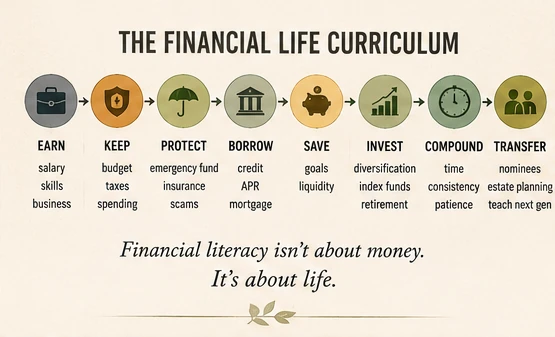
The financial life cycle, in order. Investing is one stage out of eight. That is worth sitting with, because the most common form of financial half-literacy is a brokerage account opened before an emergency fund exists.
Read the eight stages again and notice how little of it is mathematics. Keep is a habit. Protect is a fear correctly aimed. Borrow is arithmetic you can do on a phone, wrapped in a contract nobody reads aloud. Compound is mostly the ability to leave something alone.
Which is the first clue about why this subject went missing. It was never hard enough to need a specialist — and never obviously anyone’s job.
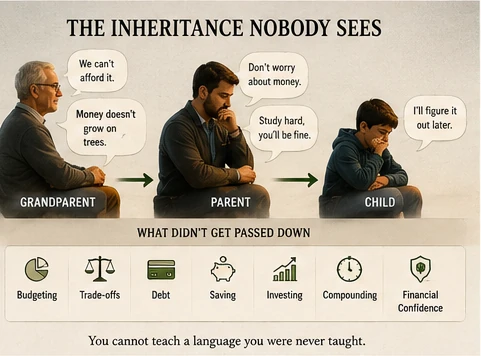
03 — The inheritance nobody sees
It is tempting to end the story at the school gate. It doesn’t end there.
Ask most people where they learned about money and they will name a parent. Ask what the parent actually said, and the answers converge on a small, familiar vocabulary.
None of those sentences is a lie. Most of them are true. But they are verdicts delivered without the case — conclusions handed over with the working scrubbed off. A child hears we can’t afford it and learns that money is a wall. A child who hears we can afford it, but we’re choosing the other thing learns that money is a set of trade-offs they will one day get to make.
One sentence transfers anxiety. The other transfers a method.
You cannot teach a language
you were never taught.
This is not an accusation, and it should not be read as one. A generation that learned money by surviving it taught what it had: caution, thrift, and silence. That was the entire curriculum available to them, and it kept families alive. What it could not include was explanation — because explanation requires having had something explained to you first.
So the thing that actually got inherited, reliably, across three generations, was not knowledge. It was a posture. A slight tightening whenever the subject came up.
Financial anxiety is inherited far more often than financial literacy.
04 — The repair, and it is small
The fix is more boring than it looks, and it happens where the family already sits.
Once a month · at the table
Question five is the one people skip, and it is the one that matters most on the worst day of a family’s life. A grieving spouse who does not know which bank, which policy, which login — that is not a paperwork problem. It is a teaching problem, arriving late.
Question four is the one that breaks the cycle. One idea a month is twelve a year. A child who has heard compounding explained twice before they turn fifteen will not need to discover it at thirty-five from a stranger on the internet.
Silence is also a financial lesson. It teaches that money is dangerous, shameful, or none of your business — and children learn it perfectly.
05 — Why the copying goes wrong
Children copy behaviour long before they understand principles. So do adults.
We copy what we can see.
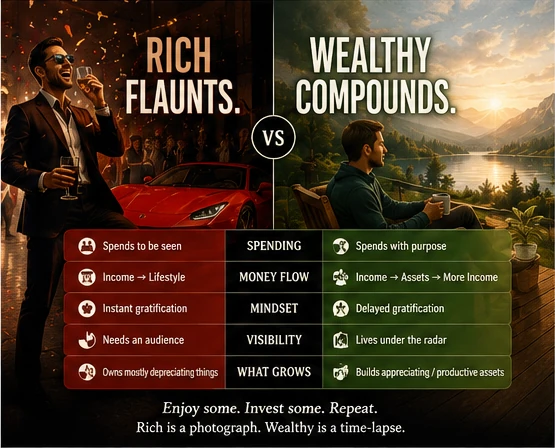
That is precisely why wealth is so easy to misunderstand.
The top half is a photograph anyone can take. The bottom half is a set of numbers nobody posts. One of them is a bill that arrives every month; the other is an income that arrives every month. From the outside, at a party, they are indistinguishable — and the one making noise is usually the bill.
Which brings us to the distinction the whole subject turns on.
06 — The distinction everything turns on
Two words used interchangeably in conversation, describing two entirely different financial states.
Nobody in this article is asking you to sit in the dark counting index funds. A life spent refusing every good dinner is not wealth either — it is just a different way of being owned by money. The instruction is smaller and easier to live with: enjoy some, invest some, repeat. The wealthy person in the right-hand column is not deprived. They simply decided which purchases needed to be seen.
Rich is a photograph.
Wealthy is a time-lapse.
07 — The engine under the whole thing
Stage seven of the eight, and the only one that does its work while you are asleep.
$500 invested every month · 8% assumed average annual return · no withdrawals
Look at the first decade. Thirty thousand dollars of contributions and almost no visible growth — a thin sliver above a thick base. Anyone judging the strategy at year seven would conclude, quite reasonably, that it wasn’t working.
Now look at the last five years, where the curve stops behaving like a line at all. Nothing changed. The contribution is the same $500 it was in year one. The only new ingredient is that there is finally enough time behind it.
Compounding looks unimpressive early because its greatest results live at the end.
This is the single most expensive thing the missing subject failed to teach, and it is expensive in a very specific way: the cost is not paid in money. It is paid in years — and years, unlike money, cannot be earned back later.
08 — The one input you cannot buy
Same contribution. Same assumed return. Same finish line. The only variable is when they began.
Both invest $500 a month until 65 · 8% assumed average annual return
| Priya | Raj | |
|---|---|---|
| Starting age | 25 | 35 |
| Monthly contribution | $500 | $500 |
| Years contributing | 40 | 30 |
| Assumed annual return | 8% | 8% |
| Total contributed | $240,000 | $180,000 |
| Value at 65 | $1,745,504 | $745,180 |
Time is an asset you cannot buy back.
There is a version of this chart that gets circulated to make a sharper point, and it is worth stating carefully because it is true. If Priya had contributed for only ten years — $500 a month from 25 to 35, $60,000 in total — and then never added another cent, she would still reach roughly $1,000,317 by 65 under the same 8% assumption. More than Raj, who paid in three times as much for thirty years.
That is a real arithmetic result, not a trick. But it is not a recommendation to stop at 35. It is only a way of showing where the value actually sits: not in the size of the deposit, but in the number of years standing behind it.
And if you are reading this at forty-five, none of it is an accusation. The chart is not a scoreboard of what you missed. Raj still finishes with three quarters of a million dollars, from a decision he made in his thirties.
Starting early is powerful.
Starting today is still better than starting tomorrow.
09 — Why it was never really about the maths
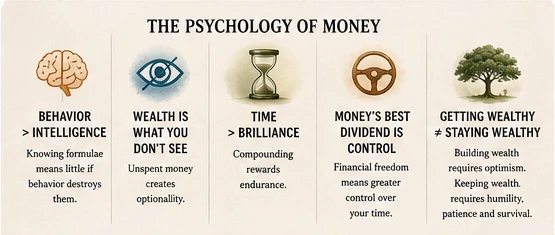
The reason a missing subject did so much damage is that the subject was never primarily technical.
Knowing the formulas means little if behaviour destroys them.
Unspent money is the part that creates optionality.
Compounding rewards endurance, not cleverness.
Financial freedom is mostly control over your own time.
Building it takes optimism. Keeping it takes humility, patience and survival.
Five ideas drawn from Morgan Housel’s The Psychology of Money, which is the closest thing we have to the missing textbook.
Every one of those five is a behaviour, not a calculation. Which is precisely why the subject could never have been taught the way physics was, in a room, once, with an exam at the end. It needed repetition at a kitchen table over fifteen years — the one place it was never spoken about.
10 — Closing the loop
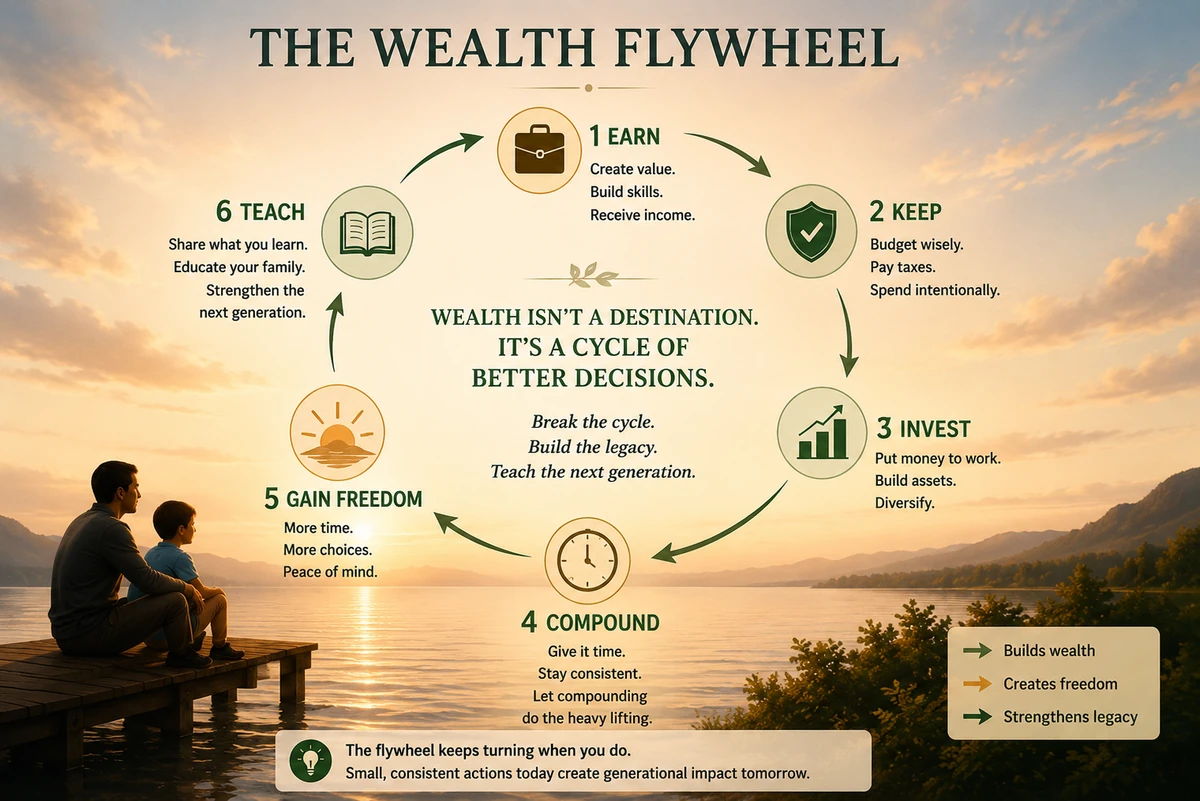
Everything above is a line. It only becomes a cycle at the last step.
↻ And the wheel starts turning for them
Five of these stages make you comfortable. Only the sixth makes it permanent.
A family that reaches stage five and stops has bought one generation of security. A family that takes stage six has changed what the next generation starts with — not the money, which can be spent in a decade, but the method, which cannot be.
Which is why the arrow out of Teach does not end. It runs back round to Earn, except that the person earning is no longer you. They begin where you finished, with the working shown.
This article began here
Nobody taught us.
It ends here
So we teach the next generation.
Wealth isn’t what you earn.
It’s what you keep, grow, and pass on — including the education.
Learn it late if necessary.
Teach it early if possible.
This article is general commentary on financial education, not personal financial advice. Every figure in it is an illustrative calculation from stated assumptions — not a forecast, a recommendation, or a guaranteed return. What suits your situation depends on facts this page cannot know.