The migration that passed every test — and still broke in production
How a hidden privacy boundary was turned into an engineering guardrail.
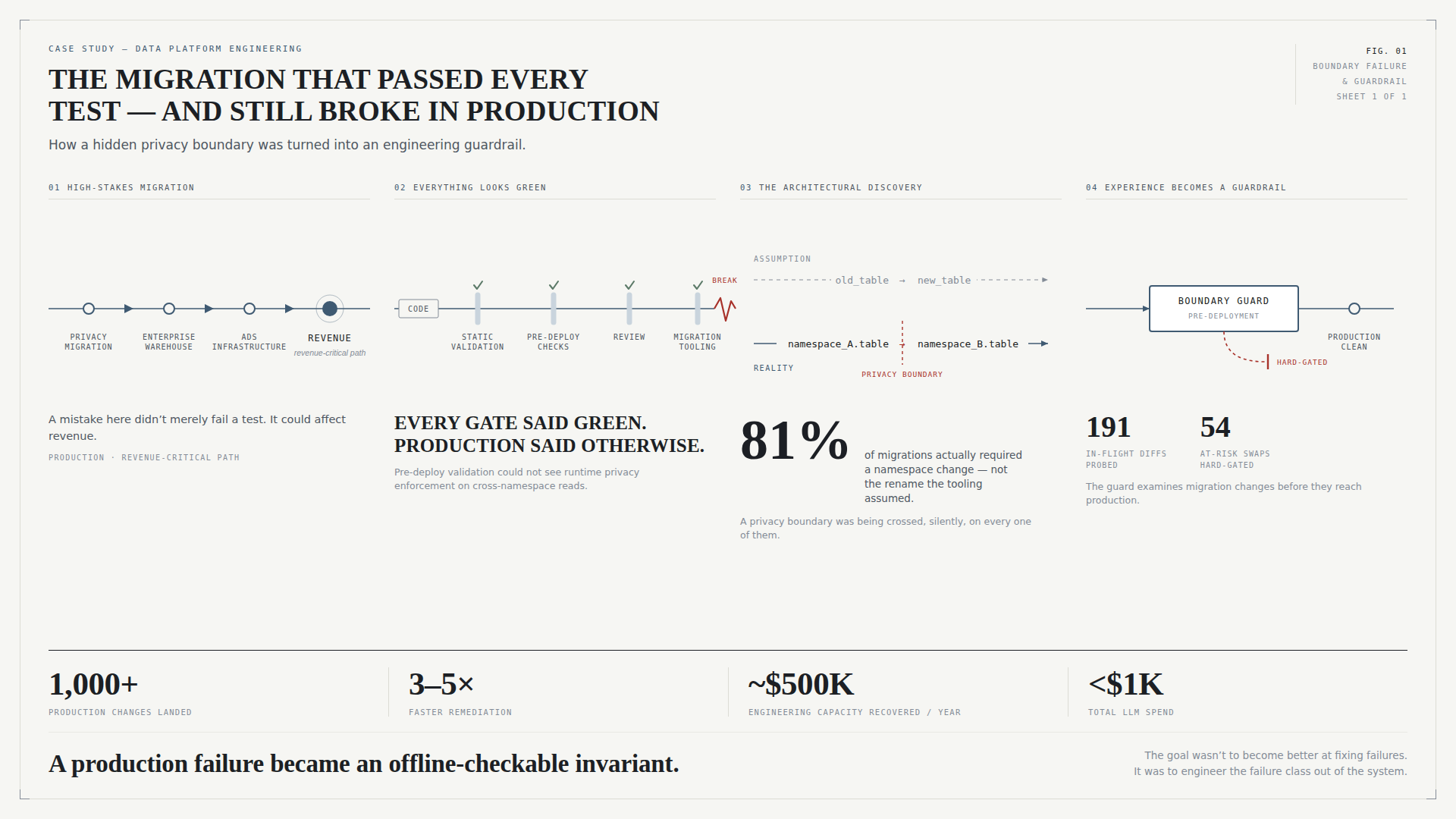
Where a mistake shows up as revenue, not a red build
The migration ran through the part of the warehouse that sits directly in the advertising revenue path. Data moved from the privacy migration, through the enterprise warehouse, into ads infrastructure, and out the other side as revenue.
A mistake here didn't merely fail a test. It could affect revenue. That constraint drove every design decision that followed — most importantly, the decision to invest in prevention rather than in faster recovery.
Every gate passed. Production disagreed.
A change moved through the full pre-deployment stack — static validation, pre-deploy checks, human review, migration tooling. Four gates. All green.
Then it hit an unexpected runtime boundary and broke.
Production said otherwise.
The gap was structural, not a missed case: pre-deploy validation could not see runtime privacy enforcement on cross-namespace reads. Permission checks returned PASS for tables that did not exist, and nothing in the stack modelled the enforcement that actually runs at query time. The diffs were not sneaking past the gates. The gates were looking at the wrong thing.
It was never a rename
The tooling assumed each migration was a name change — old_table → new_table. Swap the identifier, update the references, done.
The reality was a namespace change — namespace_A.table → namespace_B.table. Every one of those moves crossed a privacy boundary, silently, and the boundary was the thing the runtime enforced.
That turned a diffuse class of production failures into something mechanical. The source namespace had been encoded in the old table name all along, which meant the correct transform was provable offline, from the name itself, instead of depending on a lookup that pre-deploy validation could not perform.
Move the check to where it can still say no
The fix was not a better runbook. It was a new component placed before deployment: a boundary guard that examines migration changes while they are still diffs, and refuses the ones that would cross a boundary incorrectly.
It probed 191 in-flight diffs and hard-gated 54 at-risk swaps before they could reach production. Every gate in it traces back to a specific postmortem — the guard is the accumulated incident history, expressed as code that runs before the damage rather than after it.
A production failure became an offline-checkable invariant.
The goal wasn't to become better at fixing failures. It was to engineer the failure class out of the system.