There is a text in Indian philosophy that most spiritual teachers
handle like a live grenade.
It doesn't ask you to meditate. It doesn't prescribe rituals. It doesn't even ask you to be good. It simply says: you are already free. Not "will be free after 10,000 hours of sadhana." Not "free once you've conquered desire." Free. Right now. As you read this. As you sit in that meeting. As you scroll past this on your phone in an auto-rickshaw.
The Ashtavakra Gita is a 298-verse dialogue between a physically deformed sage named Ashtavakra and King Janaka of Mithila. It is, without exaggeration, the most uncompromising statement of non-duality (Advaita) ever committed to Sanskrit. Where the Bhagavad Gita gently holds your hand through karma yoga, bhakti, and jnana, the Ashtavakra Gita slaps your hand away and says: there is no hand, there is no you, and there never was a journey.
If the Bhagavad Gita is a university curriculum with multiple electives, the Ashtavakra Gita is a single-line answer sheet: You are pure consciousness. Everything else is a dream.— The radical premise of the Ashtavakra Gita
The Sage With Eight Bends
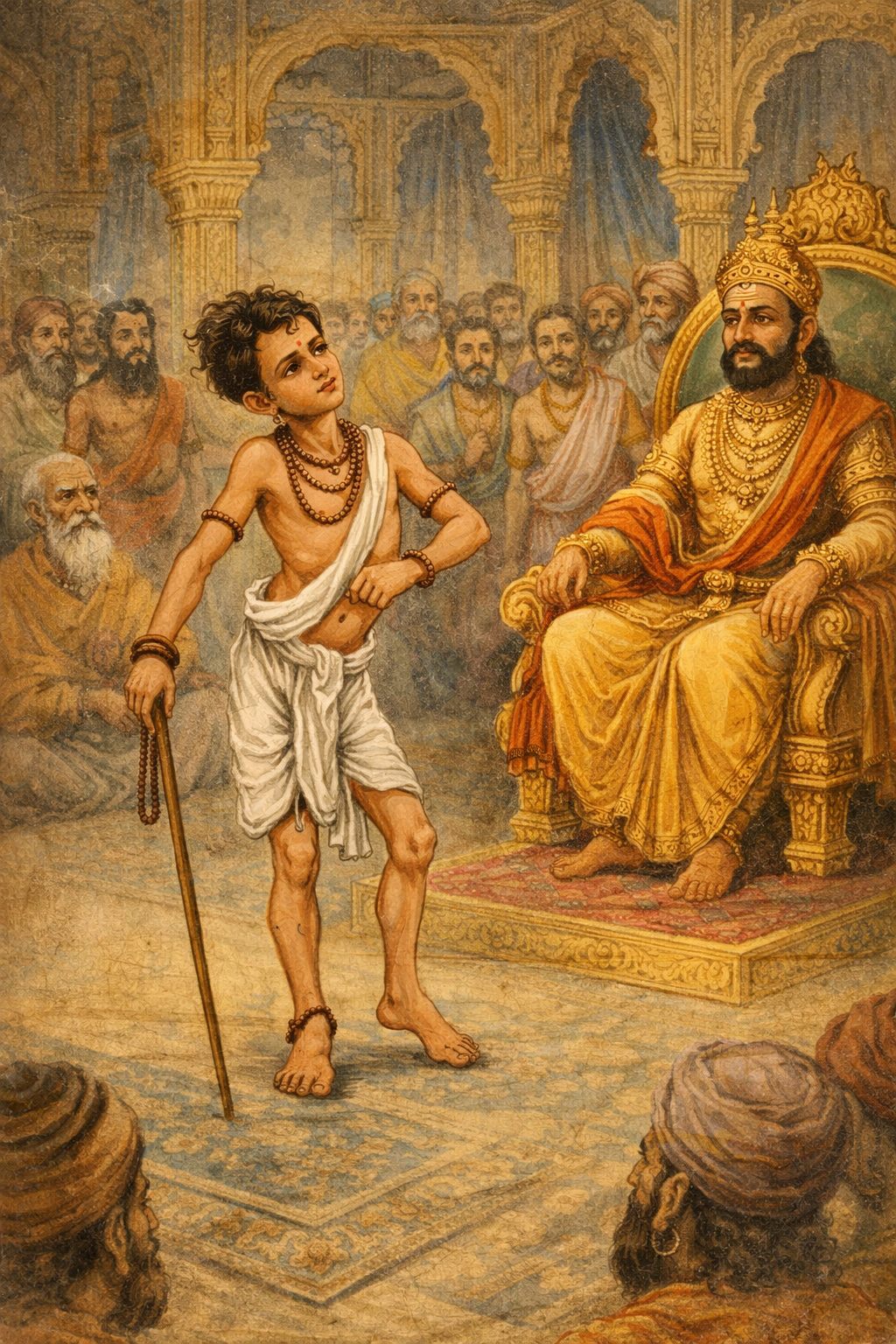
Who Was Ashtavakra — The Body as Counter-ArgumentThe name itself is a teaching. Ashta (eight) + Vakra (bends/deformities). Born with a body twisted in eight places, cursed while still in the womb by his own father Kahoda, who grew irritated when the unborn child corrected his Vedic recitation errors. Yes, you read that right—the child was so steeped in knowledge that he corrected his father's chanting from the womb, and got cursed for it.
This is not incidental detail. It is the setup for the text's most radical teaching: the body is irrelevant to the Self. A sage whose body was a monument to imperfection became the voice of the most perfect philosophy ever articulated.
When the Brahmins in Janaka's court laughed at his twisted form, Ashtavakra's response was devastating: "I see this is an assembly of cobblers, not scholars. Cobblers judge by skin. Scholars judge by knowledge."
Janaka, stunned by the clarity of a child who saw through the pretensions of his entire court, fell at Ashtavakra's feet. The king who had everything—wealth, power, armies, scholars—recognized something he lacked: someone who would tell him the truth without decoration.
In a world that worships six-pack abs, flawless skin, and the "right look" for leadership—the Ashtavakra origin story is a grenade lobbed at every boardroom that confuses presentation with substance. The sage who knew the most looked the worst. And the king who had it all bowed to him.
The Core Teaching: You Are Not What You Think
Chapter 1 — Janaka's Three QuestionsThe Ashtavakra Gita opens with Janaka asking the most fundamental questions a seeker can ask:
kathaṁ jñānam avāpnoti kathaṁ muktirbhaviṣyati |
vairāgyaṁ ca kathaṁ prāptaṁ etad brūhi mama prabho ||1.1||
"How is knowledge acquired? How is liberation attained? How is detachment reached? Tell me this, O Lord."
Three questions. Clean. Direct. No philosophical foreplay. And Ashtavakra's response is equally surgical:
muktim icchasi cet tāta viṣayān viṣavat tyaja |
kṣamārjava-dayā-toṣa-satyaṁ pīyūṣavad bhaja ||1.2||
"If you wish to be free, my child, shun the objects of the senses like poison. Cultivate forgiveness, sincerity, compassion, contentment, and truthfulness as nectar."
But don't be fooled by this seemingly gentle opening. Within a few verses, Ashtavakra detonates the core bomb:
na pṛthvī na jalaṁ nāgnir na vāyur dyaur na vā bhavān |
eṣāṁ sākṣiṇam ātmānaṁ cidrupam viddhi muktaye ||1.3||
"You are not earth, water, fire, air, or space. To be liberated, know yourself as the witness of all these—as Consciousness itself."
You are the screen, not the movie.
Every sensation, thought, emotion, ambition, fear, quarterly target, LinkedIn notification, and existential crisis is a projection on the unchanging screen of your awareness. The screen is never damaged by the scenes it displays.
- You are not earth — not the body that ages, aches, and dies
- You are not water — not the emotions that flood and recede
- You are not fire — not the ambition that burns and consumes
- You are not air — not the restless mind that never stops moving
- You are not space — not the emptiness you feel at 3 AM
You are the witness of all five. Unchanging. Untouched. Already free. This is not metaphor. This is not poetry. This is a direct instruction.
And then Ashtavakra goes further. Having demolished your identification with the body and elements, he turns his blade on the most sacred scaffolding of Vedic society itself:
na tvaṁ viprādiko varṇo nāśramī nākṣagocaraḥ |
asaṅgo'si nirākāro viśvasākṣī sukhī bhava ||1.5||
"You are not a Brahmin or any other caste. You are not in any ashrama (stage of life). You are not perceivable by the senses. Unattached and formless, you are the witness of the entire universe. Know this and be happy."
Not Brahmin. Not Kshatriya. Not Vaishya. Not Shudra.
Not student, not householder, not retiree, not monk.
Not anything the world has ever called you.
Let the weight of this sink in. In a civilization where varna and ashrama were the twin pillars of social identity—where your caste determined what you could eat, who you could marry, what work you could do, and even which scriptures you could hear—a sage looks a king in the eye and says: none of it applies to you. Not because caste reform is needed. Not because the system is unjust. But because you are not the kind of thing that can be classified at all.
The Bhagavad Gita's Chapter 4, Verse 13 says Krishna created the four varnas. The Ashtavakra Gita's Chapter 1, Verse 5 says you are beyond all four. One organizes the world. The other dissolves the organizer.
This verse doesn't just challenge caste. It annihilates every label you have ever worn: your nationality, your religion, your gender identity, your professional designation, your political affiliation, your generational cohort. None of these are you. You are the formless awareness in which "Brahmin," "CEO," "millennial," "Indian," "liberal," "conservative"—all of it—appears and disappears like clouds in a sky that has never been cloudy.
Next time someone asks "What do you do?" and your entire sense of self contracts into a job title—remember verse 1.5. You are not a Data Architect. You are not a VP of Engineering. You are not a "serial entrepreneur." You are asaṅgo nirākāro viśvasākṣī—unattached, formless, the witness of the universe. Everything else is a costume.
Three verses in, and Ashtavakra has already dismantled the body (1.3), the elements (1.3), the social order (1.5), and every identity framework humans have ever constructed. Most philosophers need entire books to build a worldview. Ashtavakra needed five verses to demolish all of them.
The Five Pillars
The Architecture of Radical FreedomYou Are Already Free (Nitya-Mukta)
Liberation is not a destination. It is your starting point.yadi dehaṁ pṛthak-kṛtya citi viśrāmya tiṣṭhasi |
adhunaiva sukhī śānto bandha-mukto bhaviṣyasi ||1.4||
"If you detach yourself from the body and rest in consciousness, you will at once be happy, at peace, and free from bondage."
Note: "at once." Not after a 10-day Vipassana retreat. Not after your startup IPOs and you finally have "time for spirituality." At once. Bondage is not a condition to be overcome—it is a misunderstanding to be corrected. You are not a prisoner working toward parole. You are a free person who fell asleep and dreamed of chains.
Witness Consciousness (Sakshi Bhava)
Become the one who watches. Not the one who drowns.tvam ekaś cetanaḥ śuddho jaḍaṁ viśvam asattathā |
avidyāpi na kiñcit sā kā bubhutsā tathāpi te ||1.17||
"You are one, pure consciousness. The universe is inert and unreal. Ignorance itself is nothing. What then do you wish to know?"
The modern parallel is striking. Cognitive behavioral therapy's cornerstone technique—"cognitive defusion"—is essentially the same instruction: you are not your thoughts. You are the awareness in which thoughts appear. Daniel Kahneman spent a career proving that "System 1" thinking hijacks us precisely because we identify with our automatic reactions. Ashtavakra diagnosed this hijack 3,000 years ago and offered a simpler prescription: stop identifying.
The Unreality of the World (Jagat Mithya)
The world is not unreal. It is unreal the way you think it is.This is where Western minds recoil and Eastern scholars debate endlessly. Ashtavakra doesn't say the world doesn't exist. He says it doesn't exist the way you think it does.
When you watch a movie, the characters, plot twists, and emotional beats feel real. You cry. You laugh. Your heart races. But the moment the lights come on, you remember—none of it was happening to you. The Ashtavakra Gita says the lights have always been on. You just forgot to look up from the screen.
The Bondage of Desire
Not desire for bad things. All desire. Including the desire for liberation.muktābhimānī muktaḥ sa baddho baddho'bhimānyapi ||1.11||
Ashtavakra Gita 1.11"He who considers himself free is free indeed, and he who considers himself bound is bound. 'As one thinks, so one becomes' is a popular saying in this world, and it is true."
Modern neuroscience calls it the "self-fulfilling prophecy" or "confirmation bias." You become what you believe you are. If you believe you are a struggling middle manager who will find peace "someday," that is exactly what you will remain. If you recognize that your essential nature is already unlimited, your relationship with every problem changes—not because the problems disappear, but because the one who was "burdened" by them was never real.
Dissolution of the Knower-Known Duality
Even the spiritual seeker is an illusion.jñātā jñeyaṁ tathā jñānaṁ tritayaṁ nāsti vāstavī |
ajñānād bhāti yatraitad so'ham asmi nirañjanaḥ ||2.15||
"The knower, the known, and knowledge—these three do not exist in reality. I am that stainless Self in which this triad appears through ignorance."
This is the endgame of non-duality. Even the idea "I am seeking truth" is a thought appearing in consciousness. There is no one to seek and nothing to find. There is only this—awareness, already complete, already whole.
The Verses They Don't Print on T-Shirts
Radical, Rational, and Ruthlessly HonestThe Ashtavakra Gita is full of verses that would get you cancelled on social media, fired from a theology department, and uninvited from polite spiritual gatherings. Here are the ones that matter most:
On Virtue and Sin — Both Are Chains
dharmam artha ca kāmaṁ ca parityajya idaṁ trayam |
puṇyapāparahitaś cāhamas trimūrtir iti sthitiḥ ||1.6||
"Abandon dharma, artha, and kama—all three. Be free of virtue and sin alike. The Self transcends this trinity."
Every religion, every moral system, every corporate ethics training tells you: be good, avoid evil. Ashtavakra says: both "good" and "evil" are categories that apply to a character, not to the actor playing the role. The Self is beyond puṇya (merit) and pāpa (sin) the way a movie screen is beyond the hero and the villain projected onto it. This isn't moral relativism—it's ontological transcendence. A realized being naturally acts with compassion, not because of a rulebook, but because clarity sees no separation between self and other.
On Religion and Ritual — You're Wasting Your Time
na te deho na te prāṇo na te mano na te dhīḥ |
na te śūnyatā vairāgyaṁ tyaja sarvaṁ nirāmayaḥ ||1.18||
"The body is not yours, nor the breath, nor the mind, nor the intellect. Even emptiness and detachment are not yours. Abandon everything and be free of all affliction."
Even your detachment is not yours.
Even your spiritual progress is not yours.
The one keeping score does not exist.
On Free Will — The Most Provocative Verse
kṛtaṁ dehena karmedam iti cintā na me yathā |
karomi naiva kiñcit tu karomīti na me sthitiḥ ||11.6||
"This action was done by the body, not by me—such thinking is not mine either. I do nothing at all, nor is 'I do nothing' my position."
Read that again. He doesn't just say "I am not the doer." He says "The claim 'I am not the doer' is also not mine." Every position, including the spiritual position of non-doership, is demolished. This is non-duality taken to its logical end—where even the statement "I am non-dual" becomes one more thought appearing in the thoughtless awareness. Zen koans try to get you here through confusion. Ashtavakra gets you here through clarity.
On Meditation Itself — The Sacred Cow Gets Slaughtered
dhyānaṁ hi ajñasya dṛśyate dhyānaṁ hi ajñasya kalpitam |
tattvamasyādi-vākyena svātmā hi pratibodhitaḥ ||18.10||
"Meditation is prescribed for the ignorant. Once the Self is revealed through 'Thou art That,' what remains to meditate upon?"
The global meditation and mindfulness market is projected to hit $15 billion. Ashtavakra just dismantled its entire premise. Not because meditation is harmful—but because it presupposes a "you" that needs to reach a "state." The Ashtavakra Gita says: there is no journey from here to there because you are already there. Meditation becomes one more thing the ego does to convince itself it's making progress. The one who meditates and the one who doesn't are both waves on the same ocean. The ocean doesn't need to practice being wet.
On God — The Silence That Roars
viśvaṁ sphurati yatro'daṁ tarṅgā iva sāgare |
so'ham asmi iti vijñāya kiṁ dīna iva dhāvasi ||2.23||
"The universe rises in you like waves in the ocean. Knowing 'I am That,' why do you run about like a beggar?"
No temple needed. No priest needed. No intermediary.
The universe rises in you.
You don't visit the sacred. You are the sacred.
Notice what's absent from the entire Ashtavakra Gita: there is no personal God. No Vishnu, no Shiva, no Devi. No prayer, no puja, no pilgrimage. The text is, in the purest sense, a manual for recognizing that the one who would worship and the one who would be worshipped are the same consciousness wearing different masks. This isn't atheism. It's something far more radical: the dissolution of the worshipper-worshipped duality altogether.
On Insult — The Verse Every Human Needs
bhṛtyaiḥ putraiḥ kalatraiśca dauhitraiścāpi gotrajaiḥ |
vihasya dhikkṛto yogī na yāti vikṛtiṃ manāk ||18.55||
"Mocked by servants, sons, wives, grandchildren, and relatives—the yogi is not disturbed in the least."
Strangers insulting you is easy to handle. You can walk away. You can block them. But your own son laughing at your beliefs? Your wife rolling her eyes at your meditation? Your in-laws dismissing you at the dinner table? Your colleagues snickering behind your back? That's where it cuts deep. That's the real battlefield—not Kurukshetra, but your living room.
Ashtavakra doesn't say "don't feel hurt." He says the yogi na yāti vikṛtiṃ—undergoes no alteration. Not suppression. Not forced smile. No alteration. Because the one who could be insulted—the ego, the identity, the "me" that needs respect—has been seen through. You can't insult a sky. You can only insult someone who believes they are a cloud.
The worst insults don't come from enemies.
They come from people who share your last name.
And that is exactly where freedom is tested.
On Praise and Blame — The Twin Poisons
stuto'pi na praharṣam upaiti sthāne nindito'pi na kopam upaiti cet |
guṇā guṇeṣu vartanta iti jānāti yaḥ sa paṇḍitaḥ ||18.59||
"He who is not elated when praised, not angered when blamed, knowing that qualities act upon qualities—he alone is wise."
Your manager gives you a stellar review. You float for a week. Next quarter, a poor rating. You spiral. Same person, same job, same you. What changed? Only the words someone else said. Ashtavakra's diagnosis: you handed your inner state to another human being and said "here, you decide if I'm happy today." The wise one knows that praise and blame are guṇā guṇeṣu—qualities acting on qualities. The body-mind receives praise; the body-mind receives blame. You are neither the body-mind nor the praise nor the blame. You are what watches all three.
On Fear — The Root of All Bondage
ihāmutra viraktasya nityānityavivekataḥ |
āścaryaṁ mokṣakāmasya mokṣād eva vibhīṣikā ||1.15||
"It is strange that one who is detached from this world and the next, who discriminates between the eternal and the transient, and who longs for liberation—should still fear liberation."
You say you want freedom. You read the books. You attend the retreats. You nod at the satsangs. But when freedom actually stares at you—when you feel the ego dissolving, when the familiar "me" starts to thin—you panic. You grab your phone. You check your email. You start planning tomorrow. Anything to avoid the terrifying openness of what you actually are. Ashtavakra finds this both strange and predictable: the prisoner has fallen in love with the prison.
On Desire — Even The Desire To Help
muktau viṣayavairasyaṁ viṣayeṣu ca bandhanaṁ |
etāvad eva vijñānaṁ yathecchas tathā kuru ||15.2||
"Aversion to sense-objects is liberation. Attachment to sense-objects is bondage. This is knowledge. Now do as you please."
Yathecchas tathā kuru.
Now do as you please.
After laying out the entire teaching, Ashtavakra says the four most terrifying words in Indian philosophy: "Now do as you please." No commandments. No guilt. No spiritual blackmail. He trusts that once you see, you will naturally act from clarity. This is the ultimate respect a teacher can give a student—and the ultimate test. Most people don't want freedom. They want a better set of rules. Ashtavakra gives you no rules at all. Just sight.
On Loneliness vs. Aloneness
ekākī vihara sukhaṁ kliśyante loka-saṁsarge |
tathāham iti niścitya layam icchā parityaja ||18.100||
"Wander alone in happiness. In the company of the world, one suffers. Knowing this with certainty, abandon the desire for association."
This isn't introversion. This isn't antisocial advice. It's the recognition that most human suffering comes from performing for an audience that doesn't exist. You dress for others. You speak for others. You curate your life for others. Remove the audience, and what remains? You—without the performance. Ashtavakra isn't asking you to move to a cave. He's asking: can you be in a room full of people and still be alone with the Self? Can you attend the party without losing yourself in it?
Ashtavakra vs. The Bhagavad Gita
The Family Feud of Indian PhilosophyBoth texts are dialogues. Both deal with liberation. Both are called "Gita." But the similarity ends there, the way a bicycle and a rocket both qualify as "transportation."
Bhagavad Gita
- Setting: Battlefield of Kurukshetra
- Student: Arjuna, paralyzed by moral conflict
- Teacher: Krishna, God incarnate
- Paths: Karma, Bhakti, Jnana, Raja Yoga
- Morality: Central — dharma, duty, right action
- God: Krishna as Supreme Being
- Approach: Gradual, compassionate, multi-lane
- Famous line: "Do your duty without attachment"
Ashtavakra Gita
- Setting: Peaceful royal court
- Student: Janaka, burning with pure inquiry
- Teacher: Ashtavakra, a deformed child-sage
- Paths: Jnana alone — pure knowledge
- Morality: Irrelevant — beyond good and evil
- God: No personal God — only Consciousness
- Approach: Instant, uncompromising, single laser
- Famous line: "You are already free"
The Bhagavad Gita gives you something to do.
The Ashtavakra Gita takes away everything you thought you needed to do.
This is precisely why the Ashtavakra Gita never became as popular. For a species addicted to progress, goals, and self-improvement, being told "there is nothing to improve" is profoundly uncomfortable. The Bhagavad Gita is a university with multiple departments. The Ashtavakra Gita is a single professor who looks at you and says: "You already have the degree. Why are you still attending lectures?"
Janaka's Lightning
Chapter 2 — The Moment of RecognitionThe most dramatic moment in the text occurs in Chapter 2. It is not gradual understanding. It is not "I'll think about it." It is an explosion of recognition:
aho nirañjanaḥ śānto bodho'haṁ prakṛteḥ paraḥ |
etāvantam ahaṁ kālaṁ mohenaiva viplavitaḥ ||2.1||
"Oh! I am spotless, tranquil, pure awareness, and beyond nature. All this time I have been deceived by illusion!"
And then, verse after verse, Janaka pours out what can only be called the ecstasy of recognition:
aho ahaṁ namo mahyaṁ vināśo yasya nāsti me |
brahmādi-stamba-paryantaṁ jagannāśo'pi tiṣṭhataḥ ||2.11||
"Oh! I bow to myself, for whom there is no destruction—who persists even when the entire world, from Brahma to a blade of grass, is destroyed."
Not in arrogance. In awe. The self Janaka bows to is not the king, not the ego, not the man with a palace and an army. It is the Self that remains when all of that is stripped away. The awareness that was there before birth and will be there after death. The consciousness in which the entire universe appears like a brief, shimmering dream.
Have you ever had a flash—in meditation, in the shower, staring at the ocean, in the dead quiet of 3 AM—where you suddenly felt that you are not quite what you've been pretending to be? That there is something vast behind the mask of your name and your story?
That flash is not an experience.
It is the truth.
Everything else is the experience.
The Newer Janakas
Ancient Wisdom in Corner Offices and Co-Working SpacesKing Janaka was not a renunciate. He was the CEO of an ancient kingdom. He managed armies, settled disputes, ran an economy, hosted scholars, and navigated palace politics—all while pursuing the deepest questions of existence. He didn't have the luxury of retreating to a cave. Sound familiar?
The "newer Janakas" are everywhere today. They sit in corner offices and co-working spaces. They run sprints and attend board meetings. They manage P&Ls and people. And somewhere between the Slack notifications and the OKR reviews, a question gnaws at them: Is this all there is?
The Identity Trap
You are your title, your company, your LinkedIn headline, your last performance review. When the title changes—layoff, restructuring, a startup that didn't make it—the identity collapses, and with it, the person.
The Achievement Addiction
The next promotion. The next funding round. Each achievement delivers a dopamine hit that fades faster than the last, demanding an ever-larger dose. Psychologists call it the "hedonic treadmill." Ashtavakra called it bondage.
The Burnout Paradox
Burnout is not caused by hard work. It is caused by working while believing your worth depends on the work. The terror that without the output, you are nothing.
The Detachment Misunderstanding
"Don't be attached to outcomes" weaponized as an excuse for mediocrity. "The world is maya" as justification for not caring. This is not what the text teaches.
The Spiritual Consumerism Trap
Meditation apps with premium subscriptions. Wellness retreats priced like luxury vacations. Breathwork certifications. Crystal-infused water bottles. Seeking has become consuming.
The Postponement Habit
"I'll find peace when I retire." "I'll meditate when the kids are older." "I'll focus on spirituality after this project ships." The postponement itself is the bondage.
What Ashtavakra Tells the Newer Janakas
na tvaṁ deho na te deho bhoktā kartā na vā bhavān |
cidruposi sadā sākṣī nirapekaḥ sukhaṁ cara ||15.4||
"You are not the body, nor does the body belong to you. You are not the doer nor the enjoyer. You are pure awareness, the eternal witness. Go about happily."
You are not your role
You are the awareness in which all roles appear and disappear. A layoff doesn't destroy you—it changes a scene in a movie you're watching. Janaka ruled a kingdom without being ruled by it. Can you run your team without your team running you?
Freedom doesn't make you passive — it makes you precise
The most effective leaders are those who've stopped performing for applause. They make better decisions because they're not protecting an ego. Janaka governed better after enlightenment, not worse.
The sun doesn't burn out because it doesn't try to shine
When you work from identity ("I must prove myself"), you burn out. When you work from nature ("This is what flows through me"), the same work becomes effortless. Not a productivity hack—a fundamental shift in who is doing the work.
Vairagya is not resignation — it is surgical clarity
Ashtavakra sent Janaka back to his kingdom: "Your people deserve an enlightened king." A detached surgeon cuts more precisely, not less. A detached leader makes clearer decisions, not lazier ones.
Stop buying the next course. Look at who is holding the tools.
The consumer of spiritual products is the ego dressed in yoga pants. The Ashtavakra Gita requires zero equipment, zero subscription fees, and zero intermediaries. Only the courage to look directly at what you are.
The Uncomfortable Verses
What Most Commentators Skipdharmam artha ca kāmaṁ ca kim evaitat prayojanam |
tṛṣṇā-kṣaya-kare'py ete viśvāse naiva hi kṣamāḥ ||10.5||
"Dharma, wealth, pleasure—what use are these? Even when they extinguish desire, they are not trustworthy."
The text dismisses not just pleasure (kama) and wealth (artha) but dharma itself—the bedrock of the Bhagavad Gita's teaching. Even righteous action, when performed by a false self, is still bondage. A golden chain is still a chain. This doesn't mean "be immoral." It means: a realized being doesn't do good because they "should." They act from clarity, and clarity naturally produces what appears as goodness—just as the sun doesn't decide to give light.
sa bandhas tan na jānāti yaḥ kiṁ deśyaṁ vadāmy aham |
sa muktas tan na jānāti kiṁ seyaṁ bandha-kalpanā ||11.4||
"He who is bound does not know the Self—what then can I teach him? He who is free already knows—what need has he of my teaching?"
Ashtavakra acknowledges the absurdity of his own role. Teaching liberation is paradoxical: the bound cannot receive it, and the free don't need it. The text exists in a strange liminal space—a finger pointing at the moon that simultaneously admits the finger is unnecessary.
A Practical Guide for the Impractical Truth
Five Instructions for Monday Morning- Question the Questioner. Before solving any problem, ask: who has this problem? Trace it back. The problem belongs to a role, an identity, a story. You are the awareness in which the story unfolds.
- Practice Witnessing, Not Withdrawing. Sit in your next meeting and notice: there is awareness of the meeting. There is awareness of your opinion forming. There is awareness of your irritation. That awareness is untouched by any of it.
- Let Go of the Spiritual Resume. How many retreats you've attended, how many books you've read, how many mantras you've memorized—none of it is relevant. The question is not "how much do you know?" but "who are you without any of it?"
- Stop Postponing Freedom. You are free now. Not later. Not conditionally. The postponement itself is the bondage.
- Embrace the Paradox. You will still get angry, chase deadlines, feel pain. The difference: you will know that the one who gets angry is a character in a play—and you are the stage. The stage is never damaged by the drama.
The Final Teaching: Silence
Where Words End and Truth BeginsThe Ashtavakra Gita ends, fittingly, with Janaka in silence. Not because he has nothing to say, but because he has arrived at a place where words are inadequate and unnecessary:
heyopādeya-rahitaṁ nityam advaitam akṣaram |
ātmānaṁ tam avehi tvaṁ sukha-duḥkhayor dvayoḥ paraḥ ||1.25||
"Know the Self as beyond acceptance and rejection, eternal, non-dual, imperishable—transcending both joy and sorrow."
The Ashtavakra Gita will not give you peace. It will show you that you are peace—temporarily pretending to be disturbed.— A note to the newer Janakas
It will not make you successful. It will reveal that the one who craves success was never real.
It will not solve your problems. It will dissolve the problem-maker.
And if that sounds terrifying—good.
The Ashtavakra Gita was never meant for the comfortable.
It was meant for those who suspect, however faintly,
that they are more than what their business card claims.
Janaka was one such king. Perhaps you are the next.
References
1. Ashtavakra Gita — Sanskrit text with transliteration, available at Shlokam.org
2. Swami Chinmayananda — Ashtavakra Gita, Chinmaya Mission Publications
3. Thomas Byrom — The Heart of Awareness: A Translation of the Ashtavakra Gita, Shambhala Publications
4. Swami Nityaswarupananda — Ashtavakra Samhita, Advaita Ashrama
5. Adi Shankaracharya — Vivekachudamani (for comparative Advaita Vedanta study)