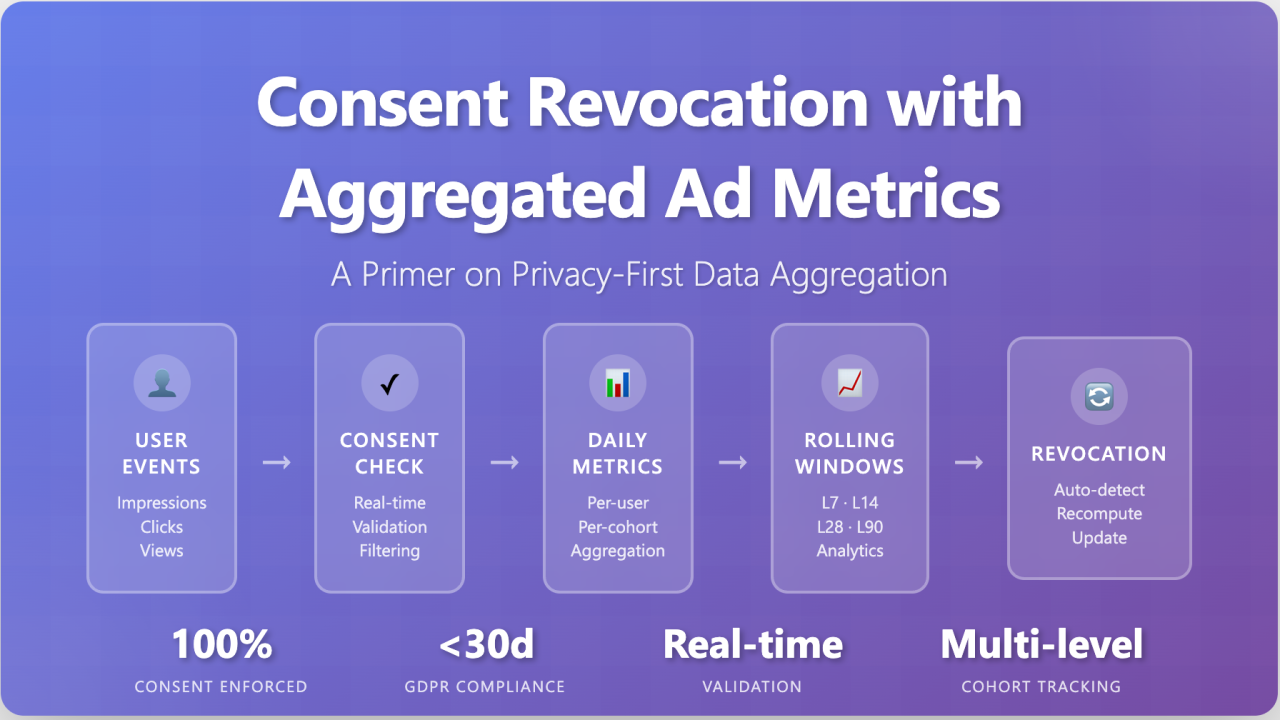
An Implementation Guide for Privacy-First Data Aggregation
⚠️ DISCLAIMER
Important Legal Notice:
This document is provided for educational and informational purposes only using a fictitious data model. By using, referencing, or implementing any content from this guide, you acknowledge and agree to the following:
Liability Waiver
No Warranty: This guide is provided "as is" without warranty of any kind, either express or implied, including but not limited to warranties of merchantability, fitness for a particular purpose, or non-infringement.
No Professional Advice: The content in this document does not constitute legal, compliance, security, or professional advice. You should consult with qualified legal counsel and compliance professionals before implementing any privacy or data management system.
No Responsibility for Damages: The author(s) shall not be held liable for any direct, indirect, incidental, consequential, special, exemplary, or punitive damages, including but not limited to: Loss of data or privacy breaches Regulatory fines or penalties (GDPR, CCPA, or other) Business interruption or lost profits Legal costs or compliance violations System failures or security incidents Any other damages arising from implementation or use
Implementation Risk: Implementation of any system described herein is done entirely at your own risk. The author(s) make no guarantees regarding GDPR compliance, CCPA compliance, or compliance with any other privacy regulations.
Company Affiliation
This work does NOT represent Meta Platforms, Inc.:
The views, opinions, code examples, and architectural designs expressed in this document are solely those of the individual author
This content is NOT endorsed by, affiliated with, or representative of Meta Platforms, Inc. or any of its subsidiaries
This document does NOT reflect Meta's policies, practices, architectures, or implementations
Any similarity to Meta's systems or practices is purely coincidental
Meta Platforms, Inc. bears NO responsibility for the content of this document
Author Attribution
Personal Work: This document represents personal research, study, and educational content created independently. While the author may be employed by Meta Platforms, Inc., this work was created outside of employment responsibilities and does not use any proprietary or confidential information.
Regulatory Compliance Notice
Privacy regulations (including GDPR, CCPA, LGPD, PIPEDA, and others) are complex, jurisdiction-specific, and subject to change. This guide provides technical implementation patterns but does NOT guarantee compliance with any specific regulation. You MUST:
Consult with qualified legal counsel in your jurisdiction
Conduct thorough compliance assessments
Implement appropriate security controls
Maintain proper documentation and audit trails
Stay updated on regulatory changes
Use at Your Own Risk
By proceeding to read or implement any part of this guide, you acknowledge that:
You are solely responsible for ensuring compliance with applicable laws
You will conduct appropriate testing and validation
You will implement proper security measures
You accept all risks associated with implementation
If you do not agree to these terms, please do not use this document.
Introduction
This article provides a complete implementation guide for building privacy-first data aggregation systems that handle:
Dynamic consent management with real-time validation
Multi-level cohort tracking with time-dependent membership
Granular consent scopes (analytics, advertising, personalization)
GDPR Article 17 compliance (Right to Erasure)
Aggregation recalculation after consent changes
Audit trails for all privacy-related actions
Business Context
For platforms like simultaneous (a general computer-use agent in the cloud), managing user consent across different data purposes while maintaining accurate growth metrics is critical. This guide shows how to:
Track advertising performance (impressions, clicks, CTR) across cohorts
Respect user consent at every step of data processing
Handle consent revocations without losing historical accuracy
Comply with GDPR requirements for data erasure
Support partial consent scenarios (e.g., analytics yes, ads no)
Architecture Overview
Core Principles
Consent is captured at event-time - Every event records the consent state when it occurred
Aggregates filter on consent - Pre-computed metrics only include consented data
Revocation triggers recomputation - Affected time windows are automatically recalculated
Historical context preserved - Events from before revocation can remain (depending on regulations)
Efficient queries - Pre-aggregation enables fast dashboards while respecting privacy
Data Flow Architecture
Technology Stack Recommendations
Event Streaming: Apache Kafka, AWS Kinesis, Google Pub/Sub
Primary Database: PostgreSQL 14+, MySQL 8+
Data Warehouse: Snowflake, BigQuery, Redshift
Cache Layer: Redis for real-time consent lookups
Object Storage: S3, GCS for backups and archives
Job Orchestration: Apache Airflow, Prefect
Consent Revocation Scenarios
Overview
This section demonstrates how to aggregate metrics like impressions, ads seen, and clicks for users and cohorts, then handle consent revocation scenarios.
Data Schema
Event Stream (Source of Truth)
Aggregation Tables
Sample Data Setup
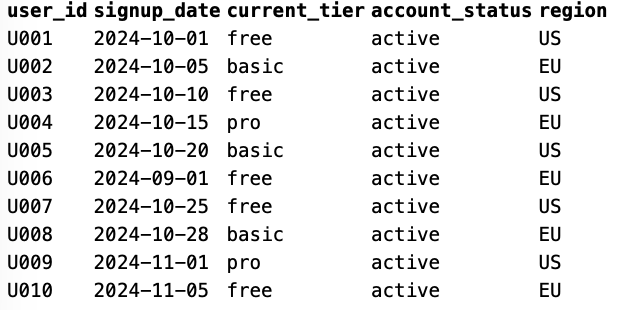
User Base (10 Sample Users)
Consent History
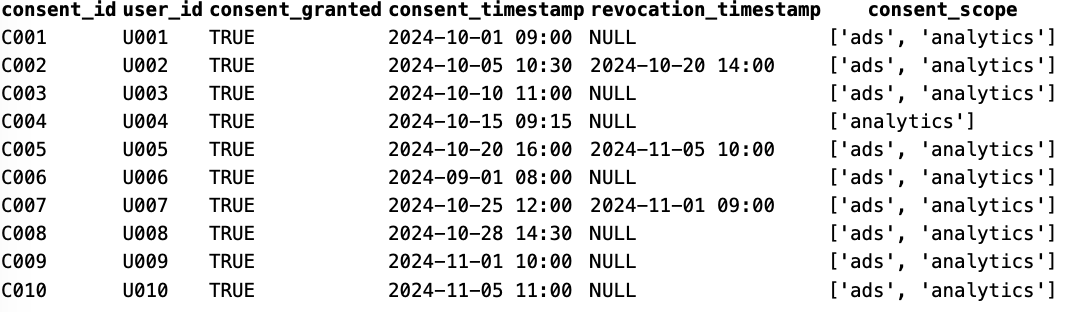
Key Observations:
U002: Revoked consent on Oct 20
U005: Revoked consent on Nov 5
U007: Revoked consent on Nov 1
U004: Only consented to analytics, NOT ads
Raw Ad Events (Nov 1-7, 2024)
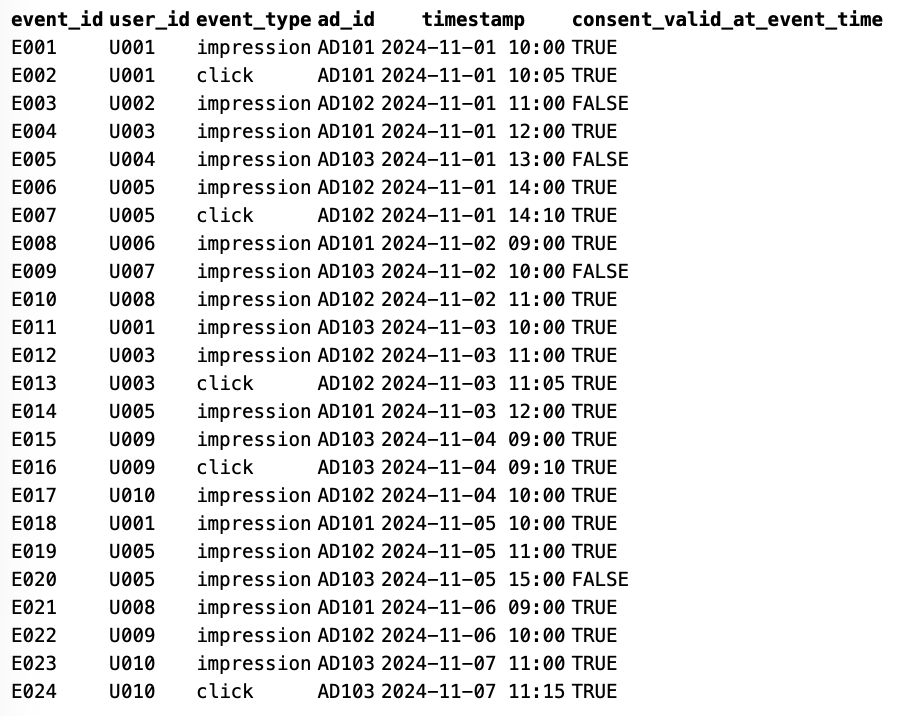
Notable Events:
E003: U002 (revoked Oct 20) - consent invalid
E005: U004 (no ad consent) - consent invalid
E009: U007 (revoked Nov 1) - consent invalid
E020: U005 (revoked Nov 5 at 10am, event at 3pm) - consent invalid
Real-Time Processing Flow
Event Ingestion with Consent Validation
Daily Aggregation Job
Rolling Window Aggregation
Consent Revocation Handling
Scenario: User Revokes Consent on Day 10
Example Timeline: User Journey with Revocation
Growth Account User Journey:

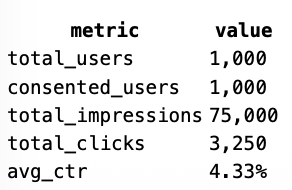
Data State Before Revocation (Day 9)
L7 Metrics (Days 3-9) for growth_account cohort:
Immediate Impact (Day 10, after 15:00)
Events for this user on Day 10:
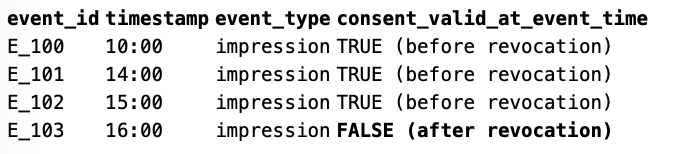
Daily aggregate for this user on Day 10:
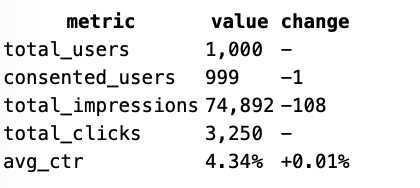
Data State After Revocation (Day 10)
L7 Metrics (Days 4-10) - Recomputed:
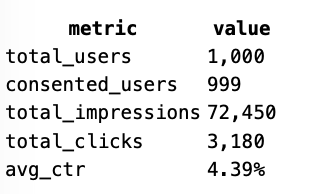
Data State 20 Days Later (Day 30)
L7 Metrics (Days 24-30) - User's data completely excluded:
L28 Metrics (Days 3-30) - Partial impact:
Days 3-9: User's data still included (pre-revocation)
Days 10-30: User's data excluded
Privacy-Preserving Query Pattern
Multi-Level Cohorts & Time-Dependent Opt-Outs
Overview
This section demonstrates how to handle dynamic cohort membership where users can join or leave cohorts at any time, combined with time-dependent consent changes.
Cohort Hierarchy
Enhanced Schema for Dynamic Cohorts
Sample Data: Tier Changes
User Tier Evolution
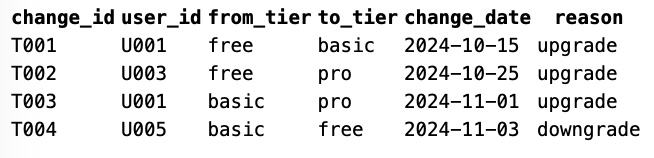
Cohort Membership Changes:
U001: free (Oct 1-14) → basic (Oct 15-31) → pro (Nov 1+)
U003: free (Oct 10-24) → pro (Oct 25+)
U005: basic (Oct 20-Nov 2) → free (Nov 3+)
Determining Cohort Membership
Daily Cohort Membership Snapshot (Nov 1-7, 2024)

Notice: U005's cohorts change on Nov 3 when they downgrade from basic to free.
Enhanced Daily Aggregation with Multiple Cohorts
Daily Metrics Per User Per Cohort
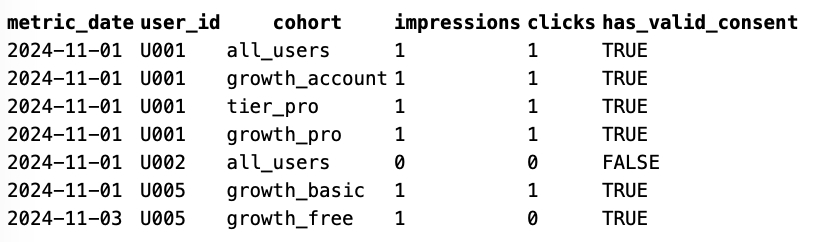
Key Observations:
Each user appears once per cohort they belong to
U001 on Nov 1 appears in 4 cohorts (all_users, growth_account, tier_pro, growth_pro)
U005 appears in different cohorts on different dates (basic on Nov 1, free on Nov 3)
U002 has no valid consent, so impressions/clicks are 0
Cohort-Level L7 Aggregation
L7 Cohort Aggregation Results (Nov 1-7)
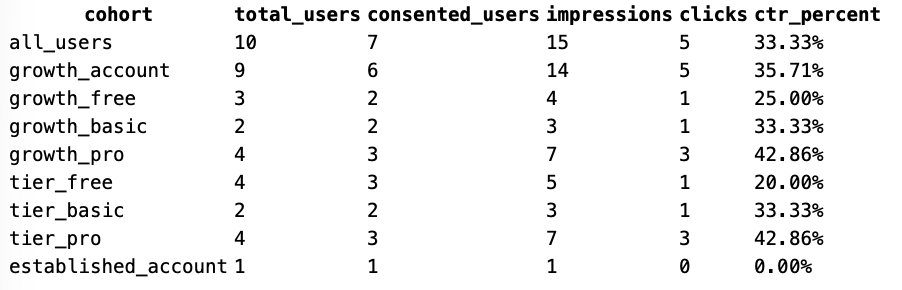
Insights:
growth_pro has highest CTR (42.86%)
growth_account overall has 35.71% CTR
3 out of 10 users have no valid consent (U002, U004, U007)
Scenario: Combined Tier Change + Consent Revocation
U005's Complete Journey:
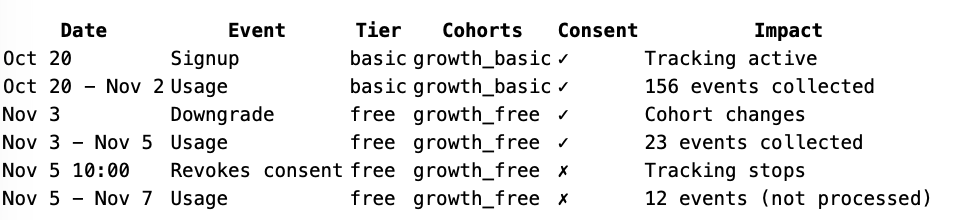
U005 Cohort Metrics Impact
Before Revocation (Nov 1-5):

After Revocation (Nov 1-7):

Partial Consent Implementation
Overview
Users can grant consent for specific purposes (e.g., analytics but not advertising). This section shows how to implement and enforce granular consent.
Enhanced Consent Schema
Sample Consent Profiles
Users with Different Consent Profiles
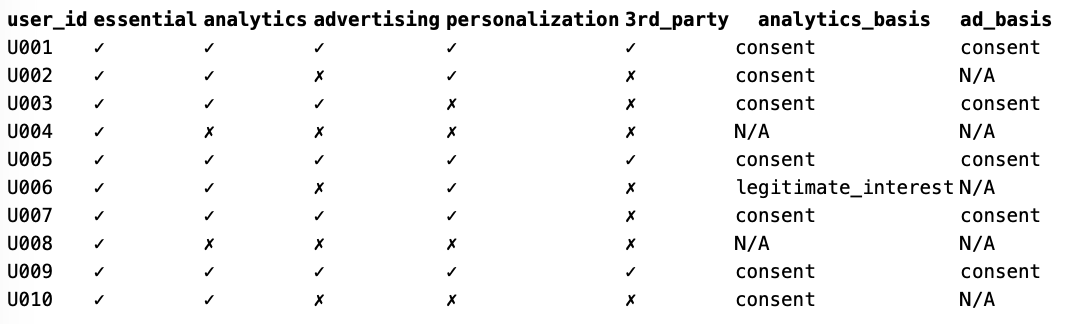
Consent Profiles:
Full Consent (U001, U005, U009): All purposes
Analytics Only (U002, U006, U010): No advertising
Analytics + Ads (U003, U007): No personalization/3rd party
Essential Only (U004, U008): Strict privacy
Events with Purpose Classification
Sample Events with Purpose Tags

Key Observations:
E005: U002 saw ad but has NO ad consent → retention_until = NULL (should be purged)
E006: U004 page view but NO analytics consent → retention_until = NULL
E002: Requires both advertising + analytics consent, U001 has both → Valid
Retention period uses shortest of applicable purposes (ads=90 days < analytics=365 days)
Event Validation with Partial Consent
Separate Aggregation Tables by Purpose
Analytics Metrics with Consent Filtering
Analytics Metrics (Nov 1-7):

Breakdown:
Users with analytics consent: U001, U002, U003, U005, U006, U007, U009, U010 (7 users)
Users WITHOUT: U004, U008 (2 users)
U004 and U008's page views are NOT counted
Advertising Metrics (Separate Consent)

Breakdown:
Users with ad consent: U001, U003, U005, U007, U009 (5 users)
Users WITHOUT: U002, U004, U006, U008, U010 (5 users)
U002's ad impressions are NOT counted (lacks ad consent)
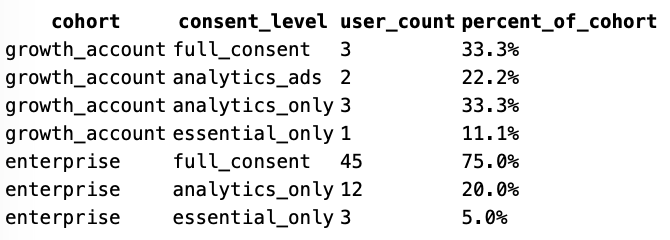
Consent Coverage Analysis Query
Consent Coverage by Cohort
GDPR Right-to-Erasure
Overview
GDPR Article 17 grants users the "Right to Erasure" (right to be forgotten). This section provides a complete implementation including data inventory, deletion workflow, and compliance certification.
Erasure Request Schema
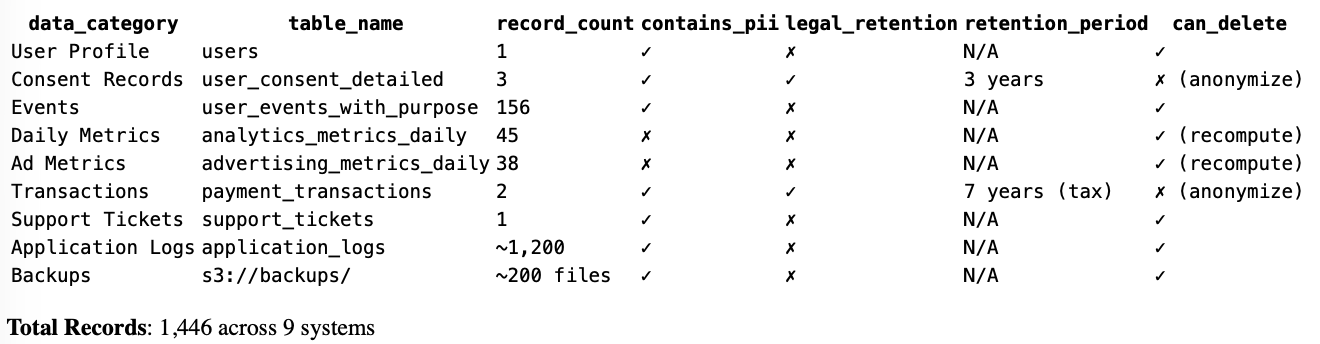
Data Inventory for Erasure
Data Inventory for User U005
Deletion Workflow Implementation
Deletion Execution Log for U005
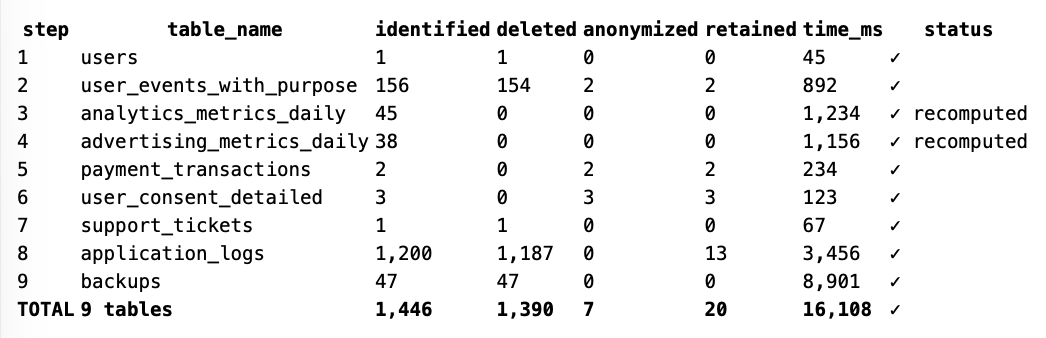
Summary:
96.1% deleted (1,390 records)
0.5% anonymized (7 records)
1.4% retained (20 records) - legal requirements
Total execution time: 16.1 seconds
Before/After Data State
Before Deletion:

After Deletion:

Impact on Aggregates After Deletion
Aggregate Recomputation
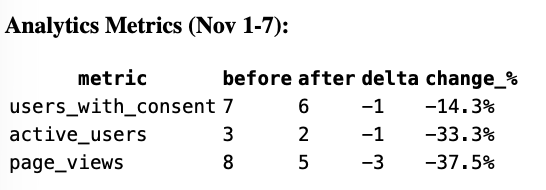
Analytics Metrics (Nov 1-7):
Advertising Metrics (Nov 1-7):
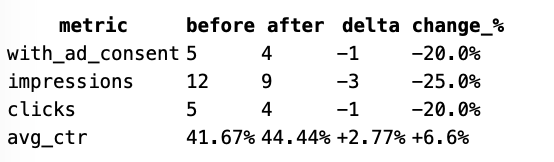
Interesting to note: CTR improved after deletion (fewer impressions, proportionally more clicks from remaining users)
Advanced Queries & Analytics
Query 1: Deletion Impact Forecast
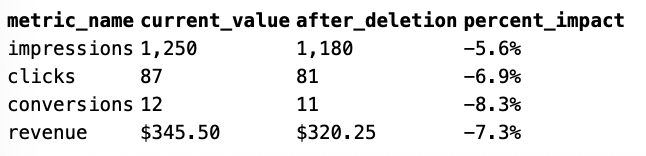
Deletion Impact Forecast Example
For high-value user U001:
Query 2: Consent Trend Analysis
Query 3: Data Retention Compliance Check
Query 4: Privacy Health Score
Compliance Dashboard
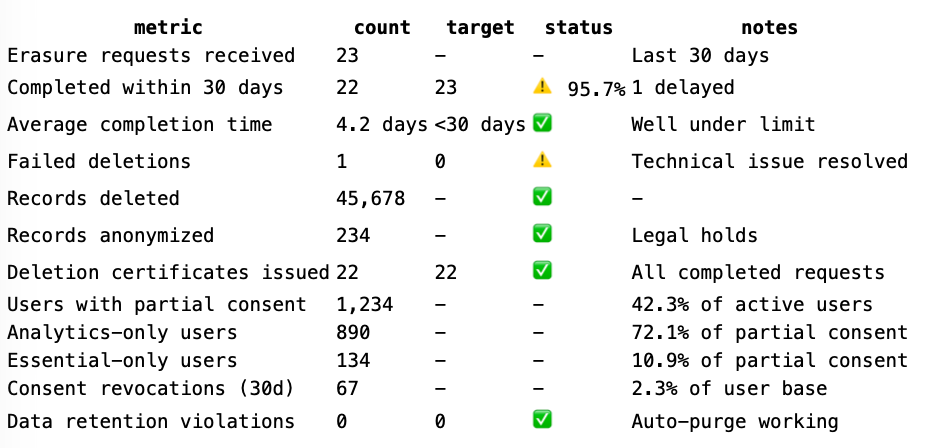
30-Day GDPR Compliance Summary
Regional Compliance Status

Implementation Checklist
Implementation Checklist
Phase 1: Foundation (Weeks 1-2)
Database Schema
Create consent tables with granular flags
Create event tables with purpose tagging
Create aggregation tables (daily, cohort-level)
Add indexes for performance
Set up audit logging tables
Consent Management
Implement consent validation service
Set up Redis cache for consent lookups
Create consent change API endpoints
Build consent preference UI
Implement consent audit logging
Phase 2: Event Processing (Weeks 3-4)
Event Pipeline
Set up event streaming (Kafka/Kinesis)
Implement real-time consent validation
Create event enrichment with consent flags
Build event storage with purpose tags
Implement retention period calculation
Aggregation Jobs
Build daily aggregation pipeline
Create rolling window calculations (L1/L7/L14/L28)
Implement per-cohort aggregations
Set up job scheduling (Airflow)
Phase 3: Dynamic Cohorts (Weeks 5-6)
Cohort Management
Implement cohort assignment logic
Create daily cohort snapshot job
Build multi-cohort aggregation
Handle tier change events
Create cohort transition tracking
Phase 4: Consent Revocation (Weeks 7-8)
Revocation Handling
Implement consent revocation API
Build affected window calculator
Create recomputation triggers
Implement aggregate refresh logic
Add revocation notifications
Phase 5: GDPR Erasure (Weeks 9-11)
Erasure Request Processing
Create erasure request API
Implement email verification
Build data inventory scanner
Create deletion orchestrator
Implement anonymization logic
Build backup deletion process
Compliance
Generate deletion certificates
Create audit trail views
Build compliance dashboard
Implement 30-day SLA monitoring
Set up legal hold management
Phase 6: Monitoring & Optimization (Weeks 12-13)
Monitoring
Set up consent rate tracking
Create erasure completion metrics
Build privacy health score
Implement alerting for violations
Create executive dashboard
Performance
Optimize aggregation queries
Tune database indexes
Implement query caching
Set up read replicas
Load test deletion process
Phase 7: Documentation & Training (Week 14)
Documentation
API documentation
Database schema docs
Operational runbooks
Privacy policy updates
User-facing consent explanations
Training
Train support team on erasure requests
Train engineers on consent system
Train legal team on compliance features
Create incident response playbook
Key Takeaways
1. Architecture Principles
Consent is First-Class:
Captured at event-time with immutable snapshots
Validated in real-time before processing
Filtered in every aggregation layer
Audited with complete change history
Dynamic by Design:
Users move between cohorts naturally
Consent can change at any time
Aggregates recompute automatically
No data is "locked in"
Privacy by Default:
Opt-in required for all non-essential purposes
Shortest retention period wins
Legal holds clearly documented
Deletion completes in <30 days
2. Data Flow Summary
3. Compliance Guarantees
GDPR Article 17: Right to Erasure in <30 days
GDPR Article 7: Clear consent with granular purposes
GDPR Article 13: Transparent retention periods
CCPA: Consumer data deletion rights
SOC 2: Audit trails for all privacy actions
4. Performance Considerations
Optimizations:
Redis caching for consent lookups (5min TTL)
Pre-aggregated metrics for fast queries
Batch recomputation for efficiency
Indexed lookups on user_id + timestamp
Scaling:
Partitioned event tables by date
Read replicas for analytics queries
Async deletion processing
Incremental aggregation windows
5. Business Value
User Trust:
Transparent consent controls
Granular privacy choices
Fast erasure response
Clear retention policies
Analytics Quality:
Accurate consent-filtered metrics
Dynamic cohort tracking
Real-time revocation handling
Audit-ready compliance
Risk Mitigation:
GDPR/CCPA compliance
Automated retention enforcement
Complete audit trails
Documented legal holds
Conclusion
This comprehensive guide provides a production-ready implementation for privacy-first data aggregation that:
✅ Respects user consent at every processing step
✅ Handles dynamic cohorts with time-dependent membership
✅ Supports partial consent for granular privacy control
✅ Implements GDPR erasure with full compliance
✅ Maintains data quality through automatic recomputation
✅ Provides audit trails for regulatory requirements
The architecture scales from startup to enterprise while maintaining the highest privacy standards. It's designed for platforms like simultaneous that need sophisticated analytics while respecting user privacy rights.
Next Steps(depends on your company needs)
Adapt schemas to your specific use case
Choose your tech stack (databases, streaming, orchestration)
Start with Phase 1 (foundation & consent management)
Iterate incrementally through each phase
Monitor compliance metrics from day one
Document everything for audits and team knowledge
Contributing to Privacy:
If you found this guide helpful, consider:
Sharing it with engineers building privacy-conscious systems
Providing feedback for improvements
Contributing additional use cases or scenarios
Implementing these patterns in your own privacy-first applications
Remember: Privacy is not just a compliance requirement—it's a fundamental user right and a competitive advantage in building trustworthy products.