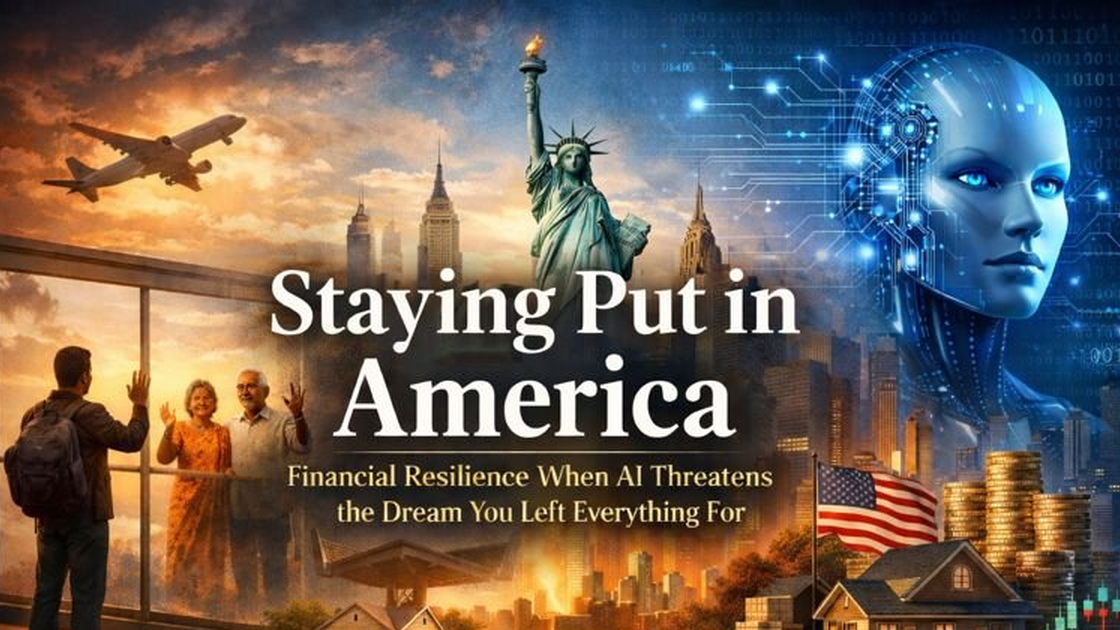
For those who waved goodbye with foggy eyes - here's how to protect what you sacrificed everything to build
Disclaimer: This article is for educational purposes only and not personalized financial, legal, or tax advice. Consult qualified professionals before making financial decisions. All investments carry risk, and individual circumstances vary. The author assumes no liability for actions taken based on this content.
The Departure That Still Haunts You
Do you remember that moment?
Standing at the airport, Maya's parents faces blurring behind foggy eyes and glass barriers. Maya's mother trying to be brave. Her father's hand raised in blessing - or was it goodbye? That eerie, hollow feeling in her chest as she walked toward the security line, knowing she might never see them again. Not like this. Not as you.
You made a choice that day. Not just to board a plane, but to split your life in half.
Half of you stayed behind - in the familiar sounds of your hometown, in your mother's kitchen, in the family gatherings where you belonged without explanation. The other half chased something you couldn't quite name. Opportunity? Freedom? The American Dream? A better life for your future children?
For what?
To stand in a country where you'd always be "from somewhere else." To work jobs where you'd prove yourself twice as hard for the same recognition — if you're lucky. To spend festivals alone. To miss weddings, funerals, your parents' aging. To send money home while living frugally. To build a life on borrowed status - H1B, Green Card, finally citizenship.
But you told yourself it was worth it.
The sacrifice had meaning. You were building something. You had stability. Your parents were proud. Your kids would have opportunities you never had. The pain of separation was the price of success.
And Now AI Wants to Take It All Away
Twenty years later, you're not worried about your immigration status anymore.
You're worried about your job.
You watch ChatGPT write code in seconds that would have taken you hours.
You see Claude analyze data sets you'd spend days on.
You read about Goldman Sachs estimating 300 million jobs globally could be exposed to automation.
You hear McKinsey warn that 12 million Americans may need to change occupations by 2030.
And you think: I left my parents to grow old without me... for this?
For a job that a machine might do better than me?
Here's the brutal truth: AI doesn't care how many temples your parents prayed in before your visa came. It will still automate your job.
The Unique Pressure on Immigrants
If you're a US citizen or Green Card holder from another country, you face something native-born Americans don't fully understand:
You can't just "go back home and figure it out."
Your entire identity is built on being the "successful immigrant"
Your family back home depends on you financially
Your kids are American - they don't have a "home country" to return to
You're in your 40s or 50s - peak earning years but also hardest years to pivot careers
You have no safety net here (no extended family) and you've been gone too long to have one there
You don't have the luxury of failure.
For an American worker facing AI disruption, it's scary. For an immigrant who sacrificed everything to be here, it's existential.
But Here's What They Don't Tell You
The same resilience that got you here can get you through this.
You didn't come to America because you were comfortable. You came because you were willing to face uncertainty for opportunity.
That DNA doesn't disappear because AI showed up.
This article isn't about false optimism or pretending the threat isn't real. The threat is very real.
This article is about channeling that same immigrant grit - the same calculated risk-taking, the same long-term thinking, the same willingness to sacrifice short-term comfort for long-term security - into a financial strategy that makes you antifragile in the age of AI.
Not just surviving the automation wave. Becoming stronger because of it.
And here's the uncomfortable truth: Immigration trauma builds grit. Unfortunately, it does not build emergency funds. That part is on you.
What This Article Covers
This is for you if you:
Have secured immigration status (Green Card, citizenship, or stable long-term visa)
Are staying in the United States
Work in sectors potentially affected by AI (tech, finance, consulting, creative, analysis)
Have family depending on you (here or back home)
Feel the weight of "I can't afford to lose" but don't know how to prepare
We'll cover:
Maximizing tax-advantaged wealth building (401k, Roth IRA, HSA - the foundations)
Building a crisis buffer (not 3-6 months - you need more)
Career resilience architecture (the skills AI can't easily replace)
AI-proof investment strategy (if AI takes your job, at least your portfolio benefits)
Skill arbitrage and continuous learning (staying ahead of obsolescence)
Insurance optimization (protecting against catastrophic losses)
Optionality framework (keeping your options open geographically and professionally)
Tax optimization strategies (keeping more of what you earn)
The catastrophe buffer (medical crises, divorce, aging parents - when life punches holes in your pocket)
This isn't theory. This is a playbook built on real financial data, immigrant experiences, and the cold reality of AI disruption.
Let's begin.
Strategy 1: Maximize Your Tax-Advantaged Wealth Building
401(k) - Your Foundation
Current limits (2025): $23,500 base contribution
Upcoming (2026): $24,500 base contribution
Catch-up contributions:
Ages 50-59: Additional $7,500 (2025), $8,000 (2026)
Ages 60-63: Additional $11,250 (2025 and 2026) - if your plan allows
Total max for ages 60-63: $35,750 (2026)
You probably already contribute to your 401(k). But are you maximizing it?
Action items:
Max out employer match immediately - If your employer matches 6%, contribute at least 6%. This is literally free money. If you're not taking it, you're leaving thousands on the table every year.
Front-load if possible - Instead of spreading $24,500 over 12 months, contribute heavily early in the year. Give your money more time in the market.
Roth 401(k) vs Traditional - If you're early/mid career or expect higher future income, consider Roth contributions (pay taxes now at lower rates, grow tax-free forever). If you're peak earnings, Traditional reduces taxes today.
Note: The $24,500 limit (2026) applies to your total employee contributions across all 401(k) accounts, whether traditional or Roth 401(k). You can't contribute $24,500 to each.
AI disruption angle:
If you lose your job, you can roll your 401(k) into an IRA without penalty. Unlike your paycheck, this money is yours, protected, growing.
When AI disrupts your income, this becomes your long-term safety net.
Roth IRA - Tax-Free Growth Forever
Current limit (2025): $7,000 ($8,000 if 50+)
Why Roth IRA is critical for AI-era uncertainty:
Contributions (not earnings) can be withdrawn anytime, tax and penalty-free
Acts as hybrid emergency fund + retirement account
Tax-free growth means more money when AI potentially shortens your earning years
No required minimum distributions (RMDs) - grows as long as you live
Income phase-out (2025):
Single: $150,000-$165,000
Married filing jointly: $236,000-$246,000
Above the income limit? Use the "Backdoor Roth":
Contribute to Traditional IRA (non-deductible)
Immediately convert to Roth IRA
Pay taxes only on gains during conversion (minimal if done quickly)
Do this every year. It's legal. The IRS knows about it.
HSA - The Triple Tax Advantage Secret Weapon
Current limits (2025):
Self-only: $4,300
Family: $8,550
Catch-up (55+): Additional $1,000
Upcoming (2026):
Self-only: $4,400
Family: $8,750
Catch-up (55+): Additional $1,000
HDHP requirements for 2026:
Minimum deductible: $1,700 (self-only), $3,400 (family)
Maximum out-of-pocket: $8,500 (self-only), $17,000 (family)
HSAs are criminally underutilized. Here's why they're powerful:
Tax-deductible contributions (reduces taxable income)
Tax-free growth (invest it like a 401k)
Tax-free withdrawals for medical expenses
After age 65, functions like Traditional IRA for non-medical expenses (taxed as income but no penalty)
Strategy for maximum benefit:
If you can afford it, don't use your HSA for current medical expenses. Pay out-of-pocket, invest your HSA, let it grow for 20-30 years.
Why? Healthcare costs in retirement average $315,000 per couple. You're building a medical retirement fund.
AI angle: If automation reduces your income in your 50s, medical costs won't decrease. This is future-proofing.
Requirements: Must have High Deductible Health Plan (HDHP) to contribute.
The Math of Maxing Everything Out
For a dual-income household (2026 numbers), total annual contribution capacity can exceed $70,000:
Two 401(k)s: $24,500 × 2 = $49,000
Two Roth IRAs: $7,000 × 2 = $14,000
Family HSA: $8,750
Total: $71,750 per year in tax-advantaged savings
For ages 50-59 (with catch-ups):
Two 401(k)s: $32,500 × 2 = $65,000
Two Roth IRAs: $8,000 × 2 = $16,000
Family HSA: $9,750 (if both 55+)
Total: $90,750 per year
For ages 60-63 (maximum catch-ups):
Two 401(k)s: $35,750 × 2 = $71,500
Two Roth IRAs: $8,000 × 2 = $16,000
Family HSA: $9,750 (if both 55+)
Total: $97,250 per year
Even for single-income on $150,000:
One 401(k): $24,500
One Roth IRA: $7,000
Family HSA: $8,750
Total: $40,250 per year (27% of gross income)
Seems impossible? Start with employer match, then increase 1% every raise.
Over 20 years at 7% return:
$40,250/year → $1.7 million
Even at $25,000/year → $1.1 million
This is your AI disruption insurance. When your job gets automated, this money is still there, compounding quietly, tax-advantaged, untouchable by economic chaos.
Strategy 2: Build Your Crisis Buffer - The 12-Month Rule
Why 3-6 Months is Dangerously Inadequate
Traditional advice: Keep 3-6 months of expenses in emergency fund.
That's outdated for the AI disruption era. Here's why:
AI-displaced jobs require retraining - 6-12 months to learn new skills, pivot industries
Age discrimination is real - Workers over 40 take 25% longer to find jobs
Industry pivots take time - You might need to change sectors entirely, not just companies
Severance packages are shrinking - Companies facing AI-driven margin pressure are cutting costs everywhere
The new rule: 12 months of essential expenses.
How to Calculate Your 12-Month Buffer
Essential monthly expenses (examples):
Housing (rent/mortgage): $2,500
Utilities: $200
Groceries: $800
Insurance (health, auto, life): $600
Transportation: $300
Minimum debt payments: $500
Total: $4,900/month
12-month buffer: $60,000
Not total income replacement. Essential expenses only.
No restaurants
No vacations
No subscription services
No discretionary spending
This is not comfort money. This is dignity money.
This is "I have time to retrain and find work without panic" money.
Where to Keep Your Emergency Fund
Do keep it in:
High-yield savings accounts (currently 4.5-5% APY)
Money market funds
Short-term Treasury bills (4-week to 6-month)
Don't keep it in:
Regular checking account (inflation erodes it)
Stocks/index funds (you might need it when market is down 30%)
Your home equity (you can't pay rent with equity)
Crypto (I shouldn't have to explain this)
Accessibility is more important than returns. This money needs to be available within 24-48 hours, no penalties, no market risk.
Taxable Brokerage Account - Your Flex Fund
Beyond retirement accounts and emergency fund, you need accessible investment money.
Why:
Retirement accounts lock money until 59½ (with exceptions)
Emergency fund is for emergencies only
Taxable brokerage bridges the gap - accessible anytime, no penalties
Suggested asset allocation:
60% Broad market index funds (VTI, VXUS)
20% Bond funds (BND, BNDX)
20% Individual stocks or sector bets
This is money for:
Taking a lower-paying job during career transition
Starting a business
Funding a sabbatical for retraining
Moving to a new city for better opportunities
Tax optimization:
Hold investments >1 year (long-term capital gains 0-20% vs ordinary income 10-37%)
Harvest tax losses annually (offset gains)
Prioritize qualified dividends
Strategy 3: Career Resilience Architecture
The Barbell Strategy - Skills AI Can't Easily Replicate
Concept: Develop skills at two extremes:
1. Hyperspecialized - Deep expertise AI can't (yet) replicate:
AI safety and alignment research
Regulatory compliance for AI systems
Complex negotiation and relationship management
Your company's unique technical stack (institutional knowledge)
Cross-cultural business development
Ethical judgment in ambiguous situations
2. Hypergeneralized - Broad skills that bridge domains:
Strategic thinking and business model innovation
Change management and organizational transformation
Storytelling and persuasive communication
Systems thinking across multiple disciplines
Leadership and team dynamics
Avoid being only a "middle" skills worker:
Only a routine coder (AI will commoditize this)
Only data entry and processing
Only basic analysis and reporting
Only template-based design
Only formulaic writing
The nuance: AI will not eliminate routine coding entirely, but it will commoditize it. The question is whether you can do more than just routine coding.
Action: Dedicate 5 hours per week to deliberately developing barbell skills. Not just doing your job - actively learning.
The Side Income Insurance Policy
Build 1-2 income streams outside your primary job:
Why:
Reduces psychological dependence on single employer
Provides financial runway if primary income disappears
Tests skills in marketplace before you need them
Creates optionality
Examples that scale:
Technical consulting (evenings/weekends) - $100-300/hour
Online course creation - record once, sell continuously
Advisory roles for startups - $2K-5K/month
Rental property income (house hacking)
Fractional executive/specialist roles
Goal: $1,000-$2,000/month supplemental income
Time investment: 5-10 hours/week
Critical mindset: This isn't about getting rich quick. It's about eliminating single points of failure in your income.
When your primary job gets disrupted, you're not starting from zero. You already have income, clients, reputation in an adjacent space.
Strategy 4: The AI-Proof Investment Thesis
Invest in What AI Can't Easily Disrupt
If AI is taking jobs, at least make money from AI's success.
Sectors with structural resilience or AI benefit:
1. AI Infrastructure (paradoxically)
Semiconductor companies: NVIDIA, AMD, TSMC
Cloud providers: Amazon (AWS), Microsoft (Azure), Google (GCP)
Data centers and energy infrastructure for AI
AI ecosystem beneficiaries (chips, cloud, data centers, energy)
2. Healthcare Services (emphasis on services, not tech)
Home health care agencies
Elderly care facilities
Specialized medical services
Mental health services (human connection still matters)
3. Essential Infrastructure
Utilities (people need power regardless)
Renewable energy (solar, wind infrastructure)
Water and waste management
4. Real Assets
Real estate (carefully selected - more on this below)
Commodities
Infrastructure funds (toll roads, airports, ports)
Diversification principle: If AI displaces your job, your investments should at least benefit from the AI boom.
Don't go all-in on one thesis. But tilt your portfolio toward AI-resistant or AI-benefiting sectors.
Real Estate Considerations for Immigrants
For those with Green Cards/Citizenship:
Pros:
Mortgage interest deduction (up to $750K loan)
Property appreciation (historically 3-4% annually)
Rental income potential
Inflation hedge
Forces saving (mortgage payment = forced investment)
Cons:
Illiquid (can't quickly convert to cash)
Requires 20-25% down payment ($80K-$100K for median home)
Property taxes, maintenance, HOA fees
Ties you geographically (limits job mobility)
Market risk (2008 wasn't that long ago)
The immigrant reality: Visa risk is gone, but career mobility risk is now the new visa risk.
Smart approach:
If you're likely to stay in your metro area for 7+ years: Consider purchasing
Use 30-year fixed mortgage (never ARM)
Never more than 28% of gross income on housing
Have 6-month buffer beyond down payment
If AI might require relocation: Wait or invest in REITs instead
REITs provide real estate exposure without liquidity risk
Can move for better job opportunities
House hacking: Rent out rooms or ADU (Accessory Dwelling Unit) to reduce your housing costs. Turns primary residence into partial income property.
Critical: Don't buy assuming your current income continues. If you lose your job, can you afford the mortgage on 60% of current income?
Strategy 5: Skill Arbitrage and Continuous Learning
The Continuous Learning Budget
Allocate 5-10% of gross income to skill development:
On $100K income: $5,000-$10,000/year for learning
High-ROI investments:
Professional certifications in AI-adjacent fields ($2K-$5K)
Executive education programs ($3K-$15K)
Coding bootcamps for adjacent skills ($5K-$15K)
Public speaking/communication courses ($500-$2K)
Industry conferences (networking + learning) ($1K-$3K)
Community college hack: Many offer professional development courses for $300-$1,000 that are as valuable as $10,000 bootcamps. Check your local community college catalog.
Company reimbursement: Most employers offer $2K-$5K annually for education. Use it or lose it.
The Pivot Preparation Fund
Set aside $5,000-$15,000 specifically for career transition.
This is for:
Bootcamp or certification if you need to pivot industries
Living expenses during unpaid apprenticeship/internship
Starting a business (LLC, website, initial marketing)
Relocation costs for better opportunities
Don't touch this unless you're actually pivoting. This is psychological safety - knowing you have resources to reinvent yourself.
When AI disrupts your field, you won't panic. You'll have the funds to invest in yourself and transition deliberately, not desperately.
Strategy 6: The Insurance Audit - Protecting Against Catastrophic Loss
Disability Insurance - The Forgotten Safety Net
Reality: You're statistically more likely to become disabled during working years than to die.
What it covers: If injury/illness prevents you from working, provides 50-70% of income replacement.
Through employer: Usually 60% of salary, but benefit is taxable (you net ~42%) Private policy: More expensive, but benefit is tax-free (you net the full amount)
For immigrants as primary breadwinners: Especially critical if supporting family across continents.
Cost: $50-$200/month depending on age, occupation, and coverage amount.
Life Insurance Realism
If you have dependents:
Term life insurance: 10-15x annual income
Duration: Until youngest child is 25 or through your retirement
Cost: $30-$100/month for $1M coverage (healthy non-smoker)
Don't buy whole life/universal life unless you're very high net worth with estate planning needs. It's expensive and investment returns are mediocre.
AI angle: If AI reduces long-term earning potential, insurance protects family from worst-case scenarios.
Review beneficiaries annually. Especially after divorce, remarriage, kids.
Umbrella Liability Coverage
What it is: Liability protection beyond your auto/home insurance limits.
Cost: $200-$500/year for $1-2M coverage
Why it matters: As you build wealth, you become lawsuit target. Especially important if you:
Have rental properties
Run side businesses
Have teenage drivers
Host events at your home
One lawsuit can wipe out decades of savings. $300/year is cheap insurance.
Strategy 7: The Optionality Framework - Keep Your Options Open
Geographic Arbitrage Planning
The immigrants who thrive are those who maintain options.
Within US:
Can you work remotely? (Lock this in contractually if possible)
Are you willing to relocate to lower cost-of-living areas?
States with no income tax: Texas, Florida, Nevada, Washington, Tennessee Relocating from California to Texas saves ~10% in state income tax on $100K = $10K/year
International options:
You have Green Card/Citizenship - you can always return to home country
Build professional network back home (don't burn bridges)
Consider keeping small property/investments in home country as insurance
Popular expat destinations: Portugal, Spain, Thailand, Mexico (lower costs, good quality of life)
The goal: Don't let geography become a trap. If AI decimates jobs in your city/industry, can you move?
The Financial Independence (FI) Calculation
Financial Independence: Having enough money that work becomes optional.
Traditional "4% rule": If you have 25x your annual expenses invested, you can theoretically sustain indefinitely.
Example:
Annual expenses: $60,000
FI number: $1.5M (60K × 25)
At $100K salary, aggressive saving + investing: Achievable in 15-20 years
Modified for AI era: Aim for 30x expenses (3.33% withdrawal rate) for extra buffer.
Why? Lower returns in future, potential need to access funds earlier than planned, increased uncertainty.
This isn't about "retiring early." It's about reaching a point where you work because you want to, not because you have to.
When AI disrupts your industry, you have options:
Take lower-paying but more fulfilling work
Start a business without income pressure
Retrain without panic
Negotiate from strength
Strategy 8: Tax Optimization in Uncertain Times
The Roth Conversion Opportunity
If you lose your job or take lower-paying work, you create a low-income year - perfect for Roth conversions.
Strategy:
Convert Traditional IRA → Roth IRA
Pay taxes at your current (lower) bracket
Future growth is tax-free
Example:
Normally earn $150,000/year (24% tax bracket)
Laid off, only earned $40,000 that year (12% tax bracket)
Convert $50,000 from Traditional IRA to Roth
Pay only 12% tax instead of 24% - save $6,000 in taxes
That $50K grows tax-free forever
This turns job loss into tax optimization opportunity.
Maximize Pre-Tax Benefits Annually
Dependent Care FSA: $5,000/year (tax-free for childcare, elder care) Healthcare FSA: $3,200/year (tax-free for medical expenses)
Use it or lose it, so plan carefully. But in uncertain times, having pre-tax money for essentials is valuable.
Health Savings Account (HSA): As covered earlier - triple tax advantage.
State Income Tax Considerations
If AI forces career change or relocation, consider state tax implications:
High state income tax:
California: 9.3-13.3%
New York: 6.5-10.9%
New Jersey: 6.37-10.75%
No state income tax:
Texas, Florida, Nevada, Washington, Tennessee, South Dakota, Wyoming, Alaska, New Hampshire
On $100K income, moving from California to Texas saves ~$10K/year.
Over 20 years: $200K more wealth.
Not suggesting you move solely for taxes. But if AI disrupts your career and you're relocating anyway, factor this in.
Strategy 9: The Catastrophe Buffer - When Life Punches Holes in Your Pocket
The Reality Nobody Wants to Discuss
Your perfect financial plan assumes smooth sailing. Life doesn't work that way.
What actually derails finances:
Medical catastrophe: 66% of US bankruptcies involve medical issues. Even with insurance, cancer costs $16K-$30K out-of-pocket
Divorce: 40-50% of marriages end in divorce. Average cost: $15K-$30K in legal fees + 50% asset split
Aging parents: Nursing care averages $108K/year. Medical emergencies in India requiring family travel: $5K-$15K per incident
Mental health crisis: Inpatient care $30K-$60K for 30 days. Lost income: 3-6 months
Special needs family member: $20K-$100K/year in additional lifetime costs
For immigrants: No extended family safety net + obligation to support family back home + cultural shame around asking for help = catastrophic consequences.
The question: Can you survive a catastrophe without permanent financial destruction?
The Three-Layer Defense
Layer 1: Insurance Stack (Non-Negotiable)
Required coverage:
Health insurance: Choose lowest out-of-pocket maximum, not lowest premium
Disability insurance: 60-70% income replacement
Life insurance: 10-15x income if dependents (term only)
Umbrella liability: $1-2M coverage for $200-400/year
Critical illness (optional): Lump sum for cancer/heart attack/stroke
Total cost: $500-800/month
Yes, it's expensive. One catastrophe without coverage costs 50x more.
Layer 2: Catastrophe Fund (Separate from Emergency Fund)
Target: $25,000-$50,000
Why so much?
Medical out-of-pocket maximum: $8K-$16K
Legal retainer: $5K-$10K
Emergency travel to India: $3K-$5K
Three months reduced income: $15K-$25K
Where: 50% high-yield savings (instant access), 50% short-term bond fund
Rule: This money doesn't exist except for genuine catastrophes. When used, rebuilding it becomes Priority #1.
Layer 3: Knowledge of Systems
Most people financially destroy themselves because they don't know what's available.
Medical crisis:
Request itemized bills (80% contain errors)
Negotiate BEFORE paying (hospitals often accept 40-60% if paying cash upfront)
Apply for hospital financial aid (available up to 400% of federal poverty line)
For major procedures, fly to India: Hip replacement $40K (US) vs $7K (India at Apollo/Fortis)
Divorce:
Start with mediation ($3K-$5K vs $30K litigation)
QDRO for retirement splits (no tax penalty)
For H1B holders: Consult immigration attorney IMMEDIATELY (divorce doesn't end status but affects renewals)
Aging parents:
Hire local help in India ($200-500/month) rather than sending $2K/month to siblings
Bring parents on visitor visa for 6 months if medical emergency
Set explicit contribution limit with siblings in writing (prevents resentment and overextension)
The Sandwich Generation Trap
The impossible math:
Kids in college: $40K/year × 2 = $80K
Parents' support: $15K/year
Your living expenses: $60K
Total: $155K before taxes on $150K salary = doesn't work
Triage priority (harsh but necessary):
Your retirement first - Kids can take loans for education; you can't take loans for retirement
Essential parent care - Medical emergencies yes, lifestyle upgrades no
Kids' education - State schools, community college transfers, part-time work
Have explicit conversations:
With parents: "I can provide $X/month reliably, $Y for emergencies, not more without jeopardizing my own retirement"
With kids: "We contribute $X to college, rest comes from scholarships/loans/work"
With siblings: "I'm sending $X monthly, can you contribute $Y or provide time/care?"
Cultural resistance? Yes. But depleting your resources creates future crises where you become the burden.
The Recovery Playbook - After Catastrophe Hits
Month 1 - Triage:
Stop all non-essential spending immediately
File insurance claims, apply for hardship programs
Communicate with creditors (most have hardship options)
Don't raid 401k unless absolute last resort (taxes + 10% penalty decimates it)
Months 2-6 - Stabilization:
Negotiate medical bills before paying
Minimum viable expenses only
Maximize any income possible (side gig, spouse increases hours, part-time)
Rebuild $1,000 emergency fund (psychological relief)
Months 6-24 - Recovery:
Debt elimination strategy (snowball or avalanche method)
Carefully normalize expenses
Catastrophe fund rebuilding (Priority #1)
Add back insurance you may have cut
Year 2+ - Resilience:
Return to aggressive retirement saving
Update financial plan with new risk understanding
Help others facing similar situations
The Action Plan: Your Next 90 Days
Week 1-2: Audit and Baseline
Calculate net worth (all assets - all liabilities)
List all income sources (primary job, side income, investments)
Track actual monthly expenses for 30 days (not what you think - actual spending)
Review all insurance policies (understand what you have)
Check 401k, IRA, HSA balances and investment allocations
Week 3-4: Optimize Foundation
Increase 401k contribution to max or at least employer match
Open Roth IRA if you don't have one, fund it
Open HSA if eligible, contribute
Set up automatic transfers to high-yield savings (start building 12-month buffer)
Cancel 3 unnecessary subscriptions
Week 5-8: Build Resilience
Identify 3 skills to develop (1 hyperspecialized, 2 hypergeneralized)
Enroll in 1 course or certification program
Schedule informational interviews with 3 people in adjacent roles/industries
Start documenting your expertise (LinkedIn articles, blog, GitHub)
Research 2-3 side income opportunities
Week 9-12: Expand Optionality
Open taxable brokerage account, set up automatic investing
Network with 5 new people in your industry (join communities, attend events)
Apply for 1-2 stretch roles (even if not actively looking - stay interview-ready)
Research 2-3 lower cost-of-living cities or countries
Update LinkedIn profile, resume, portfolio
The Uncomfortable Truth
Most people won't do this.
They'll read this article, feel motivated for 48 hours, then return to comfort and inertia.
Why?
Because taking action requires admitting vulnerability. It requires accepting that:
Your current stability might be temporary
Your specialized skills might become obsolete in 5 years
Your company might not need you
Your immigration status, while secure, doesn't guarantee economic security
That discomfort is exactly why you must act.
The Empowering Truth
But here's the flip side:
Every single strategy in this article is within your control.
You don't need:
Permission from your employer
USCIS approval
Perfect market timing
Luck
You need:
Discipline to save aggressively
Humility to keep learning
Courage to face uncertainty
Wisdom to prepare while hoping for the best
Remember Why You Came
You didn't wave goodbye to your parents with foggy eyes because America offered comfort.
You came because you were willing to trade certainty for opportunity.
You came because you could envision a future worth sacrificing the present for.
You came because you had the courage to build something in a foreign land.
That same DNA that brought you across oceans can carry you through AI disruption.
The question isn't whether you have what it takes.
You've already proven you do.
The question is whether you'll apply that same intentionality, that same long-term thinking, that same willingness to sacrifice short-term comfort for long-term security to your financial life.
From Stability to Antifragility
Nassim Taleb's concept: Systems that gain from disorder and stress.
Your goal isn't just stability (maintaining the same despite shocks).
Your goal is antifragility (becoming stronger because of shocks).
How:
Diversified income streams mean one loss doesn't break you
12-month emergency fund means you can retrain without panic
Continuous learning means you adapt faster than disruption
Strong network means access to hidden job market
Tax-advantaged accounts mean wealth compounds undisturbed
Insurance means catastrophes are setbacks, not destruction
When AI disrupts your industry, you won't panic.
You'll have:
Time (12-month buffer)
Options (multiple income streams)
Skills (continuous learning)
Resources (retirement accounts, catastrophe fund)
Network (relationships built before you needed them)
Knowledge (understanding systems and resources)
You'll be the person others ask: "How did you prepare for this?"
Your Parents Watching
Think about those foggy-eyed goodbyes again.
Your parents didn't let you go easily. They sacrificed having you nearby. They endured empty nest. They told relatives you were "doing well in America."
They believed in you.
Not in your ability to avoid hardship - in your ability to face it.
When AI disrupts the economy, when jobs disappear, when the ground shifts:
Your parents won't ask if you avoided the storm.
They'll be proud that you prepared for it. That you protected your family. That you channeled that immigrant resilience into building something that lasts.
Their sacrifice wasn't so you could have an easy life.
It was so you could have a life where you face challenges from a position of strength.
Start Today. Not Tomorrow.
Not next month after the bonus. Not next year after the promotion. Not when you're "less busy."
Today.
Open that Roth IRA
Increase that 401k contribution by 1%
Schedule one hour this week for skill development
Set up automatic transfer to high-yield savings
Message one person in an adjacent field
Small actions compound.
Your future self - the one navigating AI disruption with confidence instead of panic - will thank you.
The Final Question
When you video call your parents next, and they ask how you're doing:
Will you say "fine" and hope the future works out?
Or will you tell them:
"I'm preparing. I'm building something that lasts. I'm honoring the sacrifice you made by ensuring I can weather whatever storms come."
The choice is yours.
The time is now.
What's the ONE action you'll take this week?