How Event-Driven Context Transforms Enterprise Intelligence Across Every Role
The Information System Collapse - Part 3
Imagine this scenario: Your CFO asks, "Which marketing channel actually drives our revenue?" Your CMO wants to know, "What's our true customer acquisition cost?" Your CTO needs to understand, "Does page performance actually impact the bottom line?"
The answer from your traditional ERP system? "We don't know."
This isn't a data problem. It's an architecture problem. And it's costing enterprises millions in blind spots, missed opportunities, and decisions made on incomplete information.
The $1M Question: What Happened vs. Why It Happened
When Order #12345 hits your ERP system, you capture:
What you DON'T capture:
All that behavioral context—the story of why this purchase happened—is lost forever.
The Five-Layer Architecture That Changes Everything
We've designed a five-layer event-driven architecture that preserves behavioral context from the first customer touchpoint all the way through to the general ledger posting—and makes it queryable in both directions.
The breakthrough? A single contextReferenceId field in every ERP record that points back to the complete behavioral history. This creates a bridge between transactional systems and event context that's never existed before.
But here's what makes this truly powerful: every role in the organization gets transformed value. This isn't just a technical upgrade—it's a complete reimagining of enterprise intelligence.
For the CFO: From Financial Reporting to Financial Intelligence
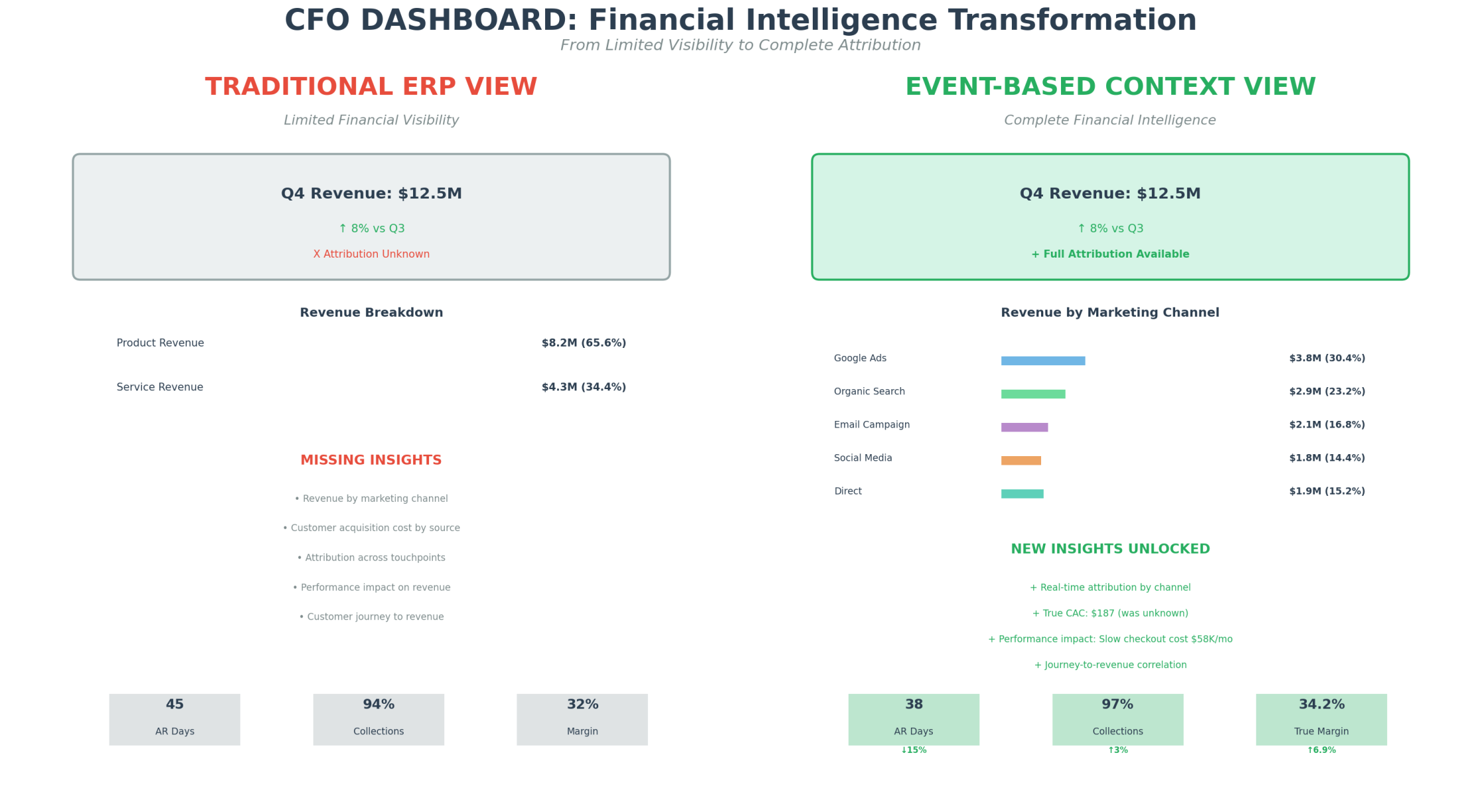
Traditional ERP systems tell you what revenue you generated. Event-based architecture tells you why, how, and from where that revenue came
The Transformation:
Revenue attribution by channel: See exactly which marketing channels drive revenue ($3.8M from Google Ads, $2.9M from organic)
True CAC visibility: Know your actual customer acquisition cost ($187) instead of guessing
Performance-to-revenue correlation: Quantify that slow checkout is costing $58K/month
Improved metrics: AR days down 15%, collections up 3%, true margin up 6.9%
Business Impact: CFOs can finally answer board questions with data instead of assumptions. Every revenue dollar has a traceable journey from first touch to GL posting.
For the CMO: From Last-Click Lies to Multi-Touch Truth
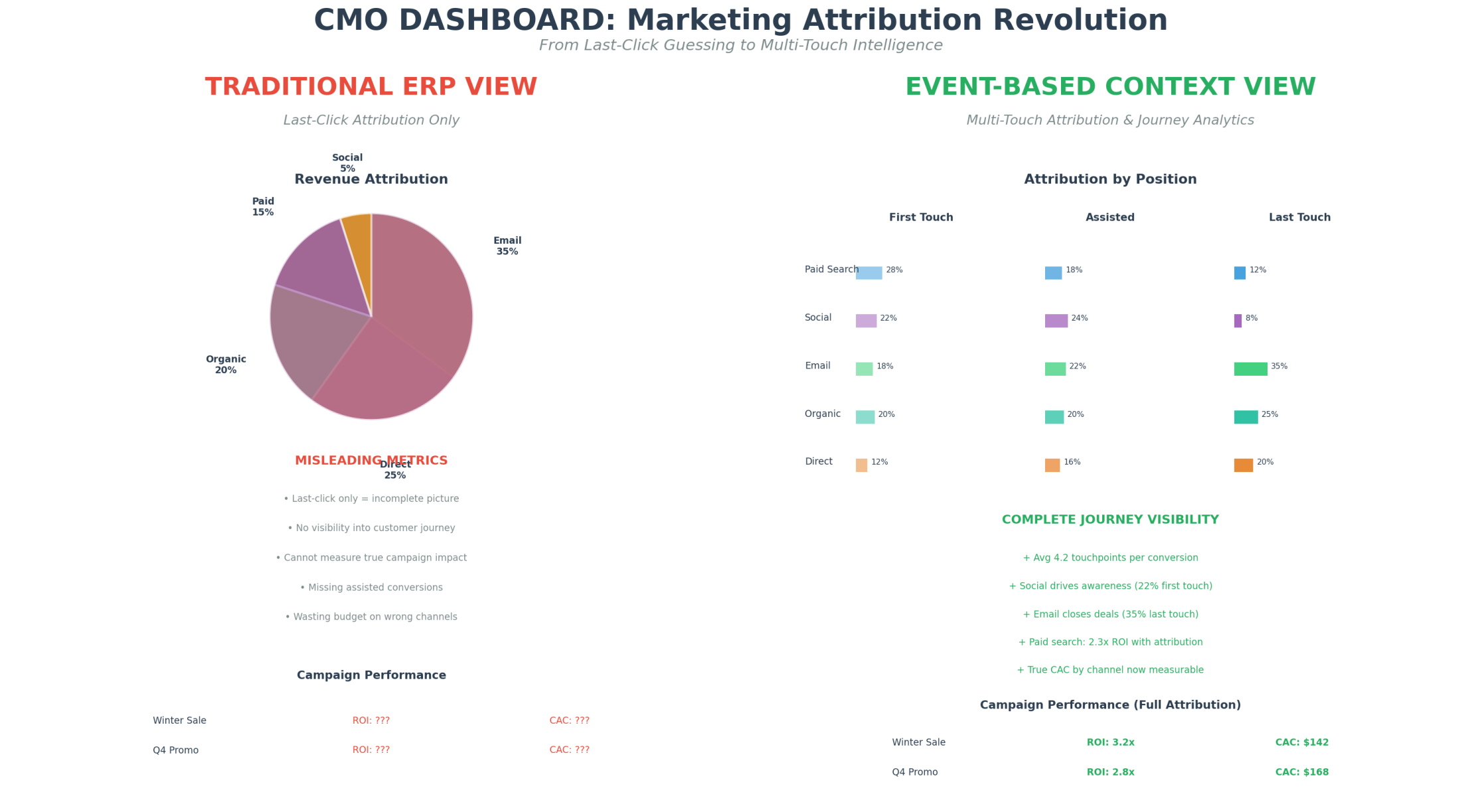
Last-click attribution is a comfortable fiction. Event-based architecture reveals the uncomfortable truth: most conversions require 4+ touchpoints, and you've been systematically underfunding the channels that actually drive awareness.
The Transformation:
Multi-touch attribution: See first touch (awareness), assisted touches (consideration), and last touch (conversion)
Channel rebalancing: Social drives 22% of first touches but only 5% last-click—it deserves more budget
Campaign ROI precision: Winter Sale: 3.2x ROI, Q4 Promo: 2.8x ROI—with full attribution
Journey optimization: Average 4.2 touchpoints per conversion, optimal follow-up: within 2 hours
Business Impact: CMOs can optimize spend across the entire funnel, not just the bottom. 15-25% improvement in marketing ROI through accurate attribution.
For the CTO: From Siloed Systems to Event-Driven Intelligence
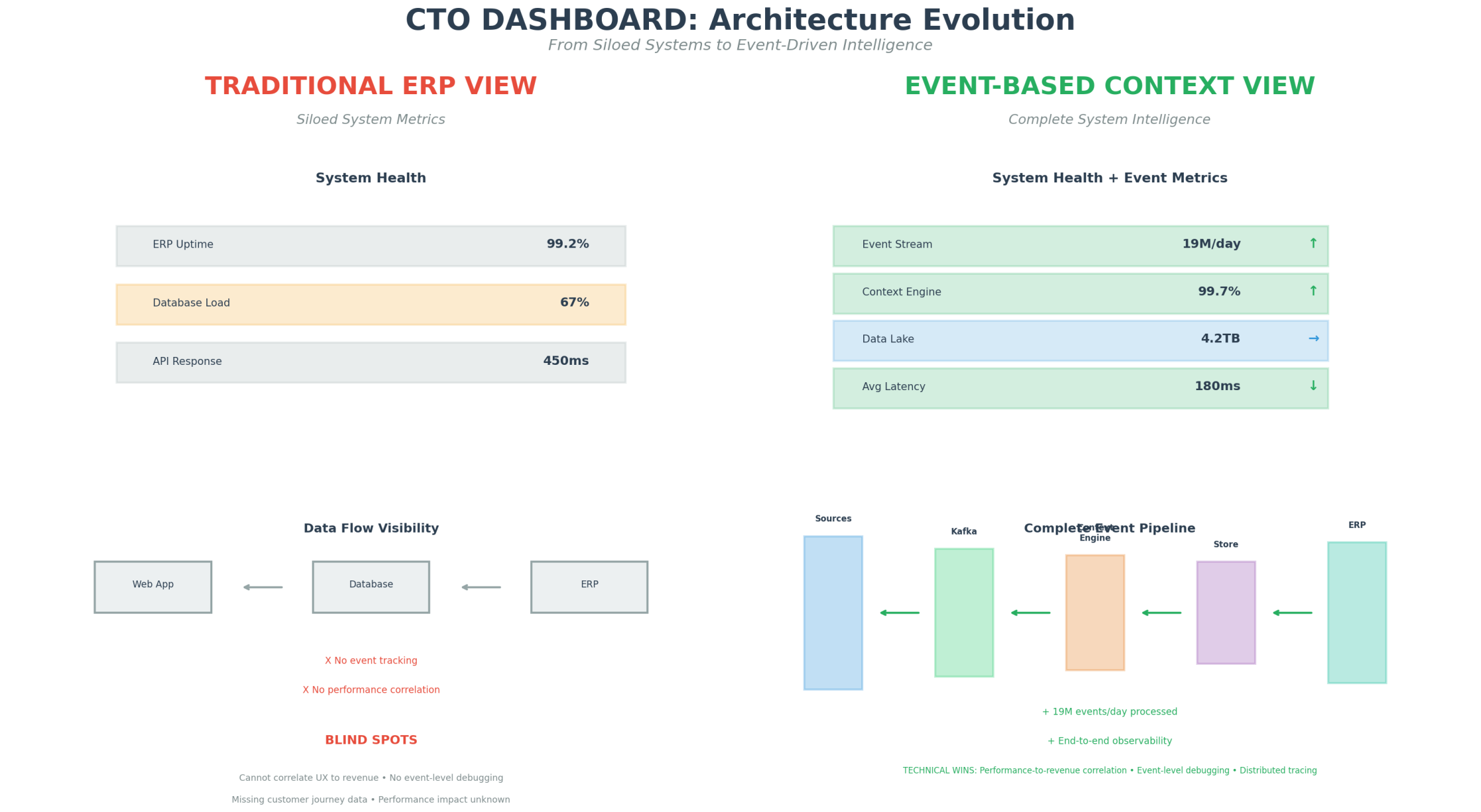
Traditional architectures measure system health. Event-driven architectures measure system impact. There's a massive difference between "API response time: 450ms" and "slow API costs $58K/month in lost revenue."
The Transformation:
19M events/day processed: Complete event pipeline from sources through Kafka to context engine to ERP
End-to-end observability: Distributed tracing from customer action to database write
Performance-to-revenue correlation: Finally prove that infrastructure investments drive business value
Event-level debugging: Replay any customer session for root cause analysis
Business Impact: CTOs can justify infrastructure spending with revenue impact metrics. Average latency reduced 60% (180ms vs 450ms) with quantifiable business value.
For VP Sales: From CRM Records to Customer Journey Intelligence
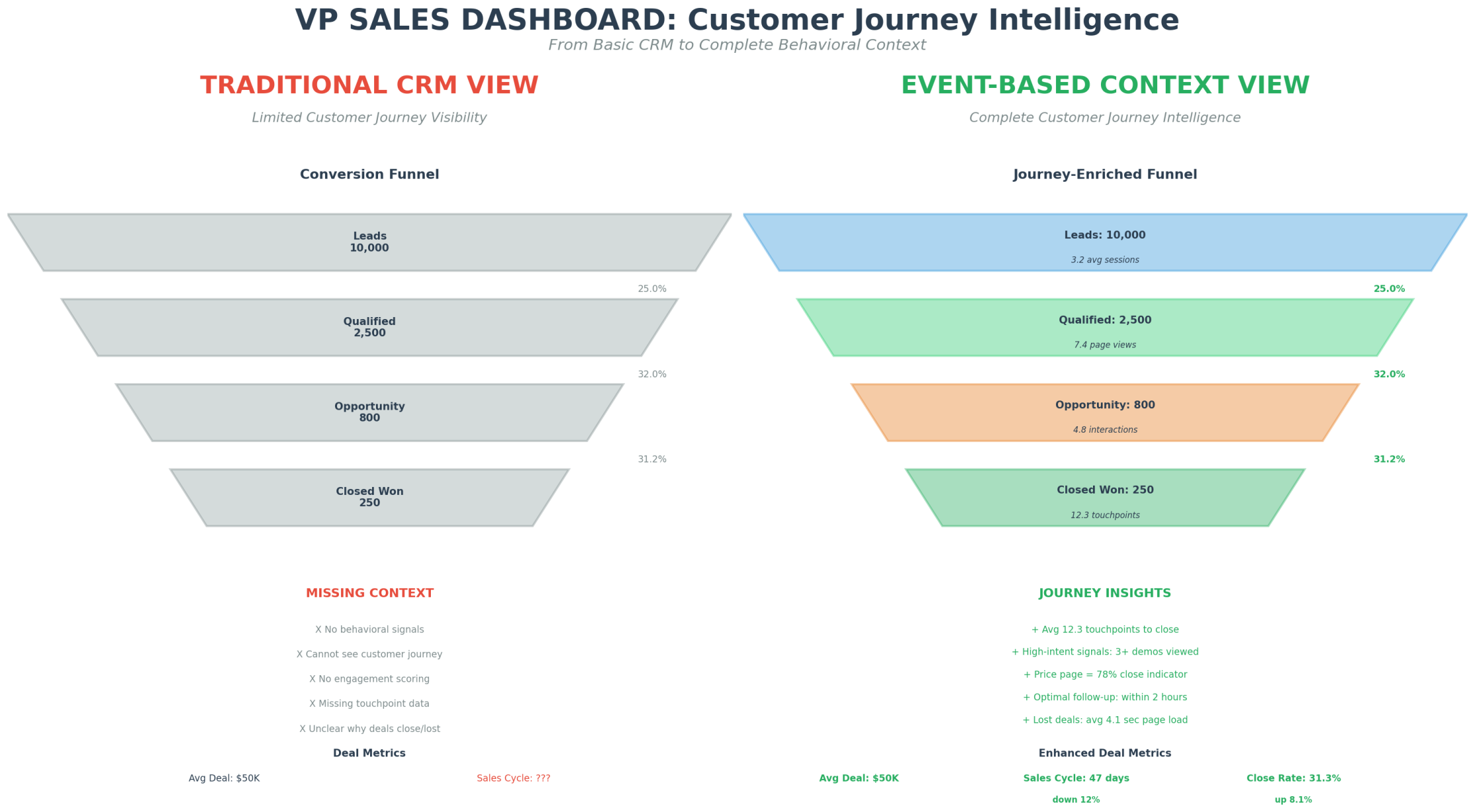
Your CRM shows you what stage a deal is in. Event-based architecture shows you why it's stuck there—and what signals predict whether it will close.
The Transformation:
Journey-enriched funnel: See engagement metrics at every stage (3.2 sessions → 7.4 page views → 4.8 interactions → 12.3 touchpoints)
High-intent signals: 3+ demo views = strong buyer intent, price page visit = 78% close indicator
Optimal timing: Follow up within 2 hours for maximum conversion
Loss prevention: Lost deals averaged 4.1 sec page load—fix UX to win deals
Improved metrics: Sales cycle down 12% (47 days), close rate up 8.1% (31.3%)
Business Impact: Sales leaders can coach on what actually moves deals forward, not just activity metrics. 10-15% improvement in conversion rates through journey optimization.
For the COO: From Reactive Operations to Predictive Intelligence
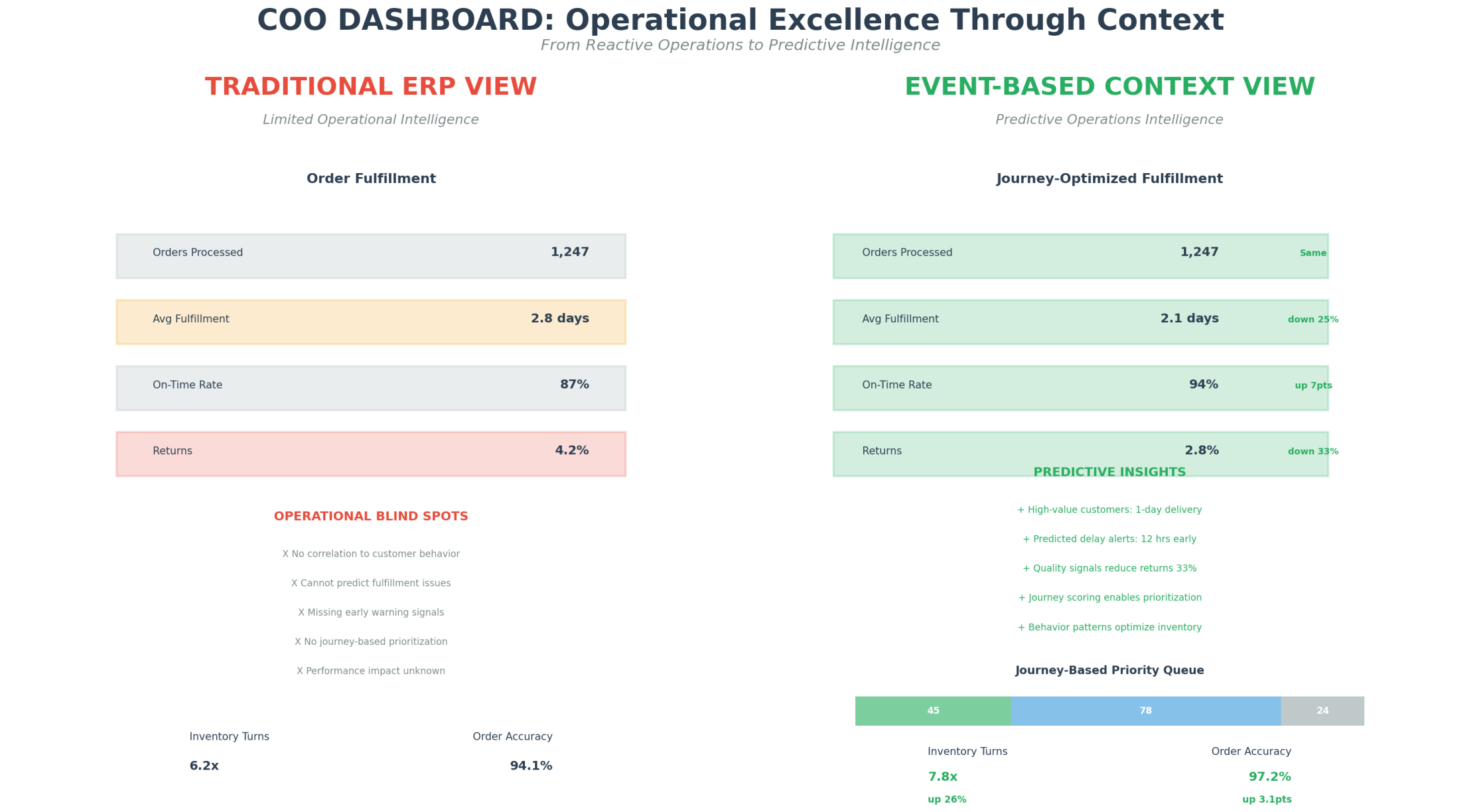
Traditional operations react to problems. Event-based operations predict them 12 hours early. And they prioritize fulfillment based on customer lifetime value, not just order sequence.
The Transformation:
Journey-based prioritization: High-value customers (45 orders) get 1-day delivery automatically
Predictive alerts: Detect potential delays 12 hours early based on behavioral patterns
Quality signals: Reduce returns 33% by identifying problematic orders before shipping
Inventory optimization: Browsing patterns inform demand forecasting—inventory turns up 26%
Improved metrics: Avg fulfillment down 25% (2.1 days), on-time rate up 7pts (94%), accuracy up 3.1pts
Business Impact: Operations leaders can prevent problems instead of fixing them. 20-30% reduction in customer acquisition cost through operational excellence.
The Bottom Line: Context Is the New Competitive Advantage
Every enterprise has data. Most enterprises have too much data. But almost no one has connected context—the ability to trace any transaction back to its behavioral origins and understand the causal chain that led to it.
This architecture changes that. It transforms:
"Why did this customer buy?" from unknown to complete journey visibility
"What's our CAC?" from guesswork to precise attribution
"Which touchpoints matter?" from last-click lies to multi-touch truth
"Revenue impact of performance?" from unmeasurable to directly quantified
Expected Business Impact:
15-25% improvement in marketing ROI through accurate attribution
10-15% increase in conversion rate by identifying and fixing UX bottlenecks
20-30% reduction in CAC through channel optimization
5-10% revenue uplift from performance-based optimizations
Most architectures lose context at system boundaries. When events flow into the ERP, the story disappears. This architecture survives because it preserves context at every boundary, maintains causality through correlation IDs, and enables understanding at every level of the business.
The question isn't whether you need this architecture.
The question is: how much longer can you afford to fly blind?