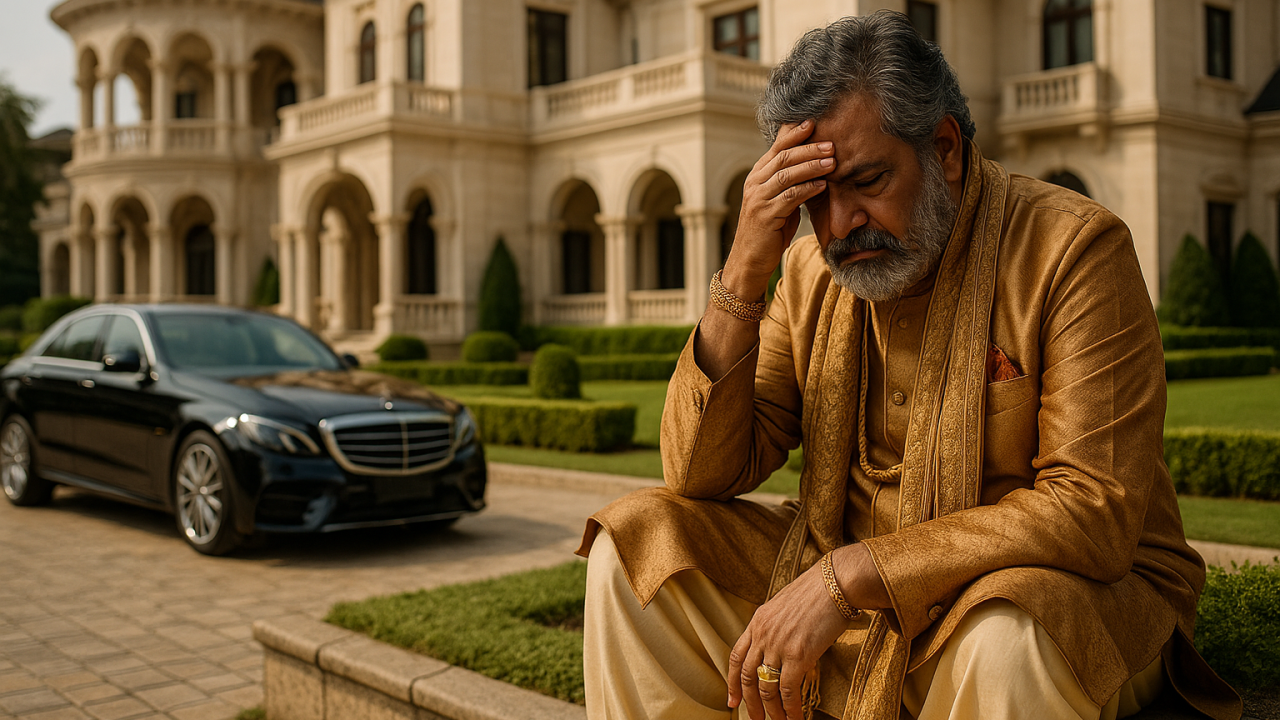
The village of Amarapuram gleamed like a crown beneath the sun. It had everything—fertile lands, gleaming cars, a school built from marble, and a mansion so vast it needed directions inside. In that mansion lived the chieftain—richer than kings, respected like a god.
But none of it mattered when the child coughed.
It began as a fever. “Just the heat,” they said. A small temple festival was being held in a nearby town. Everyone insisted he come—there would be ministers, celebrities, God’s blessings in golden chariots. But his son was unwell.
So the chieftain, for once, stayed behind. Alone with his boy.
That day, the mansion stood silent. Even the wind was still, as though it were holding its breath.
Then came the screams.
The boy’s body twisted violently—seizures struck like lightning. Eyes rolled back. Hands flailed. His lips turned blue. The chieftain ran, barefoot across marble floors, shouting for the doctor, for the driver, for anyone. But most had gone to the festival. The mansion—usually crawling with staff—was hollow. Like a golden cage with no bird.
The chief cradled the boy, running from gate to gate. But the hospital was 40 kilometers away. His phone had no signal. He couldn’t drive. And even if he could, it would take too long.
He was a man who could summon a helicopter if needed—but not now.
Not in that hour of need.
Not when his entire world was twitching in his arms.
And just like that— The child gasped. Once. Twice. And then… stillness.
The boy was gone.
Not because of poverty. Not because of lack of love. But because fate doesn’t check your bank balance before it writes your tragedy.
Days later, the house filled with mourners, rituals, and hollow condolences. But the chief sat like stone. No appetite. No rage. Just… silence.
An old schoolteacher finally came—not to console, but to remind.
He sat beside the chieftain and whispered:
“Do you remember Abhimanyu?”
The chief blinked, hollow-eyed.
“Son of Arjuna. Nephew of Krishna. Raised by Subhadra. Loved by Draupadi. Protected by Bhima.”
The teacher’s voice cracked.
“Surrounded by the greatest warriors the world had ever known—and yet, he died. In the Chakravyuha. Because destiny had whispered only half the story into his mother’s womb.”
And then, with trembling hands, the teacher listed them:
Drona — the war strategist, whose eyes had no mercy.
Karna — cursed but fearless, whose arrows were dipped in fate.
Duryodhana — the jealous prince, who made hate into a weapon.
Ashwatthama, Kripacharya, and even Shakuni—each circling Abhimanyu like hungry vultures.
They all fought one boy.
Sixteen years old.
Half-trained.
But brave.
Abhimanyu entered the Chakravyuha knowing he didn’t know how to come out.
Still, he fought.
He fought like a lion caught in a burning cage—alone, slashing, bleeding, roaring.
And where were his protectors?
Arjuna—lured away by illusion. Krishna—tied by dharma. Bhima—too far to reach. The world watched, and Abhimanyu fell.
Because even the gods must obey the script written by fate.
That day, the chieftain understood.
His money, his mansion, his power—were his Chakravyuha. And just like Arjuna, he too had watched his son die, helpless, outside the circle of control.
He wept—not just for his son, but for the illusion he had lived in.
And then—he acted.
He didn’t buy another car.
He built a 24x7 rural emergency center with trained staff and telemedicine. He brought doctors who wouldn’t leave for festivals. He gave his land for an air ambulance helipad. He didn’t want statues built for his son—he wanted lives saved in his name.
Because he had seen something that not all men live long enough to realize:
Even the greatest warriors lose their children. Even the richest men cannot bargain with time. And when destiny strikes, the only dignity lies in what you do after.
Read this, share this, remember this— For one day, your power, your position, your possessions… Might all sit in silence, As you scream for help that never comes.
Let this story build a bridge—from arrogance to awareness. From helpless grief to humble service.
Because the mansion couldn’t save the boy. But maybe, just maybe… His memory can save many more.