The Monkey's Tail and the Captain's Dilemma
There's an old fable about a monkey who desperately wanted a longer, more magnificent tail. He believed it would make him stronger, more respected among his peers, and help him swing faster through the trees. After months of wishing, his tail grew to enormous proportions—thick, heavy, and impressively long.
At first, he was delighted. Other monkeys admired his spectacular tail. He felt powerful and important. But then came the rude awakening: his magnificent tail kept getting caught in branches, slowing him down when predators approached. What once helped him swing gracefully now made him clumsy and vulnerable. The very thing he thought would be his greatest strength became his greatest weakness.
Corporate America is living this fable in real-time.
Here's another way to think about it:
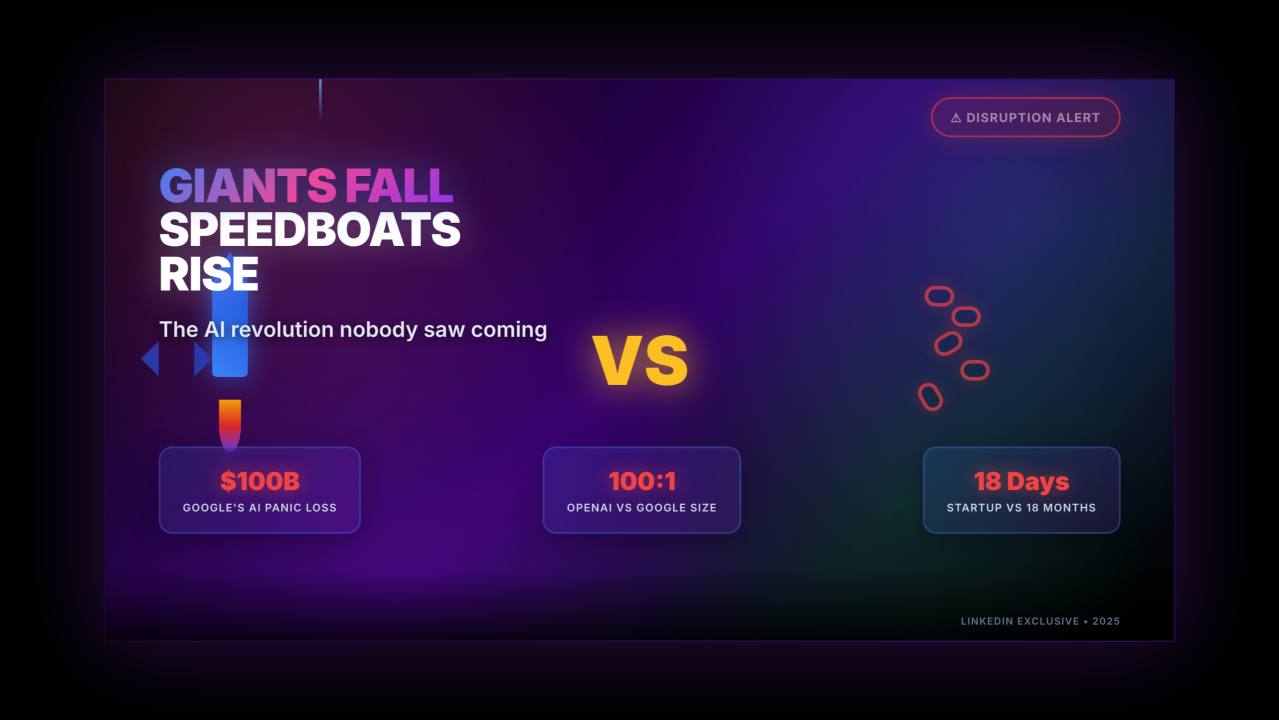
A speedboat can pivot instantly when it spots an iceberg. The captain sees the danger, turns the wheel, and within seconds they're heading in a completely new direction. But an aircraft carrier? The captain might spot the same iceberg from twice the distance, yet still struggle to avoid it. Despite having more powerful engines, better radar, and hundreds of skilled crew members, the sheer mass and momentum make quick course corrections nearly impossible.
In the AI revolution, every Fortune 500 company has become an aircraft carrier trying to navigate like a speedboat.
As AI threatens millions of jobs across industries, there's a cruel irony unfolding: the very companies we expect to lead through this transition— Google , Microsoft , Apple , Oracle, Salesforce, and several others —are paralyzed by the same bureaucratic inertia that killed their innovation in the first place.
While workers everywhere panic about AI displacement, these tech titans are fumbling the AI revolution despite having superior resources and talent. This isn't just a corporate strategy problem—it's creating the biggest entrepreneurial opportunity in decades for those brave enough to seize it.
The cruel irony is that as these companies have achieved unprecedented financial success, they've simultaneously lost much of the innovative spirit that made them great. This isn't coincidence—it's the predictable result of organizational dynamics that favor stability over breakthrough thinking.
The AI Wake-Up Call: When Bureaucracy Meets Disruption
Consider this timeline: Google's researchers invented the transformer architecture in 2017—the foundation of ChatGPT or Perplexity. They had the best AI talent, unlimited computing resources, and six years to commercialize this breakthrough. Instead, ChatGPT launched from OpenAI, a startup with a fraction of Google's resources, and changed everything in just two months.
Why? Because while OpenAI's 100-person team could move at startup speed, Google's AI teams were trapped in the same bureaucratic quicksand that has paralyzed innovation across Big Tech. Every AI product had to navigate through committees worried about cannibalizing search revenue, legal teams concerned about liability, and policy groups managing regulatory risk.
The result: Google panicked. They declared a "code red" and rushed out Bard—a product so flawed it cost the company $100 billion in market cap during its first demo. Microsoft, despite owning a stake in OpenAI, took months to integrate ChatGPT into Bing because of internal processes and coordination challenges.
Here's what this means for you: The same organizational rot that killed innovation is now making these giants vulnerable to disruption from smaller, more agile competitors. And that creates unprecedented opportunities for individuals willing to think like entrepreneurs.
Consider this: When Facebook was building its news feed in 2006, Mark Zuckerberg made the decision in a conference room with a handful of engineers, despite knowing it would initially anger users. The feature launched within months and became Facebook's defining innovation.
Fast forward to 2021: Meta spent over two years and involved hundreds of employees across multiple teams to launch... Threads. A Twitter clone that required navigating content moderation policies, EU regulatory compliance, advertiser concerns, and integration with Instagram's existing infrastructure. The result? A product that launched without basic features like a chronological feed or web version.
Every innovative idea now must navigate through layers of risk assessment, legal review, and stakeholder alignment. The very processes designed to manage complexity end up strangling the creative chaos that breeds innovation.
The Middle Management Multiplication
Perhaps nowhere is this more evident than in the explosion of middle management layers. At Google, a simple feature request now travels through:
By the time it reaches decision-makers, the original vision has been "optimized" through six different lenses.
Here's a stark example: In 2004, Google's Larry Page personally reviewed the design mockups for AdWords. Today, a similar product decision involves Product Marketing, User Experience Research, Legal, Policy, International, and Accessibility teams—each with their own managers and approval processes. The median time from concept to launch has grown from months to years.
Steve Jobs understood this intuitively. His famous "no more than one layer" philosophy meant breakthrough ideas could travel from conception to his desk without being filtered through bureaucratic telephone. When an engineer had a revolutionary idea for multi-touch interfaces, they could schedule time directly with Jobs, not navigate through a hierarchy of middle managers who might lack the technical depth or vision to understand its potential.
The Oracle Acquisition Syndrome
Oracle's trajectory offers a particularly telling case study. In the 1980s, Oracle's small team of database engineers would ship new versions with breakthrough features like read consistency and parallel processing within 12-18 months. Larry Ellison himself would review architectural decisions and push for radical performance improvements.
Today, Oracle Database releases take 3-5 years and primarily focus on incremental improvements and compliance features. Why? Each new feature must be tested across dozens of acquired platforms—PeopleSoft's HR modules, Siebel's CRM components, JD Edwards' manufacturing systems. The engineering team spends more time ensuring backward compatibility with legacy systems than pioneering new database technologies.
Here's the kicker: Oracle's 2010 acquisition of Sun Microsystems brought not just Java and MySQL, but also Sun's infamous bureaucratic processes. Former Sun employees described approval workflows that required sign-offs from up to 12 different departments for a simple product feature. These processes didn't disappear with the acquisition—they metastasized throughout Oracle's organization.
The Skype Tragedy: How to Kill a Revolutionary Product
Perhaps no example illustrates this phenomenon more dramatically than Skype's fall from grace. In 2003, Skype's tiny Estonian team revolutionized communication by making international calling free. By 2005, they had 100 million users with a lean team of fewer than 200 employees.
Then came the corporate acquisitions. First eBay bought Skype for $2.6 billion in 2005, immediately imposing eBay's auction-focused culture on a real-time communication platform. Product decisions now required approval from eBay's marketplace teams who didn't understand VoIP technology. Development slowed as Skype engineers spent months in meetings explaining why video calling couldn't work like auction bidding.
Microsoft's 2011 acquisition for $8.5 billion made things worse. Skype had to integrate with Microsoft's existing communication products—Lync, Messenger, Outlook. Instead of innovating, engineering resources were diverted to ensure Skype worked seamlessly with SharePoint and Exchange. The original peer-to-peer architecture that made Skype revolutionary was gradually replaced with Microsoft's server-based infrastructure to fit corporate IT requirements.
The result? When COVID-19 hit and the world desperately needed video calling, Skype—the company that invented consumer video calling—was largely irrelevant. Zoom, built by a 40-person team using modern architecture, captured the market that Skype had owned for over a decade. While Microsoft had thousands of engineers working on Skype integration, Zoom's small team focused obsessively on one thing: making video calls that actually work.
The cruel irony: Microsoft Teams, launched in 2017 with Skype's technology, succeeded precisely because it operated as a separate product with its own team, temporarily escaping the bureaucratic processes that had strangled Skype innovation.
While this strategy drove revenue growth, it created what I call "innovation antibodies"—the inherited bureaucratic processes, conflicting cultures, and technical debt from acquired companies. Each acquisition brought not just technology and talent, but also the organizational inefficiencies that may have hindered the acquired company's own innovation.
The result? Oracle, once known for breakthrough database innovations, is now primarily seen as an enterprise software integrator struggling to compete in cloud computing against more agile competitors like Salesforce and cloud-native providers.
The Revenue Growth Paradox
Risk Aversion at Scale
Here's a mind-bending example: In 2007, Apple's iPhone team was so small that Steve Jobs knew most engineers by name. When they discovered a critical flaw in the plastic screen just months before launch, Jobs made a $100 million bet on switching to glass—a decision that took one meeting and involved fewer than 10 people.
In 2023, Apple reportedly spent three years and involved over 1,000 engineers developing... a slightly thicker iPhone with better cameras. The decision process included market research studies, focus groups, supply chain risk assessments, and extensive financial modeling. The revolutionary risk-taking that defined early Apple has been replaced by sophisticated risk management.
Microsoft offers an even starker contrast. Under Steve Ballmer, the company had 25,000 people working on Windows Vista for five years, producing an operating system so problematic it nearly killed the Windows franchise. Why? Because large teams optimized for avoiding failure rather than achieving breakthrough success.
Under Satya Nadella, Microsoft deliberately created small, autonomous teams for products like Teams and Azure. Teams was built by a 30-person team in just 18 months and captured significant market share from Slack. Azure's initial success came from giving the cloud team permission to operate independently of Windows dependencies—essentially recreating startup conditions within a massive corporation.
The Innovation Theater Problem
Many large tech companies have responded to this innovation deficit by creating what appears to be innovation—corporate innovation labs, hackathons, "intrapreneurship" programs, and venture capital arms. While these initiatives generate positive PR and employee engagement, they often serve as innovation theater rather than sources of breakthrough products.
Here's a revealing comparison: Google's X division employs hundreds of PhD researchers and has consumed billions in funding over 15 years. Its most celebrated "success," Google Glass, was discontinued after failing to find product-market fit. Meanwhile, TikTok was built by a small team at ByteDance in 18 months and now has over a billion users.
The difference? Google X operates within Google's risk-averse, committee-driven culture. Every moonshot must justify its existence through quarterly reviews, align with Google's existing business model, and navigate privacy and regulatory concerns. TikTok's team had one mandate: create something that teenagers couldn't stop using.
Even more telling: Google's actual innovations in recent years—like BERT and transformer architectures that power ChatGPT—came from Google Research, not Google X. These emerged from individual researchers pursuing intellectual curiosity, not from managed innovation programs.
The Talent Hoarding Effect
Hiring for Scale, Not Innovation
Steve Jobs' obsession with hiring "A+ players" wasn't just about individual quality—it was about maintaining a culture where exceptional people attracted more exceptional people. As companies scale, hiring processes become systematized, often optimizing for consistency and cultural fit rather than breakthrough thinking.
Here's a telling contrast: When WhatsApp was building their messaging platform with just 55 employees, every engineer was handpicked by the founders and could ship features directly to hundreds of millions of users. The entire company could fit in a single conference room for architecture decisions.
At Facebook (pre-acquisition), a similar messaging feature would require approval from: Product Management, Engineering Leadership, Design, Legal (for privacy), International (for localization), Accessibility, Security, Data Science, and Business Integrity teams. By the time WhatsApp was acquired for $19 billion, Facebook had 6,000+ employees but couldn't build a messaging app as elegant or fast as WhatsApp's tiny team.
Large companies can afford to hire thousands of smart engineers, but they often end up with what Jobs called "B players"—competent professionals who execute well within existing frameworks but don't challenge fundamental assumptions. The A+ players who drive true innovation either gravitate toward startups or get buried within large organizational structures where their impact is diminished.
The Golden Handcuffs Dilemma
Ironically, these companies' financial success creates its own innovation problem. When engineers receive generous stock packages and benefits, they become economically incentivized to avoid the career risks associated with truly innovative thinking.
Consider this perverse incentive: A Google engineer earning $400,000 annually with unvested stock options worth $800,000 is essentially trapped in a golden cage. Why propose a radical AI architecture that might cannibalize Search revenue—Google's primary profit driver—when steady performance on incremental Search improvements guarantees financial security?
This explains why ChatGPT emerged from OpenAI, not Google, despite Google having superior AI research for over a decade. Google's researchers published the transformer architecture that powers ChatGPT, but they couldn't productize it because it threatened their advertising business model. OpenAI's team, working for startup salaries with uncertain equity, had nothing to lose and everything to gain from disrupting the status quo.
The most innovative Google products in recent years—like Google Research's breakthrough AI models—consistently come from teams isolated from the main business, not from engineers optimizing existing revenue streams.
Breaking the Pattern: Your Action Plan for the AI Era
The Entrepreneurial Window Is Wide Open
While Big Tech struggles with AI integration, individual entrepreneurs and small teams are building AI-powered solutions at unprecedented speed. Consider these David vs. Goliath stories:
Midjourney: 11 employees built an AI art platform that competes directly with Google's and Meta's billion-dollar AI research divisions
Anthropic: Former OpenAI researchers created Claude, a serious ChatGPT competitor, with less than 500 employees
Runway: A 100-person team created AI video generation tools that Hollywood studios now use, while massive media companies struggled to implement basic AI workflows
For Professionals Facing AI Displacement:
Become the Bridge, Not the Wall: Instead of fighting AI, become the expert who helps traditional industries implement it. Consultants who understand both AI capabilities and industry-specific needs are commanding premium rates.
Exploit the Enterprise Gap: Big companies can't deploy AI fast enough due to bureaucracy. Small consulting firms and service providers are capturing massive contracts by offering rapid AI implementation.
Focus on Human-AI Collaboration: The most successful professionals aren't being replaced by AI—they're becoming 10x more productive by mastering AI tools that large companies are too slow to adopt.
For Aspiring Entrepreneurs:
Target Specific Industry Pain Points: While Big Tech builds general-purpose AI, focus on solving specific problems in industries you understand—legal document review, medical diagnosis assistance, financial analysis.
Speed Is Your Superpower: What takes Google 18 months to ship through committees, you can prototype and test in 18 days. Use this velocity advantage.
Leverage Open Source AI: You don't need Google's resources. Open-source models and cloud APIs give you access to cutting-edge AI capabilities at startup costs.
The Motivation Crisis Solution:
The stalemate many professionals feel isn't permanent—it's an opportunity in disguise. The same forces that make large companies slow make small, agile operators incredibly valuable. Every bureaucratic layer at Big Tech creates market opportunities for faster, more focused alternatives.
The Path Forward: Your Competitive Advantage
The Great Reshuffling Has Begun
We're witnessing the biggest redistribution of economic opportunity since the internet's early days. The companies that dominated the last era—hamstrung by bureaucracy and risk aversion—are struggling to adapt to AI disruption. This creates massive opportunities for individuals and small teams willing to move fast.
The professionals thriving right now aren't waiting for their companies to figure out AI strategy. They're learning AI tools independently, identifying specific problems these tools can solve, and either launching their own solutions or positioning themselves as indispensable AI implementers within their organizations.
The Uncomfortable Truth
Yes, AI will eliminate many jobs. But history shows that periods of technological disruption create more opportunities than they destroy—just not always for the same people or companies. The question isn't whether change is coming (it's already here), but whether you'll be among those who adapt quickly enough to benefit from it.
The same bureaucratic inertia that prevented Big Tech from capitalizing on their AI research advantages is preventing most traditional companies from implementing AI effectively. This gap represents the biggest entrepreneurial opportunity of our lifetime.
Your Next Move
While others are paralyzed by uncertainty, start experimenting with AI tools today. Find one specific problem you can solve better, faster, or cheaper using AI assistance. Build a prototype. Test it with real users. Iterate rapidly.
The companies and individuals who master this cycle—while giants debate in conference rooms—will define the next era of business success.
The giants are stumbling. The opportunity is massive. The question is: Will you seize it?
The Ultimate Takeaway: Your Moment Is Now
Here's the uncomfortable truth that most won't tell you: The same forces that made Big Tech dominant are now making them irrelevant. Their "magnificent tails"—the resources, processes, and scale that built empires—have become anchors in an AI-first world that rewards speed over size.
While these corporate aircraft carriers debate in conference rooms, individual speedboats are capturing entire markets. The window of opportunity won't stay open forever. In 18 months, the current chaos will stabilize into new market leaders—and history shows those leaders won't be the ones who hesitated.
Your competitive advantage isn't your resume or your company's brand. It's your ability to move fast, think clearly, and act while others are paralyzed by analysis. The monkey wished for a magnificent tail and got trapped by his own success. Don't be the monkey. Be the speedboat.
What AI opportunities are you exploring? How is your organization adapting to AI disruption? Share your experiences and let's learn from each other as we navigate this transformation.