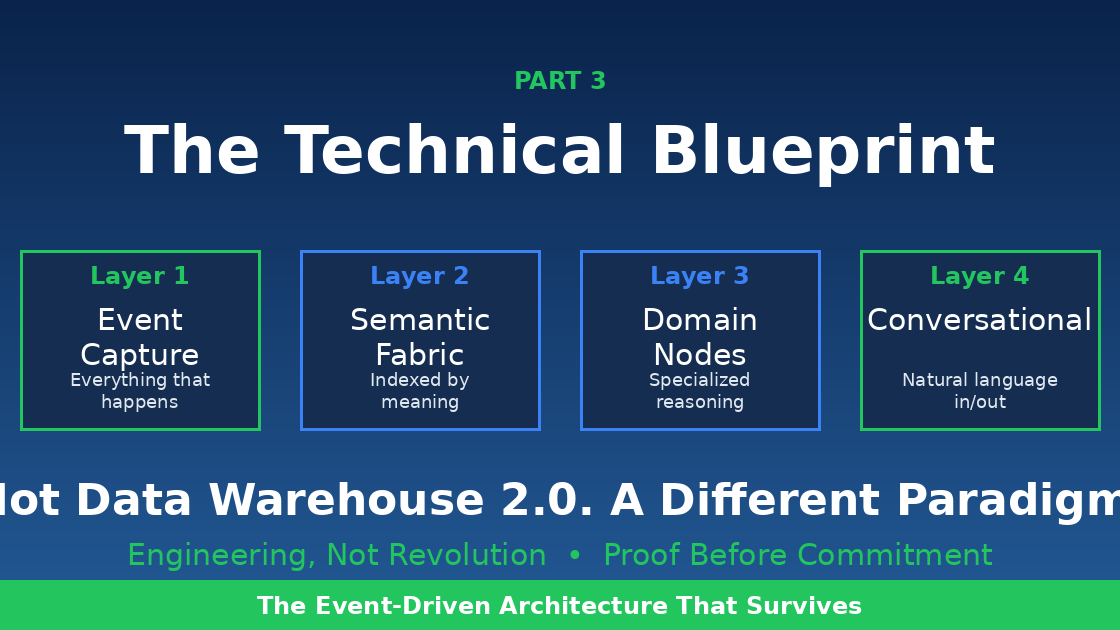
From Collapse to Construction: Building Event-Driven Systems That Actually Work
Where We've Been
Part 1 exposed the delay problem: Your traditional ERP→ETL→Warehouse→BI stack takes 3 days to answer simple questions. By the time you get the answer, the opportunity is gone.
Part 2 revealed the source: ERP's two ancestral curses (Customization Chaos + Thousand-Table Labyrinth) force data teams to excavate instead of analyze.
Now comes the hard question: What do we build instead?
The Honest Starting Point
Let's be clear about what we're NOT doing:
❌ We're not "eliminating data warehouses" (too evangelical)
❌ We're not claiming "AI solves everything" (too magical)
❌ We're not proposing a rip-and-replace (too risky)
What we ARE doing:
✅ Building a parallel system that handles 80% of business questions faster
✅ Using proven technologies (Kafka, PostgreSQL, LLMs) in a new way
✅ Starting with one use case, proving value, then expanding
✅ Keeping your existing infrastructure running while we transition
This is engineering, not revolution.
The Core Insight: Events, Not States
The fundamental problem with ERP→Warehouse architecture: It stores STATES (final values) instead of EVENTS (what actually happened).
When your ERP records a sale, it stores:
Order ID: 12345
Customer ID: CUST_789
Amount: $500
Date: 2025-01-15
What it DOESN'T store:
Customer browsed 7 products before buying
Added item to cart, removed it, added it back
Hesitated at checkout for 3 minutes
Applied a discount code
Checkout page loaded slowly (4 seconds)
All that context is LOST.
And that context is exactly what you need to answer "why did this happen?"
The New Architecture: Event-Driven Intelligence
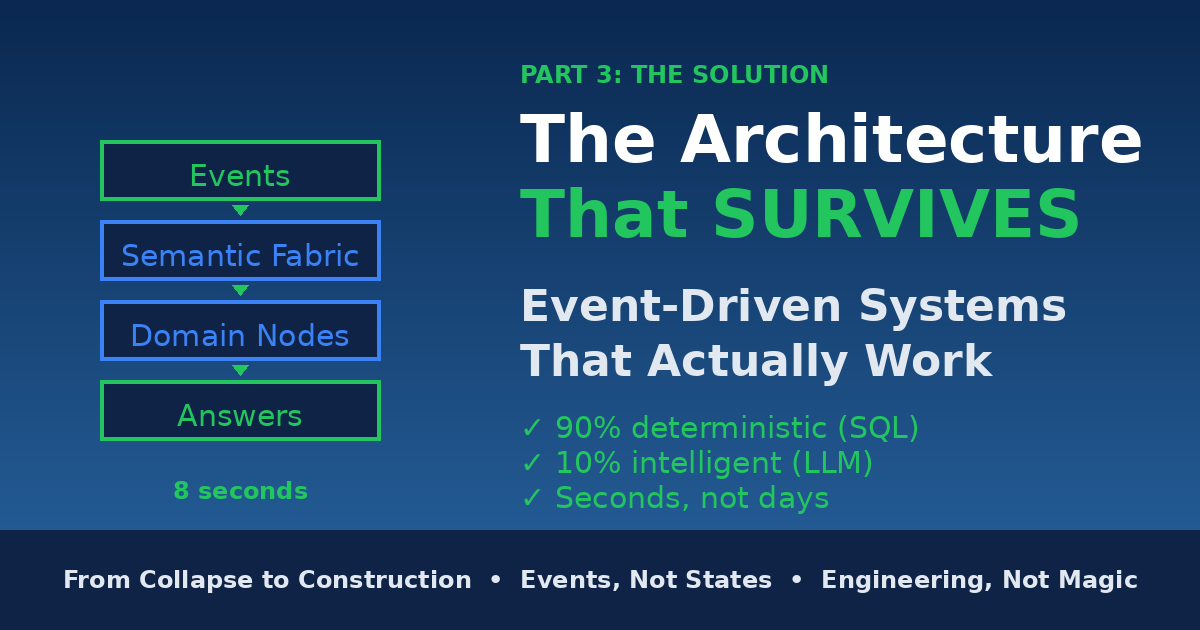
Here's what we're building:
Let's break down each layer with actual technical details, not buzzwords.
Layer 1: Event Capture (The Foundation)
What Is An Event?
An event is an immutable record of something that happened, with full context.
Example Event Schema:
Key Properties of Events
Immutable Once written, never changed. To correct an error, you write a new event (like accounting).
Self-Contained Every event has all the context it needs. No need to join 12 tables to understand it.
Causally Linked Every event knows what caused it and what it might trigger.
Semantically Indexed Each event has a vector embedding that captures its meaning, enabling semantic search.
Layer 2: Semantic Event Fabric (The Smart Storage)
This is where we store and index events in a way that makes them queryable by meaning, not just by field names.
Technical Components
Component 1: Event Store (PostgreSQL with TimescaleDB)
Why PostgreSQL?
Battle-tested reliability
Native JSON support for flexible event payloads
TimescaleDB extension for time-series optimization
pgvector extension for semantic search
ACID guarantees (unlike some NoSQL solutions)
Schema:
Component 2: Event Bus (Apache Kafka or Redpanda)
Why Kafka/Redpanda?
Handles millions of events per second
Guaranteed ordering within partitions
Replay capability (reprocess events if needed)
Multiple consumers can read same stream
Topic Structure:
Component 3: Stream Processors (Kafka Streams or Flink)
Real-time enrichment and aggregation:
Layer 3: Domain Reasoning Nodes (The Intelligence)
These are specialized query engines for specific business domains. Not generic AI—focused, deterministic processors with LLM-enhanced reasoning.
Anatomy of a Domain Reasoning Node
Example: Customer Behavior Node
Why This Architecture Works
90% of queries are deterministic (fast SQL):
"Show me conversion funnel for last week"
"What's the cart abandonment rate by device?"
"How many orders today?"
10% of queries need synthesis (SQL + LLM):
"Why did mobile conversion drop yesterday?"
"Which customer segments are at risk?"
"What happened before high-value users churned?"
The LLM is only used for:
Understanding intent (parsing natural language)
Finding semantic patterns (when causality needed)
Synthesizing explanations (turning data into narrative)
The LLM never does math. All calculations are SQL.
Layer 4: Conversational Query Interface
Users don't write SQL. They ask questions.
How It Works
Input: Natural language query Output: Answer with evidence and confidence
Example Interaction:
Technical Implementation
Real-World Example: E-commerce Flow
Let's trace a complete customer journey through the system.
Events Generated
Query Examples
Query 1: Simple Aggregation (Deterministic)
Query 2: Funnel Analysis (Deterministic)
Query 3: Diagnostic (Hybrid - SQL + Vector Search + LLM)
Infrastructure Requirements (Real Numbers)
For a mid-sized e-commerce company (1M visitors/month, 50K orders/month):
Event Volume
~50M events/month
~60 events/second average
~300 events/second peak
Infrastructure
Event Store (PostgreSQL + TimescaleDB):
3-node cluster (primary + 2 replicas)
16 vCPU, 64GB RAM per node
2TB SSD storage (with compression)
Cost: ~$2,000/month (AWS RDS equivalent)
Event Bus (Kafka or Redpanda):
3-node cluster
8 vCPU, 32GB RAM per node
1TB SSD per node
Cost: ~$1,500/month
Domain Reasoning Nodes:
4 nodes (customer, revenue, inventory, product)
8 vCPU, 32GB RAM per node
Cost: ~$1,200/month
LLM API (Claude Sonnet):
~10K queries/month
~80% deterministic (no LLM needed)
~2K queries need LLM synthesis
Cost: ~$500/month
Vector Embeddings (OpenAI):
Batch process 50M events/month
Cost: ~$400/month
Total Infrastructure: ~$5,600/month
Compare to Traditional Stack
Traditional (Snowflake + dbt + Fivetran + Looker):
Snowflake: $3,000/month
Fivetran: $1,500/month
dbt Cloud: $500/month
Looker: $1,000/month
Data team time: 60% on maintenance
Total: $6,000/month + massive time waste
Event-driven stack: $5,600/month + 10% time on maintenance
Migration Strategy: 90-Day Proof of Concept
Week 1-2: Event Capture POC
Goal: Prove we can capture events from existing systems
Tasks:
Set up Kafka cluster
Write event producers for 1 source system (e.g., e-commerce platform)
Capture 1 event type (e.g., order_completed)
Store in PostgreSQL
Success metric: 100K events captured and stored
Week 3-4: Build First Domain Node
Goal: Answer 1 business question faster than current system
Tasks:
Build Revenue Node
Implement deterministic queries (simple aggregations)
Compare results with existing warehouse
Success metric: "Daily revenue by product" query: 0.5s (vs 3 minutes in warehouse)
Week 5-6: Add Vector Search + Semantic Layer
Goal: Enable semantic queries
Tasks:
Generate embeddings for all events
Implement vector similarity search
Test semantic queries
Success metric: "Find orders similar to this one" works accurately
Week 7-8: Conversational Interface
Goal: Natural language queries work
Tasks:
Integrate Claude API
Build intent parser
Implement answer synthesis
Test with 20 real business questions
Success metric: 90%+ accuracy on test questions
Week 9-10: Hybrid Query Execution
Goal: Handle complex "why" questions
Tasks:
Implement causal chain analysis
Build cross-domain query capability
Test diagnostic queries
Success metric: "Why did conversion drop?" answered in <10 seconds with causality
Week 11-12: Pilot with Real Users
Goal: Prove business value
Tasks:
Give access to 5 business users
Track: queries asked, time saved, satisfaction
Compare accuracy vs traditional dashboards
Success metrics:
50+ queries asked
80%+ user satisfaction
100x faster than traditional method
Demonstrate ROI
What Makes This Different
Not Data Warehouse 2.0
This isn't "a faster warehouse." It's a different paradigm:
Old: Store aggregated states, visualize, human interprets
New: Store events, synthesize answers, explain causality
Not "AI Does Everything"
90% is deterministic SQL (fast, accurate, cheap) 10% uses LLM (for understanding intent and synthesis)
The intelligence is in the architecture, not just the AI.
Not Rip-and-Replace
Your existing warehouse keeps running. New system handles new use cases. Migrate gradually as you prove value.
Not Vendor Lock-In
Built on open technologies:
PostgreSQL (open source)
Kafka (open source)
DuckDB (open source)
Claude API (anthropic.com, but swappable)
You own the infrastructure.
The Path Forward
Months 1-3: POC (prove it works)
Months 4-6: Pilot (10-20 users, 20% of queries)
Months 7-12: Scale (50% of queries)
Year 2: Primary system (80% of queries)
Year 3: Warehouse becomes archive only
You don't rip out the old system. You build the new one alongside it. You prove value before betting the company.